Key takeaways

Understanding the ‘guaranteed analysis’ on your chicken feed bag is crucial for ensuring your flock receives the right nutrition for health and egg production.
- A feed label’s guaranteed analysis lists crude protein, fat, fiber, and any calcium claim — the protein minimum is the headline number to read first.
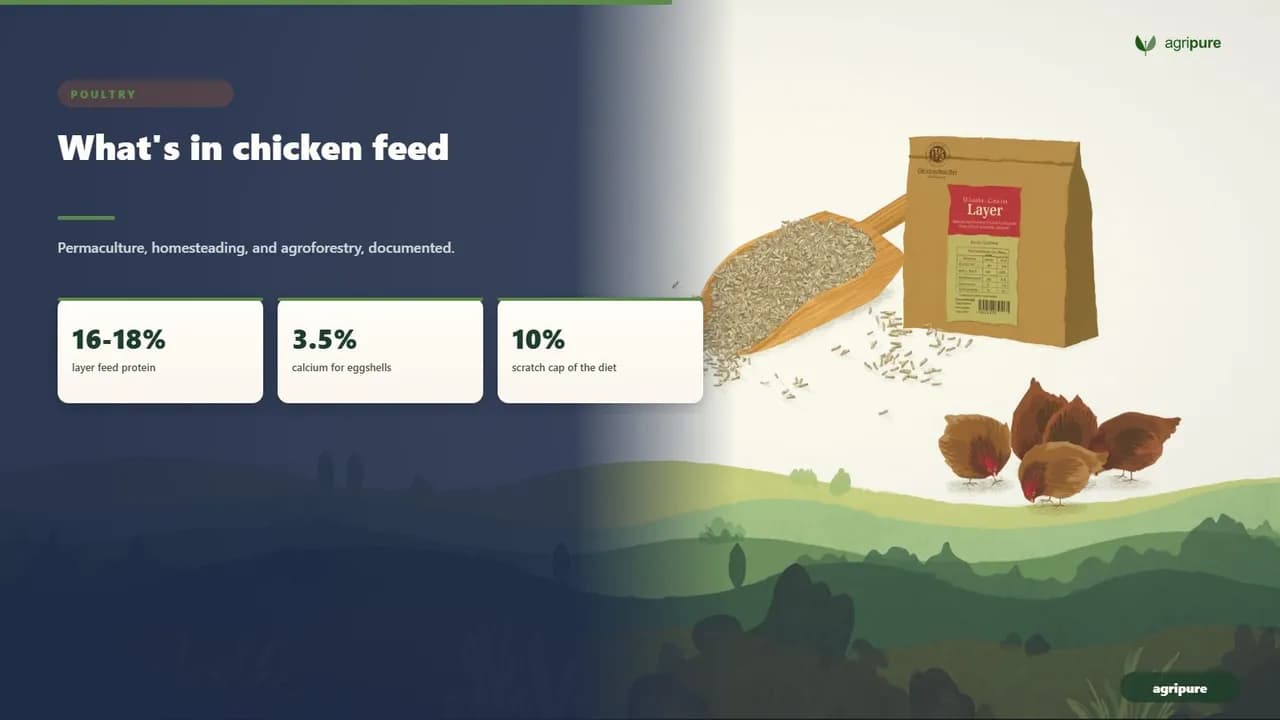
- Layer feed runs 16 to 18% protein with 2.5 to 3.5% calcium; chick starter is higher protein (20%) and much lower calcium.
- Calcium is the reason you never feed layer ration before 18 weeks: the excess permanently damages a young bird’s kidneys.
- Grains supply energy, soybean meal supplies protein, and ground oyster shell or limestone supplies the calcium for eggshells.
- Scratch is a 9 to 10% protein treat, not a feed — cap it at 10% of the diet or it dilutes the ration.
- Soy-free, whole-grain scratch-and-peck-style mixes hit about 18% protein; buying a 50 lb bag over a 25 lb one cuts cost per pound roughly 25 to 40%.
Most people buy chicken feed by the picture on the bag and never read the panel that actually matters. That panel — the guaranteed analysis — tells you in 4 or 5 numbers whether the feed will keep a hen laying or quietly let her run down. This guide reads a feed label the way a nutritionist would, explains what each ingredient is doing in the bag, walks the protein and calcium differences between starter, grower, and layer rations, and does the cost-per-pound math on buying in bulk. If you are new to the birds themselves, start with our guide to raising chickens for eggs; this piece goes deep on the feed alone.
How to read a feed label
That guaranteed analysis is the first thing to read, and it is short by law. Grubbly Farms describes the panel plainly: it “must list crude protein, crude fat, crude fiber, and moisture levels along with any claimed nutrients like calcium.” Four numbers, sometimes five, and each one tells you something specific about whether the feed fits the bird in front of you.
The headline is crude protein, expressed as a minimum percentage. Grubbly defines it as “the measure of how much protein is in a feed based on laboratory tests,” which “can include protein from meat or non-meat sources.” That last point matters: a 16% protein number says nothing about where the protein comes from, which is why the ingredient list below the analysis is the second thing to read.
The numbers that matter
Three figures carry most of the signal. Crude protein sets the growth and laying capacity. Calcium, when listed, tells you whether it is a layer feed (high) or a starter (low). Crude fiber is given as a maximum, and a high fiber number — say above 6 to 7% — often signals cheaper filler grains diluting the energy. Read protein and calcium together and you can identify almost any bagged feed without the marketing on the front.
Label line | What it means | Rough target (layer) |
|---|---|---|
Crude protein (min) | Total protein, any source | 16-18% |
Calcium (min/max) | Eggshell mineral | 2.5-3.5% |
Crude fiber (max) | Indigestible bulk / filler | Under 6-7% |
Crude fat (min) | Energy density | 3-5% |
What each ingredient does
Those label numbers come from a short list of ingredients, each doing one job. A complete feed is essentially 3 roles stacked together: an energy base, a protein concentrate, and a mineral source. Read the ingredient panel and you can usually spot all 3 in the first 5 lines.

An energy base of grain — corn, wheat, barley, or oats — makes up the bulk of the 50 lb bag. Most of the protein comes from soybean meal, which supplies the amino acids like methionine and lysine that grains lack. For a layer, the calcium source is ground limestone or oyster shell; the eXtension poultry guide notes that “laying hens require large amounts of calcium for eggshells” and that hens may need “ground oyster shell on a free-choice basis” on the side. Pasture and forage fill gaps a bag cannot — birds on pastured birds on forage pick up protein from insects and minerals from greens.
- Grains (corn, wheat, oats) — the energy base, most of the bag by weight.
- Soybean meal — the protein concentrate, supplying amino acids grain lacks.
- Limestone / oyster shell — the calcium for shells, 2.5 to 3.5% in layer mash.
- Added vitamins and minerals — the trace package a whole-grain mix needs.
Starter, grower, and layer feeds
Those same ingredients get re-balanced for the bird’s age, and getting the stage wrong has real consequences. The two variables that change are protein and calcium, and they move in opposite directions as a bird grows. The Chicken Chick gives the anchors: “day-old chicks through 18 weeks old require starter feed … containing 20% protein,” while “layer feed generally contains 16-18% protein and has added calcium.”
The calcium timing is the part people get wrong, and it is not forgiving. Layer feed “should not be fed to chickens younger than 18 weeks unless they have begun egg-laying,” because the calcium “can permanently damage the kidneys, reduce lifetime egg production and shorten a bird’s lifespan.” A pullet needs the protein of a grower ration but not the 3.5% calcium load until her body is actually building shells, around 18 to 20 weeks or her first egg.
When to switch
The switch points are simple once the calcium rule is clear. Run starter from day one to roughly 6 weeks, move to a grower at 16 to 18% protein from 6 to 18 weeks, then change to layer at the first egg or 18 weeks, whichever comes first. Heritage and heavy breeds often need an extra 2 to 4 weeks on grower before laying. Transition over several days by mixing the two rations rather than switching cold, which spares the gut the shock.
The mixed-flock fix: if you keep roosters, pullets, and hens together and cannot run separate feeds, feed an all-flock or grower ration at about 18% protein to everyone and offer oyster shell free-choice on the side. The layers take the calcium they need; the non-layers leave it alone, sidestepping the kidney risk.
Soy-free and scratch-and-peck-style feed
That standard ration assumes soybean meal and pellets, and the whole-grain movement changes both. A scratch-and-peck-style feed is a whole-grain mash rather than a ground pellet, so the bird picks individual grains instead of eating a uniform crumble. Scratch and Peck’s Naturally Free layer feed is a clean example: “formulated for laying hens and ducks 20+ weeks with 18% protein and added calcium,” as a “soy-free and corn-free blend of cracked organic grains, flax meal, vitamins, and minerals.”
The trade-offs are real on both sides, and they split into a clear list of pros and cons.
- Whole-grain mash can be fed dry, moistened, or fermented, and fermenting boosts digestibility.
- Birds can pick out favorites and leave the fine vitamin powder at the bottom of a whole-grain mix.
- Soy-free formulas swap soybean meal for field peas, flax, or fish meal to hit the same 18% protein.
- That swap costs more per pound, but suits keepers avoiding soy on principle.
None of this changes the core rule — a layer ration still needs about 18% protein and the calcium, just from different ingredients. One thing a whole-grain mash is not, though, is scratch. Scratch grains are a separate product entirely, and confusing the two undoes a good ration, which is the next section’s whole point.
Scratch grains and bulk economics
Those two — scratch and feed — get mixed up constantly, and the difference is money and laying. Scratch is “a mix of grains like cracked corn, wheat, milo, and oats … a treat, not a complete feed,” per Nutrena, and it is “low in protein — around 9 to 10%.” Because it dilutes a 16% ration, the rule is to cap it: “scratch should make up no more than 10% of the diet or what they can finish in about 10 minutes.”

On cost, the math rewards the bigger bag and the feed mill. ChickenStarter’s 2026 figures put a 50 lb bag of layer pellets at $14 to $24, with a 16% pellet at $15.99 working out to “roughly 32 cents per pound.” Buying bigger and in bulk matters: “bulk pricing can drop costs to roughly $11 to $15 per 50 lb equivalent,” a saving of 25 to 40% over small retail bags. A 50 lb bag “lasts approximately 50 days for 4 chickens” eating about 1 lb a day, so storage, not consumption, is the real limit.
The catch with bulk is freshness. Feed loses vitamins over time, so do not buy more than about 60 days’ worth, and store it in a sealed metal can against moisture and rodents. For keepers offsetting feed with free-range forage — say, birds working a food forest for chickens — a single 50 lb bag stretches well past 50 days, which makes a mid-size bag the sweet spot for a small flock.
The takeaway
Read the panel, not the picture. The guaranteed analysis tells you protein and calcium in two numbers, the ingredient list tells you where they come from, and the bird’s age tells you which of the three to buy — 20% starter, 16 to 18% grower, then layer with calcium at the first egg. Keep scratch under 10% of the diet, offer oyster shell on the side, and buy the 50 lb bag only if you will use it inside 60 days. Do that and the feed bill works as hard as the hens do.
Frequently asked questions
What is scratch-and-peck-style chicken feed?
It is a whole-grain mash rather than a ground pellet or crumble, so the bird picks individual cracked grains. A typical soy-free example is formulated for laying hens at about 18% protein with added calcium, blended from cracked organic grains, flax meal, vitamins, and minerals. It can be fed dry, moistened, or fermented, and fermenting improves digestibility. It is a complete feed, unlike scratch grains, which are only a treat.
What is the difference between scratch grains and chicken feed?
Chicken feed is a complete, balanced ration; scratch grains are a treat. Scratch is a mix of grains like cracked corn, wheat, milo, and oats, and it runs only about 9 to 10% protein with little calcium. Because it dilutes a complete 16 to 18% ration, scratch should make up no more than 10% of the diet, or roughly what the birds can finish in about 10 minutes.
How much protein and calcium should layer feed have?
Layer feed generally contains 16 to 18% crude protein and 2.5 to 3.5% calcium. The protein supports egg production and body maintenance, while the calcium builds eggshells. Many keepers also offer ground oyster shell free-choice on the side so high-producing hens can take extra calcium as needed without overloading the rest of the flock.
Why can’t you feed layer feed to young chicks?
Because of the calcium. Layer feed carries 2.5 to 3.5% calcium for eggshells, and a chick’s kidneys cannot process that load. Fed before about 18 weeks or the onset of lay, the excess calcium can permanently damage the kidneys, reduce lifetime egg production, and shorten the bird’s lifespan. Chicks need higher-protein, low-calcium starter and grower feeds instead.
What are the main ingredients in chicken feed?
Three roles: an energy base of grains such as corn, wheat, barley, or oats; a protein concentrate, most often soybean meal, that supplies amino acids; and a calcium source like ground limestone or oyster shell for layers. Commercial feeds add a vitamin and mineral premix. Reading the ingredient list matters because the protein percentage alone does not tell you whether the protein comes from grain, legume, or animal sources.
Is it cheaper to buy chicken feed in bulk?
Usually, yes. A standard 50 lb bag of layer pellets runs about $14 to $24, and buying in bulk or by the pallet can drop the cost to roughly $11 to $15 per 50 lb equivalent, a saving of about 25 to 40%. The limit is freshness: feed loses vitamins over time, so avoid buying more than about 60 days’ worth and store it in a sealed metal can against pests and moisture.
References
- Poultry Extension (eXtension). “Feeding Chickens for Egg Production in Small and Backyard Flocks.” poultry.extension.org
- The Chicken Chick. “Feeding Chickens at Different Ages.” the-chicken-chick.com
- Nutrena. “Feeding Scratch Grains: Do’s and Don’ts.” nutrenaworld.com
- ChickenStarter. “How Much Does a 50 Lb Bag of Chicken Feed Cost?” chickenstarter.com
- Grubbly Farms. “How to Read Your Feed: Chicken Feed Labels Explained.” grubblyfarms.com
- Grange Co-op. “Scratch and Peck Naturally Free Organic Layer Feed, 18% Protein.” grangecoop.com