pioneer
Spreading Hogweed (Punarnava)
itsit / punarnava
Boerhavia diffusa
Also known as Itsit (Pakistan), Red Spiderling (United States), Tarvine (Australia).
- punjab plains
- sindh coast
International hardiness
- USDA 9-11
- RHS H1c
- AU: Tropical, Subtropical, Warm temperate
Where it grows — regional guide
| Zones / rating | Regional notes |
|---|---|
USDA 9-11 | Naturalised across warm southeastern coastal soils as a sprawling perennial; its bioactive rotenoids warrant caution in pregnancy or illness. |
| Zones / rating | Regional notes |
|---|---|
H1c (5 to 10C) | No region-specific data yet |
| Zones / rating | Regional notes |
|---|---|
Tropical, Subtropical, Warm temperate | Found across tropical and warm rangelands as a hardy trailing ground cover; concentrated medicinal use warrants care in pregnancy or illness. |
| Zones / rating | Regional notes |
|---|---|
USDA 9-11 (USDA scale) Canada uses its own zone system; Canadian zones run roughly one lower than USDA. | No region-specific data yet |
| Zones / rating | Regional notes |
|---|---|
Punjab plains, Sindh coast | Pakistan:Volunteers as a monsoon ground cover across irrigated field bunds; its roots contain bioactive rotenoids requiring care in pregnancy or illness. India:A creeping herb harvested for monsoon cooking greens and Ayurvedic root remedies; bioactive rotenoids warrant caution in pregnancy or illness. |
Spreading hogweed (Boerhavia diffusa), also called red spiderling, tarvine, and by its South Asian name punarnava, is a creeping, much-branched perennial herb in the four o’clock family (Nyctaginaceae). Its true native range has never been fully resolved, but floristic syntheses suggest it is probably indigenous across warm parts of Africa, Asia, the Americas, and the Caribbean, and it is now naturalized throughout the tropics and subtropics worldwide. For a homesteader, it is a dual-purpose plant that mostly grows itself: the young leaves and shoots are cooked as a leafy vegetable in India and elsewhere, while the stout roots are a mainstay of traditional medicine, so a single self-sown patch on disturbed ground can supply both a free monsoon green and a household herb.
Identifying spreading hogweed
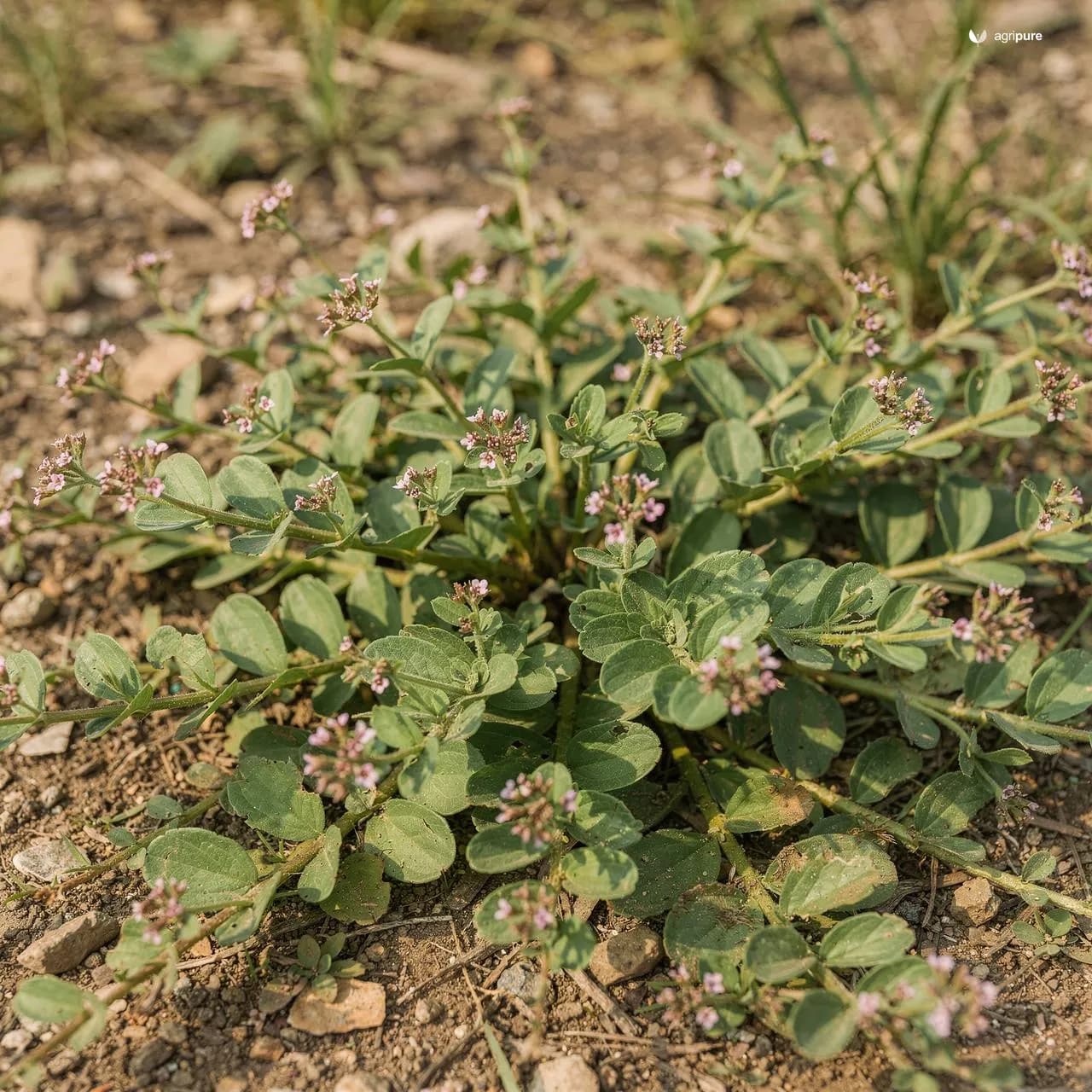
This is a low, sprawling herb with a recognizable combination of features. The stems are prostrate to ascending, often purplish, thickened at the nodes, and carry widely spreading (divaricate) branches; Ayurvedic horticultural notes describe the creeper as roughly 0.75 to 1 m long, occasionally reaching about 4 m of trailing growth in the rainy season before drying back in the dry season. The leaves are opposite, ovate to broadly oblong and about 2.5 to 4 cm long, somewhat fleshy, softly hairy, and noticeably whitish on the underside, with margins that are often slightly wavy. The flowers are small and pink to reddish-purple, borne in clusters and easily spotted as tiny star-like blooms rising on slender stalks from the stems. They are followed by small fruits about 1 cm long, more or less round, each holding a single seed; the fruit surface is glandular and sticky, which helps the seed cling to passing animals and spread. Underground, the plant forms a stout, spindle-shaped (fusiform) taproot that often becomes thick and twists as it dries, and this root is the main organ used in medicinal preparations.
Growing Boerhavia diffusa
The plant reproduces by seed, with the small rounded fruits each carrying a seed, and its sticky surface naturally scatters it across open ground. It is a plant of lowland tropical to subtropical climates and is most at home on disturbed sites, roadsides, fallows, and cultivated fields, which is exactly where it tends to volunteer on a homestead. In Indian agro-climatic notes its flowering and fruiting are reported as mainly winter, while the soft trailing growth flushes with the rains and dies back in the dry season, so its useful biomass is essentially a warm, wet-season crop.
No primary horticultural source assigns this species a precise USDA hardiness zone, so any exact zone figure would be guesswork. What can be said from its distribution is that its naturalized presence in Florida, Georgia, and South Carolina points to survival in climates roughly equivalent to USDA zones 8b to 11, and in cooler regions it is best treated as a warm-season annual, extrapolating from its tropical perennial habit. Because detailed, experimentally documented figures for sowing dates, sowing temperature, plant spacing, and time to maturity are not given in the available botanical sources, they are deliberately left out here rather than stated with false precision. In practice, sow it into warm, open ground in the rainy or warm season, let it sprawl as a self-managing ground cover, and expect it to behave as a tough pioneer of broken, seasonally wet soil rather than a fussy bed crop.
Harvest and uses
There are two distinct harvests from the same plant. The leaves and young shoots are eaten as a leafy vegetable in parts of India and elsewhere, cut from the soft seasonal growth. The roots and aerial parts, meanwhile, are the medicinal harvest: the thick fusiform taproot in particular is the main organ used in traditional medicine, especially in Ayurveda, where the plant is known as punarnava, meaning “that which rejuvenates.” The available sources do not give reliable per-plant or per-area yield figures, so none are invented here. Ecologically, the species is a colonizer of disturbed and cultivated ground, covering bare soil during the wet season, which makes it useful as a living ground cover and a source of cut-and-drop green material in the same systems where it tends to appear on its own.
Safety and cautions
Spreading hogweed is both a food and a medicinal plant, and the medicinal side calls for genuine caution. The sources note there are no well-documented cases of acute poisoning in humans, but the plant contains bioactive rotenoids and other compounds, so medicinal use is not the same as eating a salad green. Reflecting this, the research flags particular care in pregnancy, in kidney or liver disease, and where certain medications are involved, and it advises that long-term, high-dose use should be supervised by a qualified practitioner. This profile describes traditional use only and makes no claim that the plant treats, prevents, or cures any condition, and it gives no dosages. Treat the eaten young greens as the everyday use and the concentrated root preparations as a herbal medicine to approach conservatively and with informed guidance.
Sources
- Boerhavia diffusa — Wikipedia
- Boerhavia diffusa overview — ScienceDirect Topics
- Punarnava (Boerhavia diffusa) — Planet Ayurveda
- Boerhavia diffusa ethnobotanical study — Ethnobotany Research and Applications
Sourcing notes
Comes up on its own across plains bunds and waste ground in the monsoon; dried punarnava root is sold in herbal markets, and seed or self-sown plants can be moved to where you want them.