pioneer
Finger Millet
mandua
Eleusine coracana
Also known as Ragi (India), Mandua (Pakistan), African Millet (Australia, United States).
- pothohar
- kpk hills
International hardiness
- USDA 9-12
- RHS H2
- AU: Tropical, Subtropical, Arid / semi-arid
Where it grows — regional guide
| Zones / rating | Regional notes |
|---|---|
USDA 9-12 | Grown in warm southern areas as a drought-hardy annual grain and livestock forage crop across the summer season. |
| Zones / rating | Regional notes |
|---|---|
H2 (1 to 5C) | No region-specific data yet |
| Zones / rating | Regional notes |
|---|---|
Tropical, Subtropical, Arid / semi-arid | Grown in warm drylands as an annual summer cereal; it tolerates moderate drought and produces grain and stock fodder. |
| Zones / rating | Regional notes |
|---|---|
USDA 9-12 (USDA scale) Canada uses its own zone system; Canadian zones run roughly one lower than USDA. | No region-specific data yet |
| Zones / rating | Regional notes |
|---|---|
Pothohar, KPK hills | Pakistan:Grown in rainfed tracts as a hardy annual cereal; it yields drought-tolerant grain and valuable livestock straw fodder. India:Widely grown across drylands and hill slopes as a drought-tolerant annual grain; the harvested seed stores for years. |
Finger millet (Eleusine coracana) is a tropical annual grass in the grass family, Poaceae, grown as a cereal across the drylands of Africa and Asia. Reliable sources place its native center of origin in the Ethiopian and Ugandan highlands, from which it spread as one of the staple small grains of semiarid farming. For the homesteader working marginal, higher-elevation, or moderate-rainfall ground, it earns its place as a drought-tolerant grain that stores for years and doubles as livestock fodder.
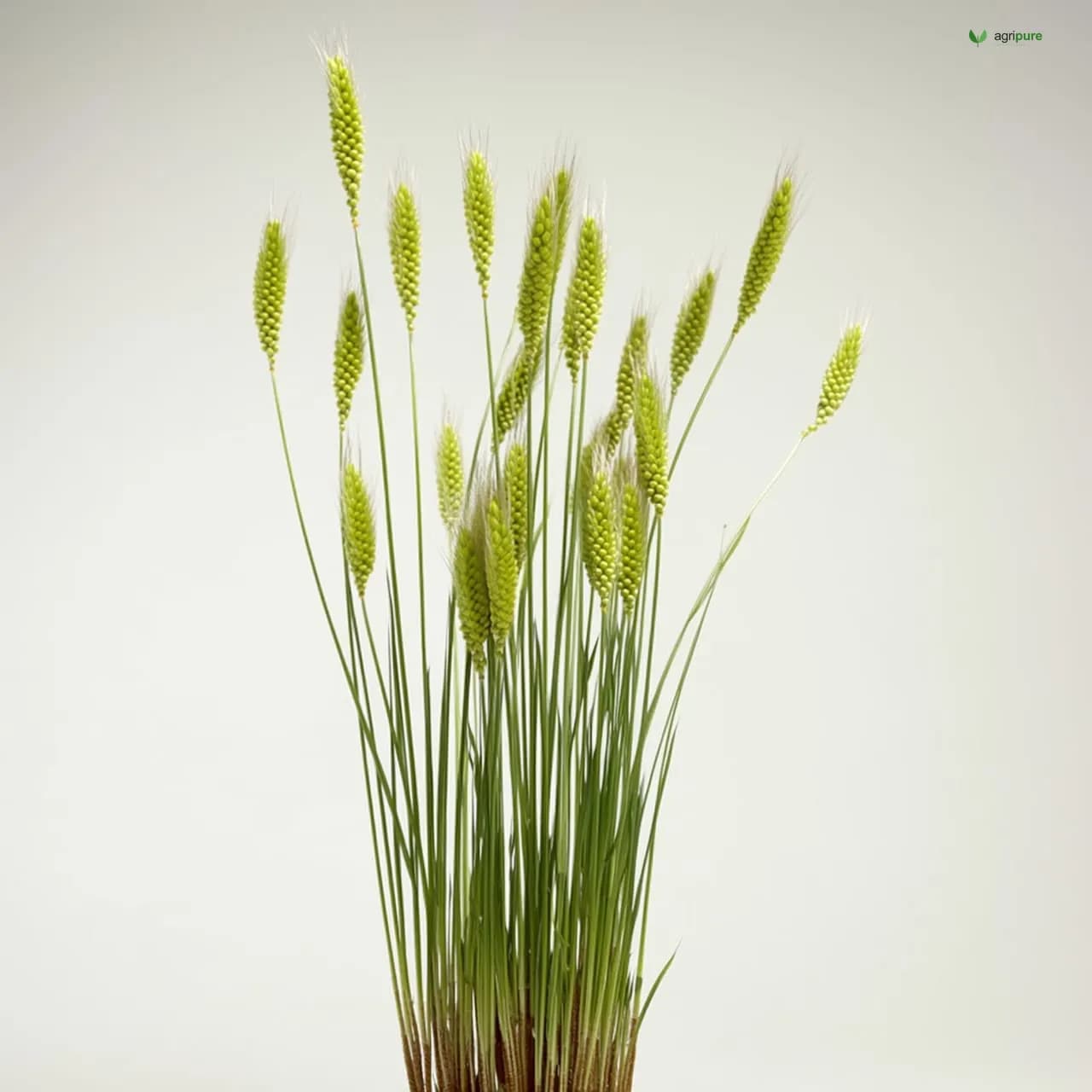
The plant is a tufted, tillering annual grass that grows up to about 170 cm tall on a shallow, branched, fibrous root system. Its most distinctive feature is the inflorescence: a panicle of roughly 4 to 19 short, thick spikes that splay out like the fingers of a hand, which is the basis of the common name. Botanically it is a tetraploid and a self-pollinating crop, so it comes fairly true from saved seed.
Growing finger millet
Finger millet is propagated from seed and grown as an annual grain crop. It is mainly a semiarid to arid tropical plant, with its main growing belt falling roughly between 20°N and 20°S, but it also climbs to higher elevations, reaching about 500 to 2,400 m in the Himalaya region. That elevation range is part of what makes it useful where other cereals struggle.
For soil, it is forgiving. It grows on a wide range of soil types, including highly weathered lateritic soils, and does best in free-draining ground that holds steady moisture; it tolerates a broad pH band of about 5.0 to 8.2.1 On light or marginal soils that defeat thirstier grains, it remains productive. For light, finger millet is a short-day plant, with most varieties responding to an optimum of around 12 hours of daylight, so sowing date relative to day length matters for timing the crop.
On water, it is genuinely drought-tolerant, but it is worth understanding the nuance: compared with some other millets it actually prefers moderate rainfall, around 500 mm a year, rather than the most extreme aridity. Treat it as a tough, low-water grain rather than a desert crop. The sources reviewed here do not give a reliable spacing recommendation or a specific days-to-maturity figure, so those details are best taken from a regional seed supplier rather than guessed at.
Harvest and uses
The harvest cue is straightforward: at the first cutting, take the earheads that have turned brown. One of the crop’s defining virtues is storage life. The grain keeps exceptionally well, and finger millet can be stored for up to about 10 years when left unthreshed, with some reports of much longer storage under excellent conditions. That keeping quality is exactly why it has long served as a reserve grain in subsistence systems.
In the kitchen, finger millet grain is milled into flour and used for cakes, puddings, porridge, unleavened breads, pancakes, and bakery products. It is also malted and fermented to make traditional beverages and beer in Nepal and parts of Africa, along with other malt-based foods and drinks. Beyond the grain, the straw is valued as animal fodder, so a single planting yields both food and feed. As a crop in the system, its principal role is as a dryland field cereal, prized for drought tolerance and the ability to produce in marginal, higher-elevation environments where many grains will not.
Nutrition and food-functional uses
Finger millet has drawn research attention as a nutrient-dense grain. Sources describe it as rich in polyphenols and in calcium, and note active interest in its low-glycemic and antidiabetic-related food applications, particularly in malted products and infant weaning foods. These are food and nutrition properties rather than established medical treatments, and the literature reviewed here frames them as functional-food uses, not therapy.
Safety and cautions
The sources reviewed do not indicate that Eleusine coracana is poisonous, and they do not identify any toxic plant parts, so no toxicity can be stated for this species from the available evidence. Likewise, while these sources discuss the grain’s health-related and functional-food properties, they do not provide interaction warnings, contraindications, or high-risk groups, so no specific medicinal-use cautions can be verified here. Because products may be malted, fermented, or decorticated, ordinary food-safety practices apply, but nothing beyond that is claimed.
Sources
- GBIF Secretariat. “Eleusine coracana (L.) Gaertn.” Global Biodiversity Information Facility.
- USDA, NRCS. “Eleusine coracana (L.) Gaertn. (goosegrass / finger millet).” The PLANTS Database.
- PubMed / National Library of Medicine. Research review on finger millet (Eleusine coracana).
- Heuzé, V. et al. “Finger millet (Eleusine coracana).” Feedipedia, INRAE / CIRAD / AFZ / FAO.
- Wikipedia contributors. “Finger millet.” Wikipedia.
- CABI. “Eleusine coracana (finger millet).” CABI Compendium.
- Tamilselvan, T. et al. “Finger Millet (Eleusine coracana).” Taylor & Francis.
- Devi, P. B. et al. “Finger millet: nutritional and bioactive properties.” ScienceDirect.