pioneer
Spear Grass
sariala
Heteropogon contortus
Also known as Black Speargrass (Australia), Tanglehead (United States), Sariala (Pakistan).
- pothohar
- balochistan highlands
- punjab plains
International hardiness
- USDA 8-12
- RHS H3
- AU: Tropical, Subtropical, Arid / semi-arid
Where it grows — regional guide
| Zones / rating | Regional notes |
|---|---|
USDA 8-12 | Warm-season perennial across USDA zones 8 to 12 on dry slopes; mature barbed seeds penetrate skin and injure animals or handlers, so check local weed assessments. |
| Zones / rating | Regional notes |
|---|---|
H3 (-5 to 1C) | No region-specific data yet |
| Zones / rating | Regional notes |
|---|---|
Tropical, Subtropical, Arid / semi-arid | Used as rangeland pasture across tropical, subtropical and arid country; graze only when young, as mature barbed seeds injure stock and humans, and check weed regulations. |
| Zones / rating | Regional notes |
|---|---|
USDA 8-12 (USDA scale) Canada uses its own zone system; Canadian zones run roughly one lower than USDA. | No region-specific data yet |
| Zones / rating | Regional notes |
|---|---|
Pothohar, Balochistan highlands, Punjab plains | Pakistan:Grown as a pioneer and forage grass across dry plains and rocky hills; graze early, as barbed seeds injure livestock and humans, and check weed regulations before planting. India:Used across dry rangelands for early fodder and erosion control; graze early, as barbed seed awns severely injure stock and people, and check local weed restrictions. |
Spear grass (Heteropogon contortus), also called black speargrass or tanglehead, is a warm-season perennial tussock grass valued as pasture and for thatching and erosion control, but armed with sharply barbed seeds that can injure livestock, pets, and people. It is native across much of the Old World tropics and subtropics and parts of Australasia, and has naturalized widely beyond that range. For a homesteader, its appeal is straightforward: it is a tough, fire-adapted, drought-hardy grass that will hold soil and produce early grazing on poor, rocky ground where gentler species struggle, provided you respect the hazard its seeds become once it flowers.
How to identify it
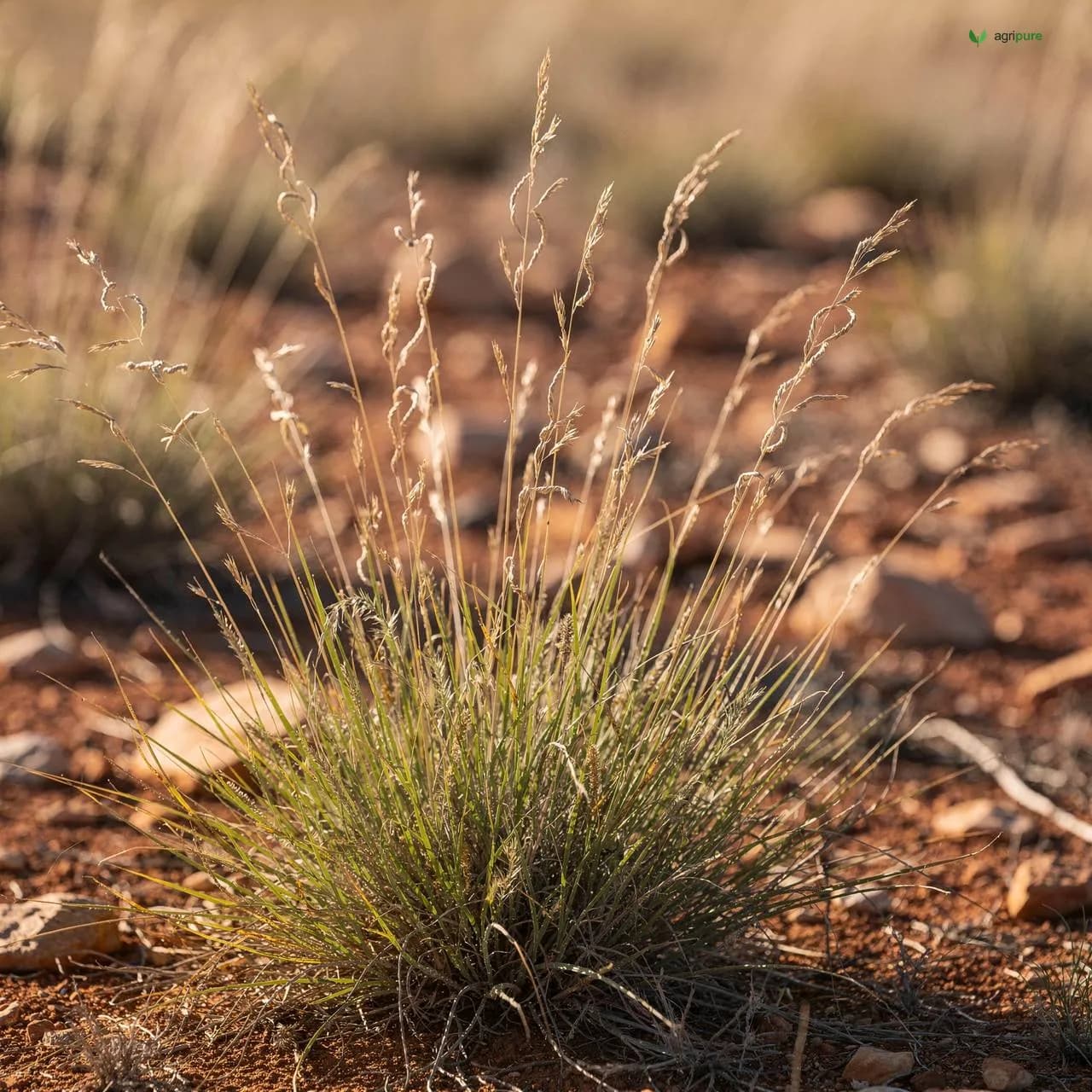
Spear grass is a tufted, tussock-forming perennial, generally short-lived at roughly 2 to 5 years. The foliage stands about 0.2 to 1.2 m high, with fertile flowering stems reaching about 0.5 to 1.5 m tall. Its leaves are greenish-grey and usually glabrous (smooth) or carry only a few hairs; the blades run about 30 to 300 mm long and 3 to 8 mm wide, are usually folded, and end in a rounded, often hooded tip, with membranous ligules. Overall it reads as a robust, erect, dense grass with light-green leaves and curled, sharp-tipped seeds.
The most distinctive features are the flower head and the seed. Each fertile stem carries a single, spike-like raceme (one “spear” per stem) with awns (elongated bristles on the seed) that look velvety in the upper half. The seeds are dark, with a single long awn at one end and a sharp spike at the other; the awn twists as moisture changes, which lets the seed effectively drill itself into the soil. Those twisting, barbed seeds are both the grass’s clever self-planting mechanism and the reason it must be handled with care.
Growing Heteropogon contortus
This is a tropical to warm-temperate species that thrives in heat and tolerates both drought and fire. It grows on a wide variety of well-drained soils, from loamy sands to clay loams, including very fertile clay loams, and is also described as thriving on sandy to clayey loam, well-drained soils, often on hillsides and among rocks. Well-drained ground is the consistent requirement across sources. It tolerates poor soils and is repeatedly noted for its usefulness on degraded land, making it a practical pioneer for eroded slopes and rough corners of a property.
In the wild it turns up in prairies, plains, meadows, pastures, savannas, grasslands, open woodlands, riverbanks, roadsides and degraded areas — generally open, sunny country rather than shade. It is a perennial warm-season grass that is favored by frequent burning and tolerant of grass fires, so it tends to persist and even increase under fire regimes that knock back less fire-hardy plants.
The primary technical sources do not assign explicit USDA hardiness zones to this grass. Based on its persistence in the southern United States — including Florida, Texas and the Southwest — and its characterization as a tropical to warm-temperate, warm-season grass, it is consistent with roughly USDA zones 8 to 11.1256 Treat that range as a reasoned inference from its distribution and climate, not a figure taken directly from the literature. Detailed sowing dates, seeding rates, spacing and time-to-maturity figures are not consistently documented in these general sources, so they are intentionally left out rather than stated with false precision.
Harvest and uses
Spear grass earns its keep in three main ways: as pasture, as thatching material, and as erosion control. As forage it is most useful young; on rangeland it forms part of the grass layer that feeds grazing stock, and its tussock habit and tolerance of poor, sloping ground make it a sound soil-binder on land prone to wash and erosion. Its tolerance of fire means it recovers and regrows after burns rather than being eliminated by them.
Because the seeds self-bury via their twisting awns, the grass spreads and re-establishes readily on open, disturbed ground, which is part of why it is so effective as a pioneer cover. The same trait, however, is exactly what makes the mature plant a hazard, which is covered below. The cited sources do not give reliable, generally applicable dry-matter yield figures for homestead conditions, so no yield number is stated here.
Safety and cautions
The serious caution with spear grass is mechanical, not chemical. No specific phytochemical toxicity has been reported for it in the scientific or forage literature; the plant is not described as poisonous. The hazard comes entirely from the sharp, barbed seed awns, which can seriously injure livestock, pets, and people.
Each seed carries a hard spike at one end and a long, twisting awn at the other; as humidity changes the awn coils and uncoils, driving the barbed seed forward into whatever it contacts. In practice this means the seeds work into wool, fur, hide and clothing and can penetrate skin, so the grass is best grazed or cut while young and green and avoided once it has set its spiked seed. If you keep it on a homestead for erosion control or early grazing, plan around its flowering and seeding: handle it before the seeds mature, and keep animals and bare skin clear of stands that have gone to seed. Note too that the University of Florida’s invasive-plant assessment evaluates this species in a regional context, so check its status with your local extension or weed authority before deliberately planting it.
Sources
- Heteropogon contortus (black speargrass) — CABI Compendium
- Heteropogon contortus — Tropical Forages
- Heteropogon contortus — PlantZAfrica, South African National Biodiversity Institute (SANBI)
- Heteropogon contortus (black speargrass) — Territory Native Plants
- Heteropogon contortus — Wikipedia
- Heteropogon contortus assessment — UF/IFAS Assessment of Non-Native Plants
Sourcing notes
Established from seed, though the twisted awns make it awkward to handle and sow; broadcasting onto roughened ground before the rains works best. It also spreads naturally onto bare dryland, so existing rangeland stands are a ready seed source.