secondary
Manila Tamarind (Jungle Jalebi)
jungle jalebi / ganga imli
Pithecellobium dulce
Also known as Madras Thorn (United States, Australia, India).
- punjab plains
- sindh coast
International hardiness
- USDA 9-12
- RHS H1c
- AU: Tropical, Subtropical, Arid / semi-arid
Where it grows — regional guide
| Zones / rating | Regional notes |
|---|---|
USDA 9-12 | Grown across USDA zones 9 to 12 as a spiny living fence and fruit tree; wear gloves against sharp spines and check local weed restrictions against invasive spread. |
| Zones / rating | Regional notes |
|---|---|
H1c (5 to 10C) | No region-specific data yet |
| Zones / rating | Regional notes |
|---|---|
Tropical, Subtropical, Arid / semi-arid | Suited to tropical, subtropical and arid regions as a tough living fence; wear gloves around its spiny branches and check local weed restrictions before planting. |
| Zones / rating | Regional notes |
|---|---|
USDA 9-12 (USDA scale) Canada uses its own zone system; Canadian zones run roughly one lower than USDA. | No region-specific data yet |
| Zones / rating | Regional notes |
|---|---|
Punjab plains, Sindh coast | Pakistan:Planted across the Punjab plains and Sindh coast for sweet coiled pods and living hedges; wear gloves against sharp spines, monitor volunteers, and check weed regulations. India:Widely naturalised across dry regions for edible arils, fodder, and thorny boundary hedges; use gloves when pruning sharp spines, monitor volunteers, and check weed rules. |
Manila tamarind (Pithecellobium dulce) is a thorny, drought-hardy, nitrogen-fixing legume tree grown for its sweet-acid pods, shade, fodder, and fuelwood. It also goes by Madras thorn, guamúchil, and jungle jalebi — the last a nod to the way its ripe pods coil into a spiral resembling the looped Indian sweet. Native to the seasonally dry tropical forests of the Americas, it has travelled widely and now naturalizes readily in warm climates worldwide. For a homesteader working hot, dry, or poor ground, the appeal is direct: a fast, tough fertility tree that builds soil, feeds livestock, and yields an edible pod while shrugging off heat and drought.
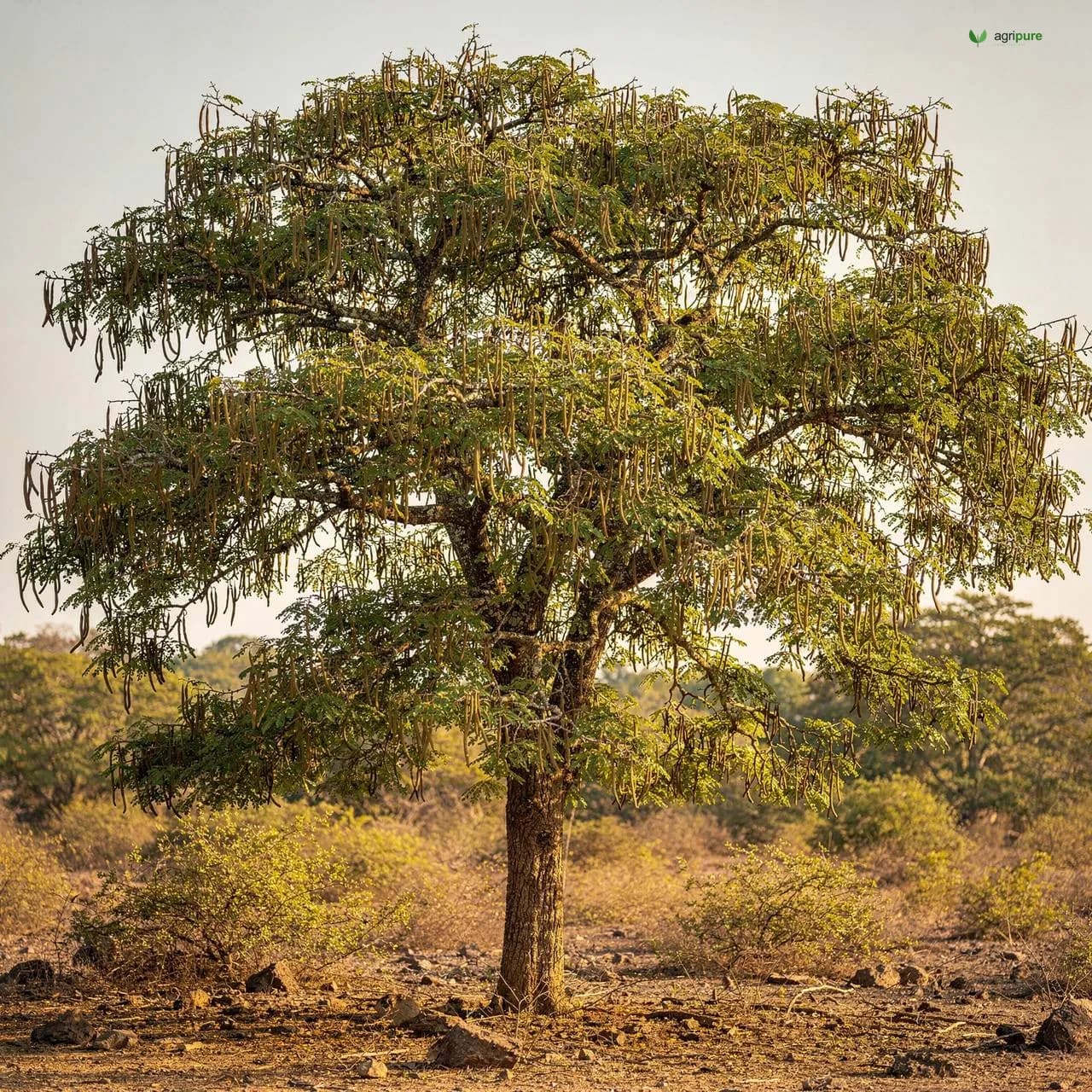
It is a small to medium tree, typically 5 to 20 m tall, often multi-stemmed with an irregular rounded crown and slender, drooping branches. The trunk and branches usually carry spines, part of why it is so often grown as a living fence. Its foliage is bipinnate and semi-evergreen in seasonally dry tropics, each pinna bearing a single pair of ovate-oblong leaflets about 2 to 4 cm long. Small, greenish-white, fragrant flowers in little heads give way to the distinctive twisted, coiled pods, pink to reddish when ripe, that split open to reveal a sweet, spongy aril — pink or white — around flat, shiny black seeds; that pulp is the most recognized edible part.
Growing Manila tamarind
The species is native to seasonally dry tropical forest from north-western and Pacific Mexico through Central America into northern South America. It has since naturalized across the Caribbean, southern Florida, the Indian subcontinent, the Philippines, and Thailand, and is invasive in Hawaii. It thrives in seasonally dry tropical climates from sea level up to roughly 1,500 m elevation, and CABI describes it as extremely heat- and drought-tolerant and able to withstand heavy cutting. Cultivation reports note it tolerates temperatures well above 100°F and survives brief, light frosts but not prolonged freezing. The sources do not assign USDA zones directly, but that heat tolerance and survival in southern Florida point to roughly USDA zones 9b to 11 — an inference, not a figure from the primary literature.
Spacing, sowing dates, and time-to-maturity figures are not consistently documented in the sources here and are omitted rather than guessed. For practical propagation and siting:
- Propagation: Most commonly grown from seed, which is numerous and viable — the tree is “seedy” and readily naturalizes. Soaking seed before sowing improves germination; it can also be grown from cuttings rooted in a well-draining medium.
- Soil: Grows in almost any soil, including poor soils, provided there is drainage; well-draining loam is preferred. As a nitrogen-fixing legume it improves fertility and is often used to rehabilitate degraded land.
- Sun: Needs bright, direct sun — about 8 hours a day — and develops its wide, shading crown in full sun.
- Temperature and water: Prefers warm tropical to warm-subtropical conditions, tolerates very high heat and brief light frost, and is markedly drought-tolerant once established.
In short, sow soaked seed into warm, well-drained ground in full sun, give it room for a broad crown, and let its toughness do the work.
Harvest and uses
The harvest most homesteaders care about is the pod. When ripe, the coiled pods split to expose the sweet, spongy aril, the widely eaten part, consumed fresh across the range. Beyond the pulp, it is a true multipurpose tree: valued for shade and fuelwood, and a source of fodder, with leaves and pods fed to livestock. Its spiny habit makes it a practical living fence, and because it fixes atmospheric nitrogen it features in agroforestry systems and in restoring degraded soils. Leaves and pods also appear in traditional medicine within its range.
Pollination
The small, fragrant, greenish-white flowers are pollinated mainly by insects, with pollen carried in polyads — packets of many grains fused together — so a single insect visit can fertilize a whole pod’s worth of seeds.
Safety and cautions
The same vigour that makes Manila tamarind useful also makes it a tree to site with care. It naturalizes readily, sets abundant viable seed, and is invasive in Hawaii, so it can spread beyond where you intend; plant it only where that is acceptable, watch for volunteers, and keep it away from sensitive native habitat. Its trunk and branches are spiny, so site it clear of paths and working areas and use gloves when pruning or harvesting. While the sweet aril is widely eaten and leaves and pods are used as fodder and in traditional medicine, this profile makes no medical claims and gives no dosages; treat medicinal use as traditional practice, not established treatment.
Sources
- Pithecellobium dulce (Manila tamarind) — CABI Compendium
- Manila Tamarind — Trade Winds Fruit
- Pithecellobium dulce — GBIF (Global Biodiversity Information Facility)
- Manila tamarind (Pithecellobium dulce) — Feedipedia (INRAE/CIRAD/AFZ/FAO)
- Pithecellobium dulce — EarthOne Plant Database
Sourcing notes
Manila tamarind is easy to raise from seed and is already naturalised across the plains, so planting stock is rarely a constraint. Because it self-seeds and spreads, site it where its vigour is wanted, such as soil-building and erosion control on degraded ground.