pioneer
Sarsaparilla Greenbrier
ushba
Smilax aspera
Also known as Ushba (Pakistan).
- kpk hills
- pothohar
International hardiness
- USDA 8-11
- RHS H4
- AU: Mediterranean, Warm temperate, Subtropical
Where it grows — regional guide
| Zones / rating | Regional notes |
|---|---|
USDA 8-11 | Grown as an evergreen climbing vine in USDA zones 8 to 11; wear gloves when pruning because sharp, hooked spines catch clothing and stems can quickly overrun fences. |
| Zones / rating | Regional notes |
|---|---|
H4 (-10 to -5C) | Hardy to RHS H4 as an evergreen climber for mild areas; wear protective gloves when handling, as stems bear hooked spines and scrambling growth can overrun borders. |
| Zones / rating | Regional notes |
|---|---|
Mediterranean, Warm temperate, Subtropical | Suited to Mediterranean and warm-temperate regions as a thorny barrier vine; site away from pathways, as stout hooked spines grab skin and rampant stems spread rapidly. |
| Zones / rating | Regional notes |
|---|---|
USDA 8-11 (USDA scale) Canada uses its own zone system; Canadian zones run roughly one lower than USDA. | No region-specific data yet |
| Zones / rating | Regional notes |
|---|---|
KPK hills, Pothohar | Pakistan:A spiny evergreen scrambler of the Pothohar and KPK hills; handle with thick gloves and site along rough boundaries because hooked spines and rampant growth cause injury. |
Sarsaparilla greenbrier (Smilax aspera), also called Mediterranean smilax or prickly ivy, is a spiny, evergreen climbing vine native to a broad band running from southern Europe and the Mediterranean to the Canary Islands and North Africa, and eastward through western and southern Asia, including parts of the Middle East and on toward India and the Himalayas. For a homesteader it is a tough, self-supporting evergreen scrambler for warm, frost-free corners: it climbs over shrubs and fences on hooked, thorny stems, holds its glossy leaves year-round, and yields edible (if bitter) young shoots and berries that double as valuable wildlife food.
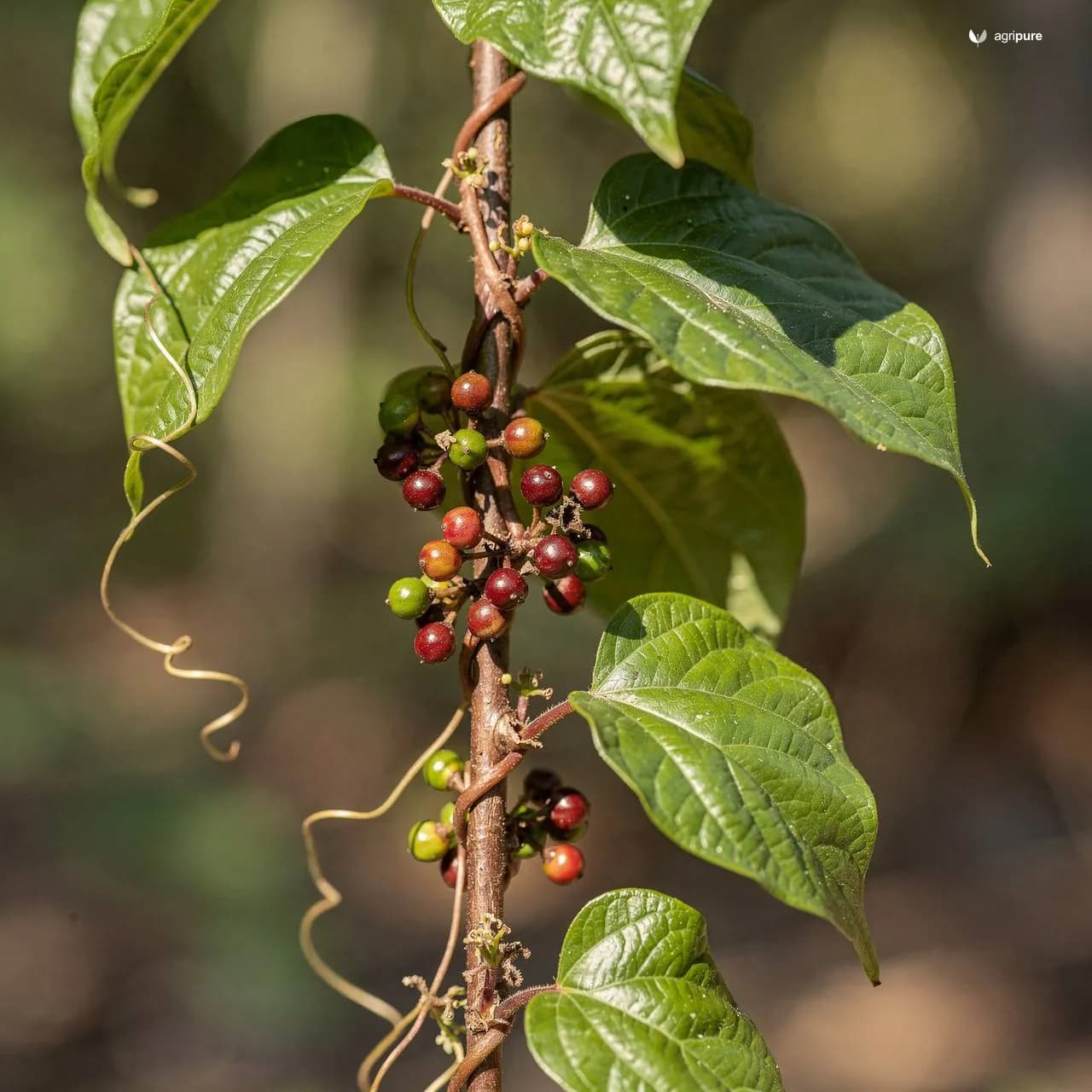
It is a liana with a dense, tangled habit, often described as semi-scandent, meaning it only partly climbs and otherwise sprawls. The stems are flexible and distinctly four- to six-angled, frequently zigzagging from node to node and armed with short, stout spines that let the plant hook and clamber over neighbouring vegetation. The leaves are leathery, glossy, and evergreen, generally heart-shaped to ovate with an entire (untoothed) margin; they are glossy green and may be mottled or blotched with grey, and the species is notably variable in leaf shape and size from plant to plant. Like other Smilax, it bears paired tendrils at the base of the leaf stalk to aid climbing, though it leans heavily on its spines and angled stems as well. In a cold greenhouse in Britain the stems reach roughly 8 to 10 feet (about 2.5 to 3 m), forming a tangle of many shoots, and the RHS lists it as an evergreen climber to about 3 m tall.
Growing sarsaparilla greenbrier
This is a warm-climate plant. In British cultivation it is not reliably hardy in colder areas and has historically been grown under glass in a cold greenhouse, and the RHS is explicit that it “requires a warm sunny position in well-drained soil” and is “not suitable for cold, frost-prone areas.” The sources here do not assign a numeric USDA hardiness zone, so none is stated; based on the cited descriptions it is best treated as a warm-temperate to subtropical, frost-sensitive climber.
- Sun: Give it a warm, sunny position; full sun in a sheltered spot suits it best.
- Soil and drainage: Plant in well-drained soil. Wet, cold ground does not suit it, and it should be kept out of frost pockets.
- Propagation by seed: The RHS advises sowing seed in autumn.
- Propagation by division: It can also be propagated by division in autumn or spring.
- Support: As a thorny scrambler it climbs over shrubs, fences, and trellis using its spines, angled stems, and paired tendrils, so give it something sturdy to grab.
The available sources give no reliable, species-specific figures for seed pretreatment, germination time, plant spacing, or time to maturity, so those are left out rather than guessed. In practice, treat it like other Mediterranean evergreen climbers: start it in a warm, free-draining bed or pot, shelter it from hard frost, and let it establish on its support.
Harvest and uses
The plant produces small, pale green, fragrant flowers carried in racemes; in British garden conditions these appear from late summer into early autumn. Flowering is followed by conspicuous berries, typically red when ripe (sometimes red to black), roughly 5 to 8 mm across and usually three-seeded, which stand out against the foliage in autumn. The young shoots and the berries are edible, though somewhat bitter, and both are an important food source for wildlife, making the vine as useful for the birds and animals on a property as it is for the kitchen. Being evergreen and densely armed, it also earns its keep as a living, thorny screen along a warm boundary.
How to identify it
Use this combination of features to separate it from other climbers:13
- Habit: A dense, tangled, semi-scandent evergreen liana that both climbs and sprawls.
- Stems: Flexible, four- to six-angled, often zigzagging, armed with short, stout spines, and bearing paired tendrils at the leaf-stalk base.
- Leaves: Leathery, glossy, evergreen, heart-shaped to ovate with entire margins, sometimes grey-mottled, and variable in shape and size.
- Flowers and fruit: Small, pale green, fragrant flowers in racemes (late summer to early autumn), followed by red-to-black berries about 5 to 8 mm wide, usually three-seeded.
Safety and cautions
The shoots and berries are described as edible but bitter, so they are a foraged curiosity and wildlife food rather than a staple, and bitter, unfamiliar wild fruit should always be tried sparingly and only when the plant has been positively identified. The main hazard for the grower is mechanical: the stems carry short, stout, hooked spines built to catch and hold, so site the plant away from paths and handle it with gloves. Its vigorous, tangled, scrambling habit also means it can overrun a tidy planting, so keep it to a boundary or rough edge where its thorny, evergreen cover is an asset.
Sources
- Smilax aspera – Trees and Shrubs Online
- Smilax aspera L. – GBIF
- Smilax aspera – Royal Horticultural Society (RHS)
- Smilax aspera L. – Plants of the World Online, Royal Botanic Gardens, Kew
Sourcing notes
Collect berries or lift rooted suckers from established wild plants on hill margins in KPK or Pothohar; it is not sold commercially, so wild-sourced propagating material is the practical route.