secondary
Custard apple
Annona squamosa
Also known as Sugar Apple (United States), Sharifa (Pakistan), Sweetsop (Australia).
- sindh coast
- punjab plains
International hardiness
- USDA 10-11
- RHS H1c
- AU: Tropical, Subtropical
Where it grows — regional guide
| Zones / rating | Regional notes |
|---|---|
USDA 10-11 | Grown in frost-free subtropical zones for sweet fruit; seeds, leaves, roots and bark are poisonous, and hard seeds must be removed without crushing. |
| Zones / rating | Regional notes |
|---|---|
H1c (5 to 10C) | No region-specific data yet |
| Zones / rating | Regional notes |
|---|---|
Tropical, Subtropical | Grown across tropical northern gardens for sweet fruit; seeds, leaves, roots and bark are poisonous, and hard seeds must be removed uncrushed. |
| Zones / rating | Regional notes |
|---|---|
USDA 10-11 (USDA scale) Canada uses its own zone system; Canadian zones run roughly one lower than USDA. | No region-specific data yet |
| Zones / rating | Regional notes |
|---|---|
Sindh coast, Punjab plains | Pakistan:Cultivated in frost-free coastal Sindh for dessert fruit; seeds, leaves, roots and bark are poisonous, and seeds must be removed without crushing. India:Widely grown across tropical plains for its sweet fruit; seeds, leaves, roots and bark are poisonous, and seeds must be removed without crushing. |
Grows alongside
Species that appear with Custard apple in 3 of our published guides — a starting list for a guild, not a planting plan.
The custard apple (Annona squamosa), better known in much of the world as the sugar apple or sweetsop, is a small tropical fruit tree grown in hot, frost-free climates for its intensely sweet, segmented fruit. It is considered native to the West Indies and tropical Central and South America, with horticultural references placing its likely origin in lowland Central America or the Caribbean before it spread across the tropical Americas; today it is cultivated throughout warm regions, including parts of India, Egypt and Brazil. For a homesteader in a genuinely warm climate, its appeal is straightforward: it is a compact, slow-growing tree that earns its place in a small orchard with a fragrant, dessert-quality fruit you will rarely find at a good price in shops because it does not travel well.
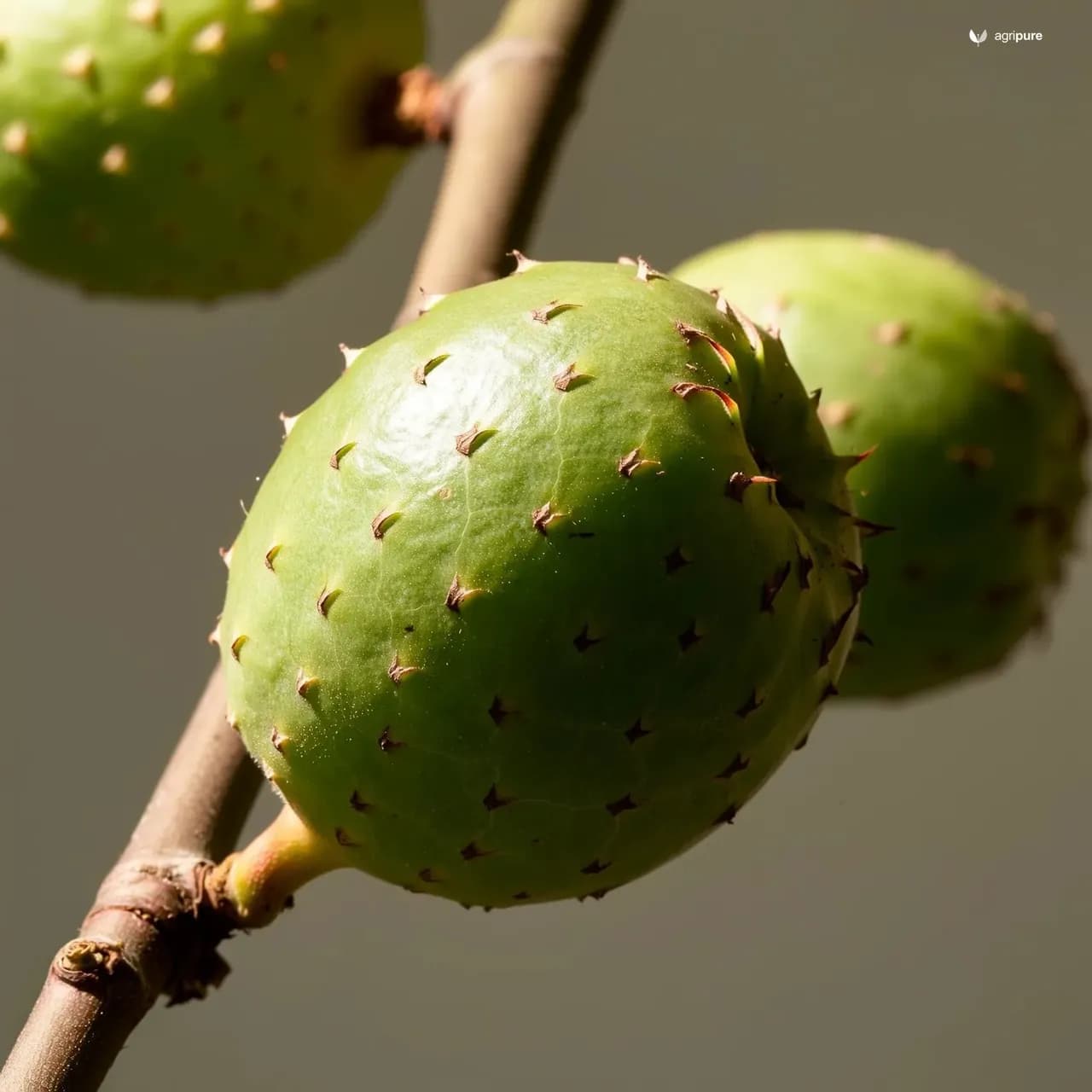
This is a small tree or shrub, typically 3 to 8 m tall, slow-growing, with an open, rounded or spreading crown and slender branches. The bark is light brown to brownish and carries visible leaf-scar marks along the branches. Its leaves are simple, alternate and pale to light green, borne singly along the branches, thin in texture and characteristically oblong to lanceolate in shape. The flowers are usually solitary or in small clusters and greenish-yellow, sometimes flushed purplish at the base; each has three fleshy outer petals (green, often purple-based) while the three inner petals are reduced to small scales or absent, surrounding numerous white stamens. Each fertilised pistil develops into a separate small tubercle, and together these form the knobby, segmented surface that makes the fruit so recognisable.
Growing custard apple
Custard apple is commonly propagated by seed or by grafting or budding onto seedling rootstocks; its seeds are viable and widely used to raise plants in both commercial and research settings. The general botanical sources here do not lay out step-by-step sowing or grafting protocols, so this profile does not invent precise timings; in practice the choice is between easy, variable seedlings and grafted trees that hold a known fruit type.
It needs a tropical or warm subtropical climate and is frost-tender. University of Arizona records it as hardy only to roughly **USDA zones 10a to 11, tolerating about 30 to 40 degF (-1 to 4 degC) only briefly and unable to survive prolonged cold or frost. It prefers hot, relatively dry lowland conditions or low-lying interior plains, generally at elevations from **0 to about 600 m. For a homestead this means it is realistic only where winter frosts are rare and short — true subtropical-to-tropical ground, or a warm protected microclimate equivalent to USDA 10a or warmer.
For soil, sun and water, the sourced guidance is:
- Soil: It does best on well-drained soils and is cultivated on a range of soil types across its production areas, often light to medium-textured soils on lowland plains; consistent with its preference for hot, dry, free-draining sites, it does not tolerate waterlogging well.
- Sun: As a fruit tree from hot, dry lowland tropics, it is grown in full sun for best fruiting.
- Water: It suits hot, relatively dry lowland environments rather than wet ground, so favour free-draining conditions and avoid soggy soil that risks rotting the roots.
Plant spacing and exact time to maturity are not given in the sourced material, so they are left out here rather than stated with false precision.
Harvest and uses
The fruit is botanically an aggregate fruit: each fertilised pistil forms a segment, giving the characteristic knobby, segmented surface. It is conical to heart-shaped with green, knobbly skin, and as it ripens the segments often separate slightly and the fruit may crack — a useful field cue that it is approaching maturity. Inside is creamy-white, fragrant, very sweet pulp surrounding many hard, glossy black or dark-brown seeds, with roughly 50 to 80 percent of the fruit being edible pulp. The pulp is eaten fresh and is the reason the tree is grown; because the fruit is delicate and does not ship or store well, it remains very much a home-orchard and local-market crop rather than a commercial export line.
Safety and cautions
While the sweet pulp is edible, the sources are explicit that other parts of this plant are toxic and must not be eaten.
- The seeds, leaves, roots and bark are poisonous and should not be ingested; only the ripe pulp is food.
- Because the pulp is studded with many hard seeds, take care to remove them when eating or preparing the fruit, and do not crush or grind the seeds into food.
This profile describes the plant for home growing only and makes no medical claims. Treat custard apple as a dessert-fruit tree whose value sits entirely in the ripe pulp, and keep its toxic seeds, leaves and bark away from people and livestock.
Sources
- “Annona squamosa” – Useful Tropical Plants Database
- “Annona squamosa” – University of Arizona Campus Arboretum
- Review of Annona squamosa – PMC, National Library of Medicine
- “Annona squamosa” botanical description – Govt. College Quepem