secondary
Rosemary
rosemary
Salvia rosmarinus
- pothohar
- balochistan highlands
- kpk hills
International hardiness
- USDA 7-10
- RHS H4
- AU: Warm temperate, Mediterranean, Cool temperate
Where it grows — regional guide
| Zones / rating | Regional notes |
|---|---|
USDA 7-10 | An evergreen perennial shrub in mild southern and western climates, requiring sharp winter drainage or indoor pot protection up north. |
| Zones / rating | Regional notes |
|---|---|
H4 (-10 to -5C) | A hardy evergreen culinary shrub for sunny borders and gravel beds, susceptible to root rot in heavy, waterlogged winter ground. |
| Zones / rating | Regional notes |
|---|---|
Warm temperate, Mediterranean, Cool temperate | A resilient, drought-hardy shrub in Mediterranean and warm temperate gardens, flourishing on sunny banks with lean soil. |
| Zones / rating | Regional notes |
|---|---|
USDA 7-10 (USDA scale) Canada uses its own zone system; Canadian zones run roughly one lower than USDA. | Grown in containers brought into bright cool rooms before hard winter freezes, or treated as a summer patio herb. |
| Zones / rating | Regional notes |
|---|---|
Pothohar, Balochistan highlands, KPK hills | Pakistan:Thrives in well-drained foothill and upland gardens, but struggles in lowland plains under humid monsoonal waterlogging. India:Grown in temperate hill stations and as a potted winter herb on plains, requiring gritty soil and minimal watering. |
Grows alongside
Species that appear with Rosemary in 98 of our published guides — a starting list for a guild, not a planting plan.
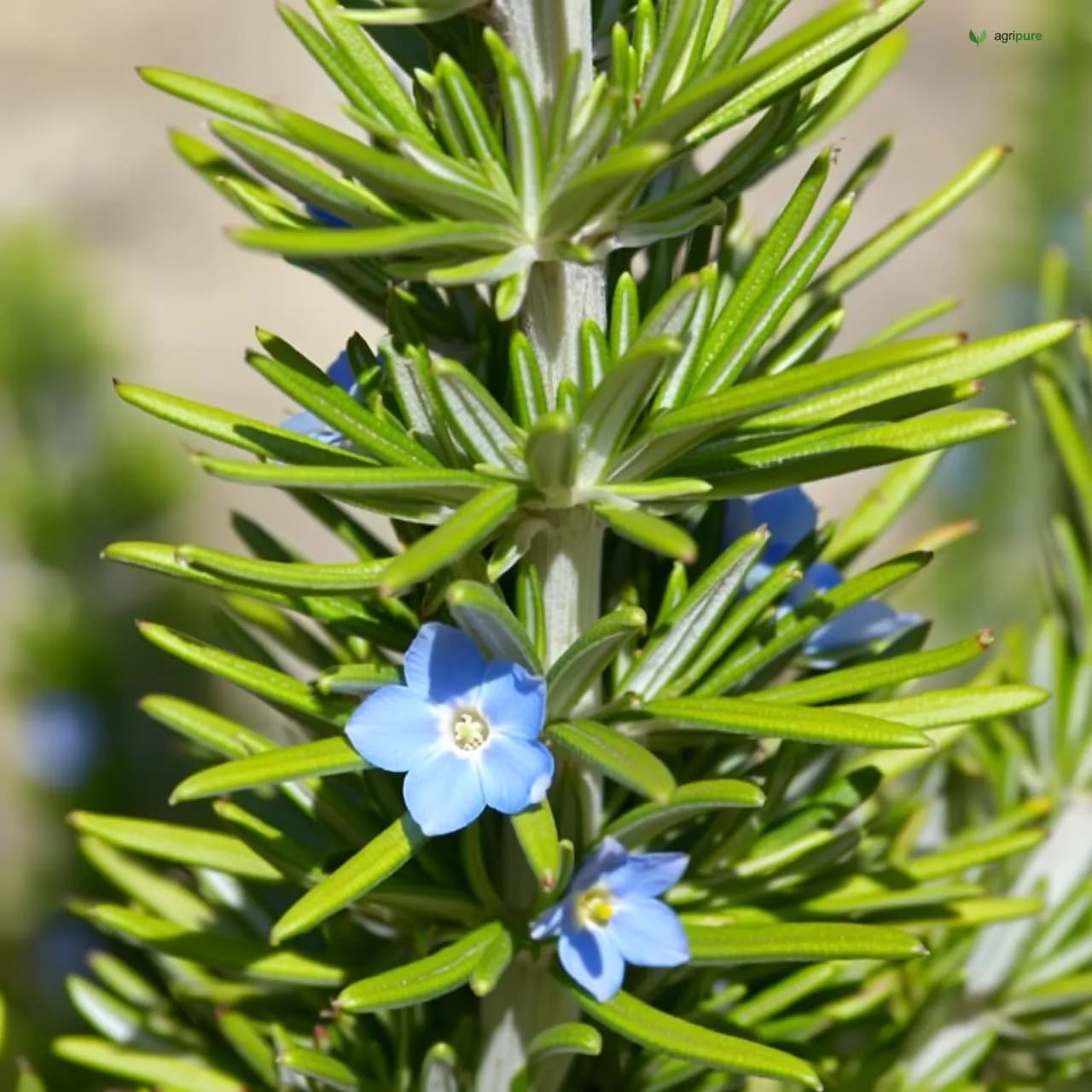
Rosemary (Salvia rosmarinus) is a fragrant, evergreen, woody shrub in the mint family, recognizable by its needle-like leaves and small two-lipped flowers in shades of blue, lavender, white, or purplish-blue. It was long known as Rosmarinus officinalis, but current authoritative plant references place it in the genus Salvia. Native to the Mediterranean region, it is a sun-loving herb of dry scrubland, and for a homesteader that is precisely its appeal: it is a tough, drought-adapted evergreen that turns hot, dry, free-draining corners of a property into a year-round supply of culinary and aromatic foliage.
How to identify rosemary
Rosemary is generally erect and rounded in habit, usually about 4 to 6 feet tall in frost-free climates. Its aromatic leaves are needle-like and gray-green to green, often white-tomentose (covered in fine white hairs) on the underside. The flowers are tiny and two-lipped, borne along the stems, and range from blue and lavender to white or purplish-blue. With age the plant builds up older woody stems beneath the leafy new growth. Its native range is the Mediterranean basin — northern Africa, western Asia, and southern Europe — and Kew lists native countries around that basin including Spain, Italy, Greece, Turkey, Morocco, and Algeria.
Growing rosemary
Rosemary is a creature of dry, sunny ground, and growing it well is mostly a matter of giving it those conditions rather than fussing over it.
- Sun: Give it full sun. Missouri Botanical Garden notes it tolerates light shade but performs best in full sun, and Kew describes it simply as sun-loving.
- Soil: It does best in light, slightly acidic, dry to medium, well-drained soils, and Kew notes it does well in dry, light, sandy soil. Excellent drainage matters more than fertility; the plant dislikes wet conditions.
- Water: Established plants have good drought tolerance and are suited to dry sites rather than moist ones. Once it is established, the fastest way to harm rosemary is to keep its roots wet.
- Climate / hardiness: Missouri Botanical Garden reports it as **winter-hardy in USDA Zones 8 to 10**; in its native range it grows in dry scrubland under a Mediterranean climate.
The plant is a long-lived evergreen shrub that builds up woody stems over time, with leaves harvested as needed off that permanent frame. Reliable, species-specific figures for propagation method, plant spacing, and a fixed time-to-harvest interval are not consistently documented in the sources used here, so they are intentionally left out rather than stated with false precision. In practice, treat rosemary as a permanent dry-garden shrub: site it in full sun on sharply drained ground, water it through establishment, and then let it run lean.
Harvest and uses
The harvest is the intensely fragrant foliage, gathered off the evergreen frame and used fresh or dried.
- Culinary: The leaves are used fresh or dried in stews, breads, stuffings, herbal butters, and vinegars, and to flavour meats, fish, and vegetables.
- Household and material: Leaves and flowers go into sachets, and the oil is used in perfumes, soaps, shampoos, lotions, and other toiletries; the foliage is also used in potpourri.
- Ecological: Rosemary is valued as a sun- and drought-adapted aromatic shrub well suited to dry, Mediterranean-type plantings.
The sources used here do not give a numeric yield figure for this species, so none is claimed. As an established evergreen, rosemary supplies leaf year-round off a low-input shrub rather than a once-a-season harvest.
Safety and cautions
Rosemary is treated by these sources as a culinary herb first. None of them classifies it as broadly poisonous, and the leaves are explicitly described as a food herb. That said, a few grounded notes are worth keeping in view:
- Rosemary has a long history of medicinal and curative use, but Missouri Botanical Garden notes that some of those uses are unsubstantiated.
- Kew records traditional use of rosemary tea for complaints such as headaches, colds, poor appetite, and others, and notes antibacterial and antifungal properties; this is traditional use, not a proven treatment, and this profile makes no claim that rosemary treats or cures any condition.
- Because the medicinal claims in the sources are partly traditional and some are described as unsubstantiated, rosemary is best treated as a food herb rather than a substitute for medical treatment.
Sources
- Salvia rosmarinus (Rosemary) — NC State Extension Gardener Plant Toolbox
- Salvia rosmarinus — Missouri Botanical Garden Plant Finder
- Rosemary — Royal Botanic Gardens, Kew