secondary
Edible Canna
achira
Canna edulis
Also known as Queensland Arrowroot (Australia), Achira (United States, Pakistan), Arrowroot Canna (UK & Ireland).
- kpk hills
- pothohar
International hardiness
- USDA 7-11
- RHS H3
- AU: Tropical, Subtropical, Warm temperate
Where it grows — regional guide
| Zones / rating | Regional notes |
|---|---|
USDA 7-11 | Grown in warm zones as a perennial starch crop; start from verified edible stock, lift rhizomes before winter in colder zones, and cook thoroughly before eating. |
| Zones / rating | Regional notes |
|---|---|
H3 (-5 to 1C) | Half-hardy under RHS H3: grow in warm moist borders from verified edible stock rather than ornamental look-alikes; lift rhizomes before winter freezes, and cook before eating. |
| Zones / rating | Regional notes |
|---|---|
Tropical, Subtropical, Warm temperate | Grown across warm-temperate gardens for starchy edible rhizomes; start from verified edible stock rather than ornamental look-alikes, and cook shoots and roots before eating. |
| Zones / rating | Regional notes |
|---|---|
USDA 7-11 (USDA scale) Canada uses its own zone system; Canadian zones run roughly one lower than USDA. | No region-specific data yet |
| Zones / rating | Regional notes |
|---|---|
KPK hills, Pothohar | Pakistan:Cultivated in moist hill microclimates and sub-Himalayan valleys for starchy roots; start from verified edible stock and cook thoroughly. |
Grows alongside
Species that appear with Edible Canna in 1 of our published guides — a starting list for a guild, not a planting plan.
Edible canna (Canna edulis) is a tall, perennial root crop grown for its large, starchy rhizomes — the part that has earned it common names like achira and Queensland arrowroot. It is the only domesticated edible species in the canna family (Cannaceae), and recent taxonomic work treats it as a cultivated form of Canna discolor, with Canna edulis widely used as a synonym. Native to the lower elevations of the Andes and ranging from Mexico south through Brazil and Argentina, achira behaves much like arrowroot or potato in the kitchen but looks like a lush tropical ornamental in the bed. For a homesteader, the draw is its toughness: it is a hardy, productive perennial that keeps coming back wherever the ground does not freeze hard, and it tolerates the poor, wet ground that defeats most root crops.
Description and identification
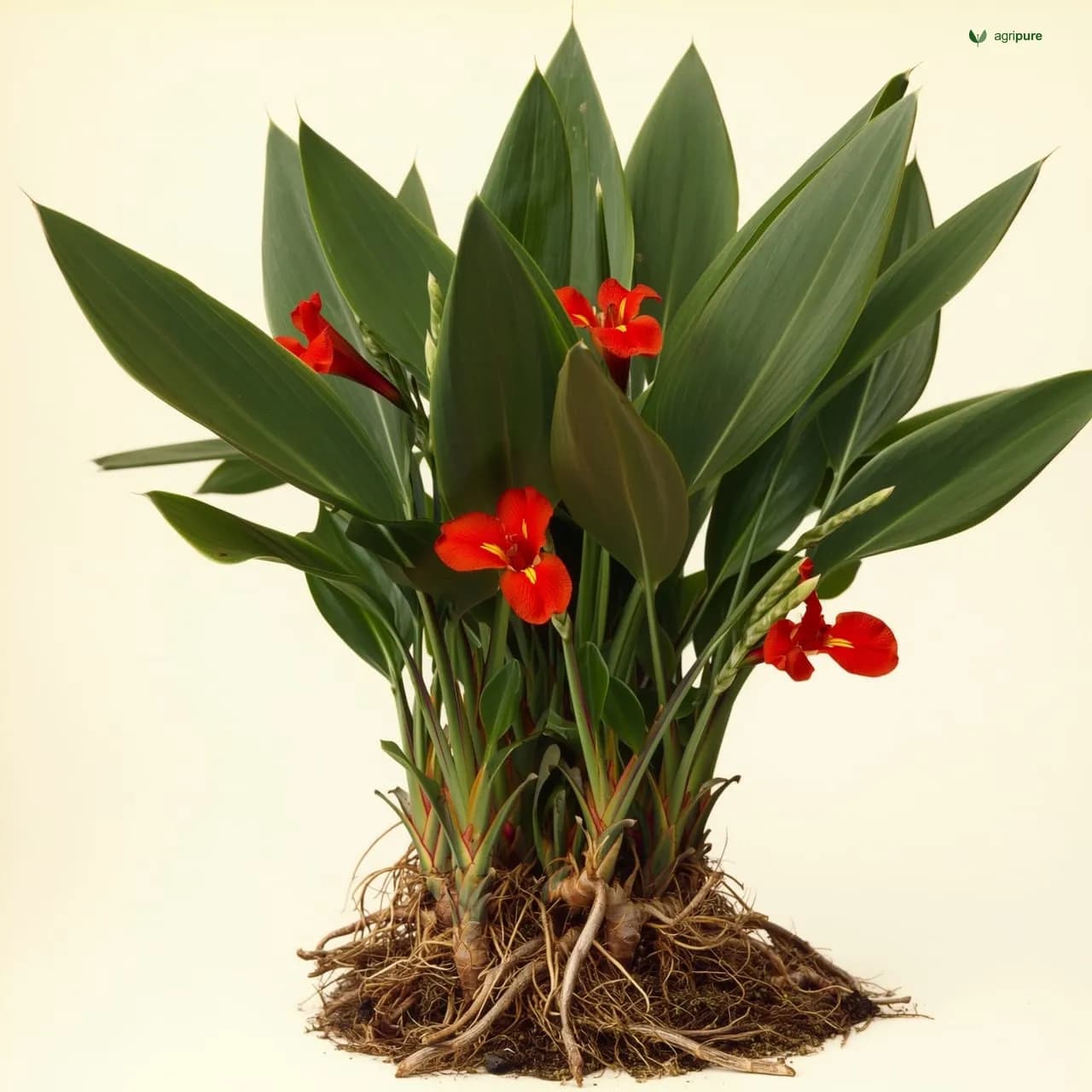
Achira is a perennial herb that grows to roughly 3 m (about 9 ft) tall and 1 m (3 ft 3 in) wide, forming dense clumps of large, entire, tropical-looking leaves; some sources describe well-grown plants reaching up to 8 ft. In edible forms the foliage is typically green and glossy, which helps distinguish it from many ornamental cannas that carry more reddish leaves. Like other cannas it bears showy flowers in terminal clusters, with colour varying by cultivar, though most growing references focus on the roots rather than the bloom. Below ground it produces large, starchy rhizomes — often loosely (and incorrectly) called bulbs — that are usually white, sometimes marked with brown or red scale leaves on the outside. Left in the ground for more than a single year, an individual rhizome can grow to nearly 3 ft (91 cm) long.
Growing edible canna
The crop is almost always propagated vegetatively from the rhizome rather than from seed. The simplest method is division: dig and split the rhizomes, making sure each piece carries at least one — preferably two — buds or growing points, and do this in spring as growth resumes. Commercially, ends of rhizomes or excised buds are planted the same way. Seed is possible but unreliable, because many edible cultivars do not set seed or do not come true from seed, especially where they have crossed with ornamental cannas. If you do raise it from seed, the hard seed coat needs help: pre-soak the seed for 24 hours in warm water and scarify it (nick or abrade the coat). Sow 2–5 cm deep in pots in a warm greenhouse at about 20 °C in late winter, expect germination over roughly 3–9 weeks, grow the seedlings on under protection through at least their first winter, and plant out only after the last frost.
One of achira’s best traits for low-input growing is its lack of fuss about soil. It thrives in poor soils and even waterlogged conditions, tolerating low fertility and heavy, wet ground that rots most tubers, and the rhizomes can sit underground for years without becoming too woody to use. It is frost-tender, hardy to roughly UK zone 8; where the ground does not freeze significantly it grows as a true perennial root crop, resprouting each year, while in colder climates it is grown as a seasonal crop and the rhizomes are lifted and stored over winter, just as gardeners overwinter ornamental cannas. It is described as growing well across much of the warmer United States wherever summers are at least moderately wet.
Harvest and uses
Achira is a long-season crop: the rhizomes bulk up over time, and a plant left growing for more than one year produces the largest roots, up to nearly a metre long. Because the rhizomes keep well in the ground without going woody, there is no rush to dig the whole clump at once — lift sections as needed. The harvest is used much like other starchy roots: the rhizomes are treated similarly to arrowroot and potatoes, and the species is grown above all as a food source. The sources note that the rhizomes, and the shoots, are best cooked rather than eaten raw, both for digestibility and palatability. Beyond the kitchen it doubles as a striking ornamental, its large tropical foliage and showy flowers earning a single planting its place as both a staple-style root crop and a structural garden plant.
Safety and cautions
Edible canna is broadly edible with no documented inherent toxicity, which sets it apart from many root crops. The sources are clear that the real risks are practical rather than chemical:
- Misidentification is the main hazard. Because achira looks like other cannas, the chief safety concern flagged in the literature is correctly identifying the plant before eating any part of it — make sure you have an edible cultivar, not a look-alike.
- Cook before eating. The rhizomes and shoots should be cooked for best digestibility; they are not intended to be eaten raw.
- Buy known edible stock. Since many ornamental cannas are selected for flowers rather than roots and edible forms may have crossed with them, start from named edible material rather than generic ornamental rhizomes.
Sources
- Canna edulis – Plants For A Future (PFAF)
- Canna (Canna edulis) – Tropical Self Sufficiency
- Perennial Food Crops – Occidental Arts & Ecology Center (OAEC)
- How to Grow Achira (Canna edulis) – Cultivariable