climax
Himalayan Elm
kain / manu
Ulmus wallichiana
Also known as Kain (Pakistan).
- kpk hills
International hardiness
- USDA 5-9
- RHS H6
- AU: Cool temperate
Where it grows — regional guide
| Zones / rating | Regional notes |
|---|---|
USDA 5-9 | No region-specific data yet |
| Zones / rating | Regional notes |
|---|---|
H6 (-20 to -15C) | Hardy to RHS H6 as a rare specimen tree for cool temperate parklands; plant for conservation value, as native Himalayan populations are red-listed as vulnerable. |
| Zones / rating | Regional notes |
|---|---|
Cool temperate | No region-specific data yet |
| Zones / rating | Regional notes |
|---|---|
USDA 5-9 (USDA scale) Canada uses its own zone system; Canadian zones run roughly one lower than USDA. | No region-specific data yet |
| Zones / rating | Regional notes |
|---|---|
KPK hills | Pakistan:A valuable lopped fodder and timber tree of the KPK hills; manage lopping cycles conservatively to allow crowns to regenerate, as wild stands are vulnerable to depletion. India:A deciduous mountain forest tree native to the western Himalaya; planted for soil conservation and nutritious winter fodder, but wild trees are vulnerable to over-lopping. |
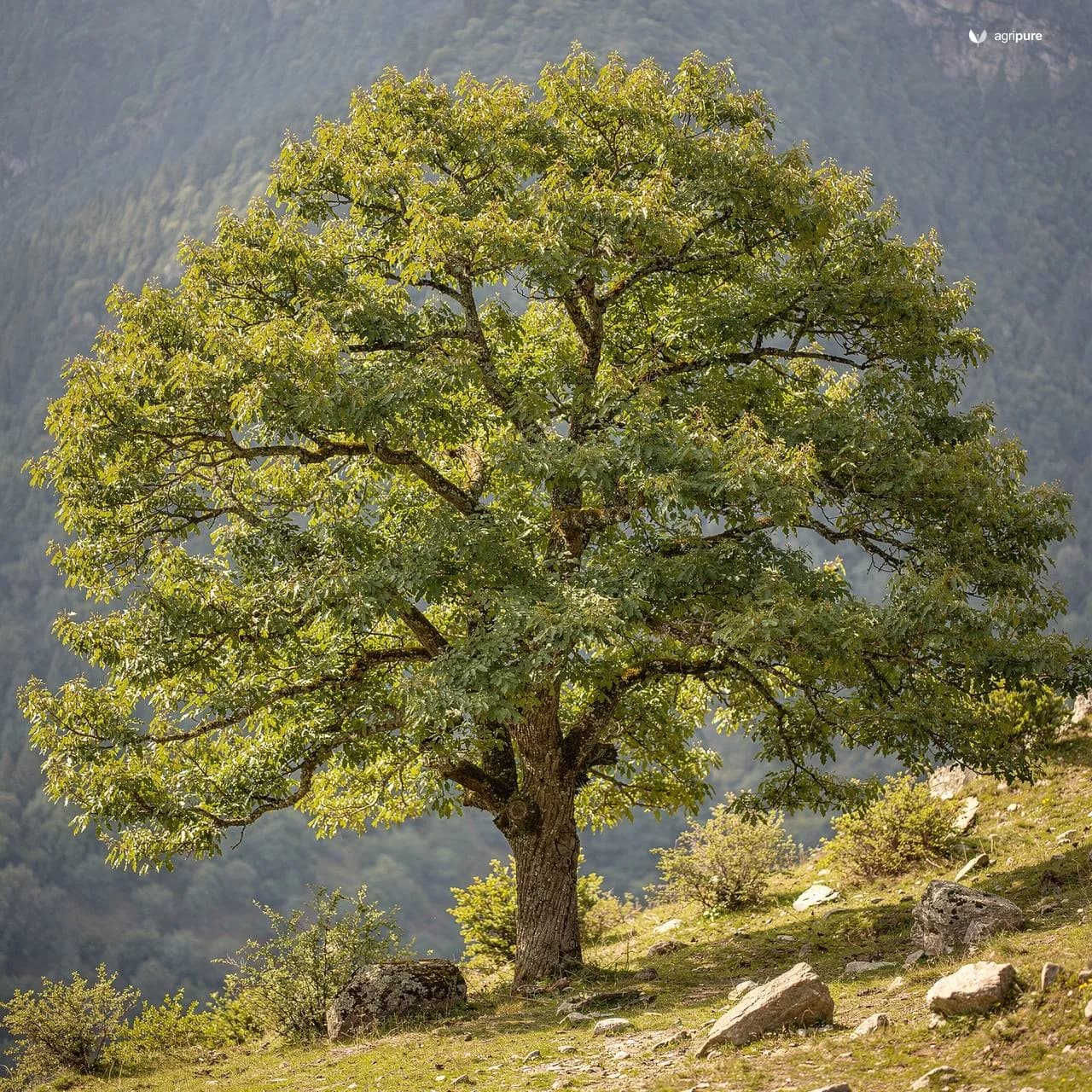
Himalayan elm (Ulmus wallichiana, locally kain or manu) is one of the most important lopped fodder trees of the northern hills, valued across the KPK ranges for the rich winter browse its crown gives and for a tough wood used in farm implements. On a syntropic site it is a climax canopy tree, slow and long-lived, planted for the long structure of the forest. Its standout return is fodder, with durable timber and good fuelwood alongside.
Where it thrives
Himalayan elm is a mountain tree of the western Himalaya, ranging from central Nuristan in Afghanistan through northern Pakistan and northern India to western Nepal, at elevations of roughly 800 to 3,000 m. It grows in the moist temperate hill forest on deep soils, often as scattered trees on farmland and field boundaries as much as in closed forest, because farmers have long kept it for the browse it gives. In Pakistan that places it across the KPK hills and the wider northern mountain belt, where it has long been a fixture of farm and forest alike. It is hardy to the cold of these elevations and holds the deeper, moister hill ground well.
Role in the system
Treat Himalayan elm as a climax canopy tree set to inherit the top stratum over a long horizon. It is long-lived, so its role is to hold the site and shelter the understorey once the faster pioneers have done their early work. Its broad crown gives shade and a wind barrier across a slope, and it withstands the heavy lopping it is traditionally subjected to, which makes it both a canopy tree and a renewable browse bank in the same planting. Feeding trials have gone as far as drying the leaf into a meal and using it to replace part of the concentrate ration of sheep, a measure of how seriously the foliage is rated as feed rather than a famine fallback. Its roots help anchor soil on the hill ground it grows on.
Uses
Fodder is the first return, and the reason the tree is so heavily relied on. It is regularly lopped for leaf-fodder across the northern hills, and the foliage is highly nutritious, carrying crude protein of around 20%, a genuine winter supplement for ruminants. The timber is tough and put to many uses, from vehicle stock and furniture to ploughs, oil-presses, sandals, and musical instruments, and the wood is also fuel. Across a year the same tree supplies winter browse, durable wood for tools and building, and firewood.
Cautions
The warning is in its status. Heavy use for fodder, fuel, farm implements, ropes, and building has left Himalayan elm depleted in parts of its range, and it is now classed as vulnerable on the IUCN Red List. On a planting it needs a lopping cycle light enough to let crowns recover, and seed should come from healthy cultivated or local trees rather than from pressured wild stands.
Sources
- Wikipedia contributors. “Ulmus wallichiana.” Wikipedia.
- Mughal, A. H. & Mugloo, J. A. “Elm (Ulmus wallichiana): a vulnerable lesser known multipurpose tree species of Kashmir valley.”
Sourcing notes
Raise from seed sown fresh in spring, or from cuttings; given its vulnerable status, take propagation material from healthy farm-grown or local trees rather than wild stands. Seedlings establish well on deep, moist hill soils.