secondary
Okra
bhindi
Abelmoschus esculentus
Also known as Bhindi (Pakistan), Lady's Finger (India).
- punjab plains
- sindh coast
- pothohar
International hardiness
- USDA 10-11
- RHS H1c
- AU: Tropical, Subtropical, Warm temperate
Where it grows — regional guide
| Zones / rating | Regional notes |
|---|---|
USDA 10-11 | Grown as a summer annual across warm zones, where it needs hot weather to produce pods after the last frost. |
| Zones / rating | Regional notes |
|---|---|
H1c (5 to 10C) | Tender under RHS H1c: it needs heated glass or a warm polytunnel through summer to set pods in cool conditions. |
| Zones / rating | Regional notes |
|---|---|
Tropical, Subtropical, Warm temperate | Grown as a summer annual in warm-temperate and subtropical gardens, setting pods through the hottest weather. |
| Zones / rating | Regional notes |
|---|---|
USDA 10-11 (USDA scale) Canada uses its own zone system; Canadian zones run roughly one lower than USDA. | Grown as a short-season summer annual in warm inland valleys; it requires warm soil after late spring frosts to produce pods. |
| Zones / rating | Regional notes |
|---|---|
Punjab plains, Sindh coast, Pothohar | Pakistan:Grown as a warm-season summer vegetable across the plains and Pothohar; it needs frost-free heat to set pods. India:Grown across tropical and subtropical plains as a warm-season vegetable through summer and the monsoon. |
Grows alongside
Species that appear with Okra in 64 of our published guides — a starting list for a guild, not a planting plan.
Okra (Abelmoschus esculentus) is a warm-season annual in the mallow family, grown for its immature green pods, which are edible and widely used as a vegetable. It is adapted to hot, frost-free climates and is typically grown as a summer annual across a wide range of zones. The precise native range is uncertain because of long cultivation, with proposed centres of origin including northern India, eastern or western Africa, and Southeast Asia; a broader review describes it as a crop native to Africa that is now grown in tropical, subtropical, and warm-temperate regions across Africa, Asia, southern Europe, and the Americas. For the home grower it is a tall, single-season vegetable that earns its place by producing through the heat of summer.
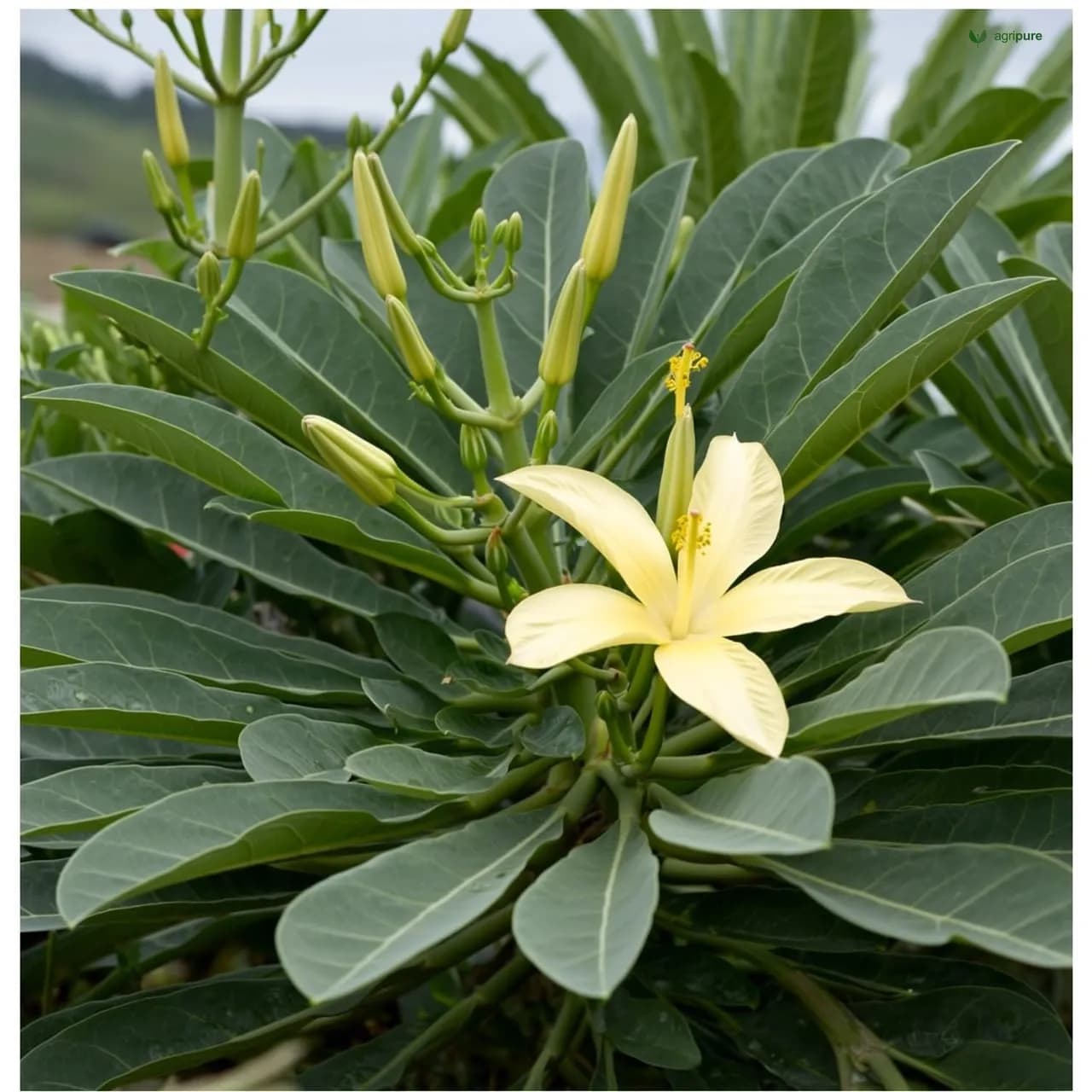
The plant is an annual, erect herb, typically about 2 metres tall but capable of reaching up to 5 metres in favourable conditions. Its stems are succulent, light green, and relatively thick, roughly half an inch to an inch (about 1.3 to 2.5 cm) in diameter. The leaves are alternate, dark green, and palmately lobed with five to seven lobes, four to eight inches (10 to 20 cm) across, and hairy or velvety with prominent veins; they are characteristically slimy when crushed, as is typical of the mallow family. The flowers are hibiscus-like and funnel-shaped, with three to five united sepals, five separate petals, and numerous stamens fused into a column around the pistil, and are typically yellow with a dark, often purple, centre.
Growing Okra
Okra prefers tropical and subtropical climates, is heat and drought tolerant, and does best in fertile, moist, well-drained soils. It is frost-sensitive and is killed or badly damaged by frost, so it is grown as a summer annual. Duke Gardens lists okra as a summer annual across USDA Zones 2 to 11, and perennial only in Zones 10 to 11 where winters are frost-free. In practical homestead terms, it can be grown wherever summers are long, hot, and frost-free, even in colder zones, as long as the growing season is warm enough.
Okra thrives in full sun and craves plenty of warm weather. For soil, it grows in a range of soil types but does best in a fertile, moist, well-drained substrate with good drainage. It benefits from moist soils to support pod production while remaining relatively drought tolerant once established.
The primary method of propagation is direct seeding: okra is sown from seed and produces flowers followed by edible pods. The seeds are moderately sized, about 5 millimetres, and globose, oval, or D-shaped, which makes them easy to handle when planting directly in prepared beds or field rows.
Harvest and uses
The fruit harvested as the vegetable is botanically a capsule. Pods are elongated, ribbed, straight to slightly curved, and taper to a blunt point, generally about 10 to 30 cm long and 1 to 4 cm in diameter, usually with five to six chambers containing numerous seeds. The pod surface is often fuzzy, and the interior is distinctly mucilaginous, or slimy, the quality that gives okra its characteristic texture in cooking. The immature green pods are the part eaten and are widely used as a vegetable.
Identifying okra
Okra is straightforward to recognise once flowering and fruiting. Look for an erect annual herb up to about 2 metres tall, with thick, succulent, light-green stems and large, dark-green, palmately five- to seven-lobed leaves that feel hairy and turn slimy when crushed. The hibiscus-like yellow flowers with a dark purple centre and the fused staminal column are diagnostic of the mallow family, and the ribbed, tapering, fuzzy seed capsule confirms the identification. The seeds themselves are inflated and globose, oval, or kidney-shaped, about 5.4 mm long and 5.0 mm wide.
Sources
- Royal Botanic Gardens, Kew. “Abelmoschus esculentus (L.) Moench.” Plants of the World Online.
- National Center for Biotechnology Information. Review on Abelmoschus esculentus (Okra). PMC.
- Duke Gardens. “Okra.” Duke Gardens Garden Talk.
- SeedID Guide. “Abelmoschus esculentus (L.) Moench” fact sheet.
- McClung Museum, University of Tennessee. “Plant of the Month: Okra.”
- Growables. “Okra (Abelmoschus esculentus).”
- PictureThis. “Abelmoschus esculentus.”