Key takeaways
Oyster mushrooms growing in clusters out of a plastic sawdust substrate fruiting bag.
Home cultivation of gourmet oyster mushrooms on pasteurized agricultural waste substrates.
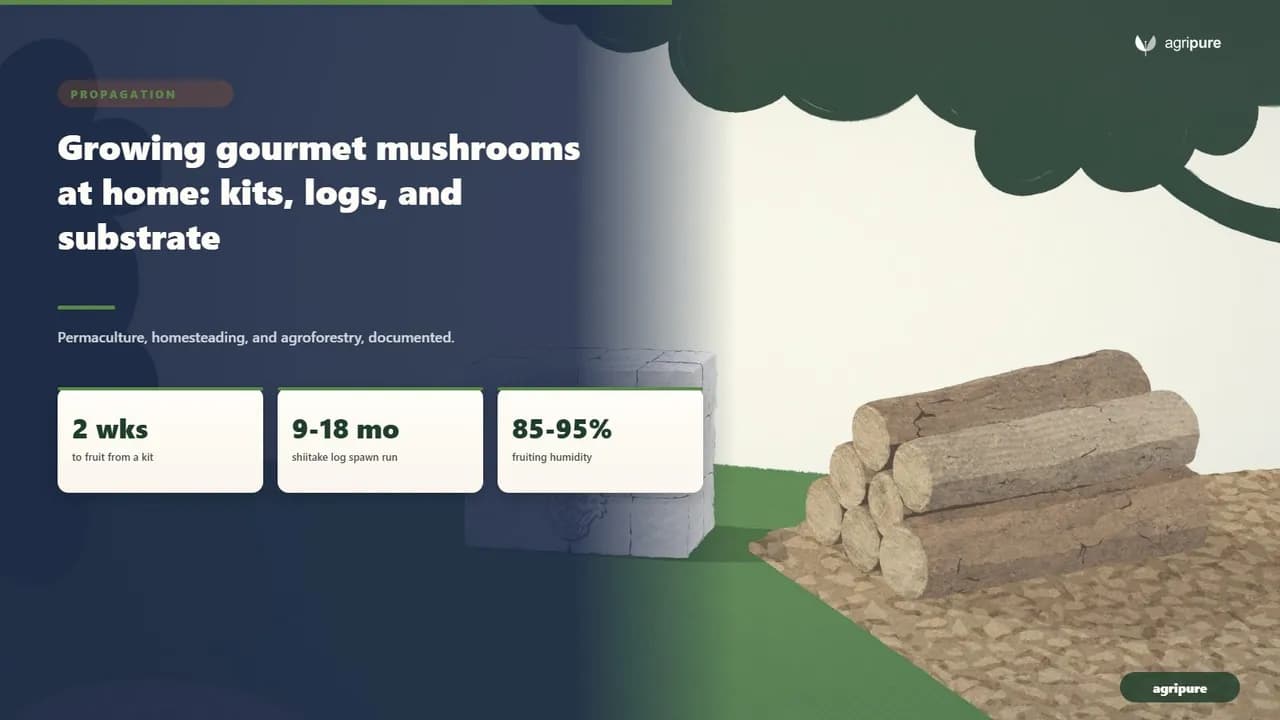
- The easiest way to start growing mushrooms is a ready-made kit: a pre-colonized oyster block fruits within about 2 weeks of opening and yields roughly half a pound to 2 pounds on its first flush, with just a few mists of water a day.
- Outdoors, hardwood logs and a wood-chip bed are the lowest-maintenance route. Shiitake plug-spawned into oak logs starts fruiting in 9 to 18 months and a single bolt produces for 2 to 3 years; wine cap in a wood-chip bed needs no pasteurizing and fruits in 2 to 6 months.
- Oyster, shiitake, lion’s mane, and wine cap are the beginner gourmet species. Each wants cool fruiting temperatures (most between 60 and 70 degrees F), high humidity (85 to 95%), fresh air, and indirect light.
- Substrate is half the game. Bulk substrates like straw need only pasteurizing at about 165 degrees F for 1 to 2 hours, while nutrient-rich grain spawn must be fully sterilized in a pressure cooker at 121 degrees C (15 psi).
- Contamination (usually green mold, Trichoderma) is the real beginner hurdle, not temperature charts. It almost always traces to weak sterilization or dirty hands, so cleanliness beats every other variable.
A blue oyster kit on the kitchen counter can put half a pound of mushrooms on your cutting board 2 weeks after you cut open the bag, and an oak log stacked in the shade can feed you every fall for 3 years. Growing mushrooms at home spans that whole range — from a 20 dollar box you mist twice a day to a sterile grain-spawn lab you build in a closet. This guide ranks the methods by difficulty, names the gourmet species worth starting with, and is honest about the one thing that trips up almost every beginner: contamination. Every number here (fruiting temperatures, days to colonize, pasteurization specs, realistic yields) traces to a university extension program, a peer-reviewed study, or a working cultivator’s published protocol. None of it covers psychedelic species; this is strictly about edible and medicinal mushrooms you can cook.
Start with a grow kit: mushrooms in two weeks
If you have never grown a mushroom, buy a kit. A ready-made grow kit is a block of substrate that a supplier has already inoculated and fully colonized, so the hard, contamination-prone work of the first 2 to 3 weeks is done. You cut a slit in the bag, mist it, and watch. It is the single best way to learn what healthy fruiting looks like before you risk your own substrate.
The numbers make the case. North Spore, a major US spawn supplier, guarantees its kits will fruit within 2 weeks of setup, and a first flush of an oyster block produces anywhere from half a pound to 2 pounds of mushrooms. After that first flush you will usually get a second, third, and sometimes a fourth or fifth, each a little smaller as the block burns through its nutrients. Maintenance is genuinely trivial: mist the cut face 2 to 3 times a day, about 5 to 10 sprays each time, to hold humidity around the forming mushrooms.
What a kit teaches you
A kit is a teaching tool disguised as a grocery shortcut. Watching one fruit shows you the rhythm every later method follows:
- Pins to harvest is fast. Once tiny mushrooms (pins) appear, most kits are ready to cut in a few days. Oyster mushrooms in particular race from pin to full cluster.
- Light matters, a little. Mushrooms are not plants and do not photosynthesize, but most gourmet species need indirect light to trigger and orient fruiting. A kit on a kitchen counter out of direct sun is perfect.
- Air matters more than people expect. A block sealed in a still, stuffy cupboard grows long, leggy stems and small caps — the classic sign of too much carbon dioxide and too little fresh air.
The honest limitation: a kit is a one-block dead end. It teaches fruiting, not the colonization and sterilization that decide success at every larger scale. Once your kit has finished, the natural next step is outdoors, where nature does the climate control for free.
Grow mushrooms outdoors on logs and wood chips
Outdoor cultivation is the most forgiving way to scale up, because the climate is free: the weather supplies the humidity, the 10- to 20-degree temperature swings, and the fresh air that you would otherwise engineer indoors. Two methods dominate for the home grower: hardwood logs for shiitake and oyster, and wood-chip beds for wine cap. Both fit naturally into a food forest or the shady, unproductive corners of a yard.
A stack of inoculated hardwood shiitake logs leaning against a frame in dappled woodland shade, drilled holes sealed with pale wax, oyster mushrooms fruiting from a log end
Shiitake and oyster on logs
Log cultivation is old, proven, and low-input. You inoculate fresh-cut hardwood with spawn, stack the logs in the shade, and wait. Mississippi State University Extension recommends fresh-cut hardwood logs 4 to 8 inches in diameter and 18 to 36 inches long, though limbs 4 to 6 inches across and 2 to 3 feet long are easiest to handle. The best species are oak, sweetgum, beech, hophornbeam, hornbeam, or persimmon — dense hardwoods that hold moisture and resist competing fungi.
The mechanics are the same whether you use dowel-plug spawn or sawdust spawn. Dowel plugs need a 5/16-inch (8.5 mm) hole drilled 1 to 1.5 inches deep; sawdust spawn wants a slightly wider 12 to 12.5 mm hole. Cornell Small Farms specifies about 40 holes per log, in rows roughly 6 inches apart along the log with the holes about 2 inches apart and staggered into a diamond pattern, so the mycelium colonizes the whole bolt evenly. You hammer in the spawn, seal each hole with wax, and stack the logs in about 60% shade near a water source.
Then comes the patience. Cornell notes the spawn run takes 9 to 18 months of outdoor exposure, with winter and spring inoculations ideal. Fruiting begins on its own when temperatures drop to 60 degrees F or below and the rains come, roughly October to January. The second and third flushes are the most productive, and a single bolt stays fruitful for 2 to 3 years depending on its size. If you do not want to wait for rain, you can force a flush: Mississippi State says soak the log in chilly water for 12 to 24 hours and it will pin within days. Realistic output is modest but reliable — Cornell’s commercial data works out to roughly a pound of mushrooms per log per year over a 3-season life.
Wine cap in a wood-chip bed
Wine cap, also called king stropharia or garden giant, is the easiest outdoor mushroom there is, and it pairs beautifully with no-dig beds and pathways. The killer feature: unlike every indoor method, wine cap needs no pasteurizing or sterilizing of its substrate. You simply layer fresh hardwood wood chips and spawn.
North Spore’s protocol is to build a bed 6 to 8 inches deep, alternating about 2 inches of wood chips with a crumble of spawn, in a shaded spot. Then you wait 3 to 6 months for the bed to fully colonize before mushrooms form. Wine caps fruit between 50 and 70 degrees F, especially after heavy rain, and the caps can grow from palm-size to as big as a dinner plate. Cornell confirms the pattern: wood-chip beds can be inoculated any time in the growing season, fruit 2 to 6 months later, and a patch lasts several seasons if you top it up with fresh chips. For a homesteader who already mulches paths with wood chips, wine cap is close to free food.
Straw and coffee grounds: the cheap indoor bridge
Those outdoor methods all skip sterilizing because their substrates are low in nutrients, and that same logic powers the most popular DIY method for growing oyster mushrooms indoors: pasteurized straw or coffee grounds in a 5-gallon bucket or grow bag. This is where most people graduate from buyer to grower, because oyster mushrooms are aggressive colonizers that tolerate beginner mistakes.
The reason this method is easier than grain spawn comes down to nutrition. Straw and spent coffee grounds are relatively low in nutrients, so they only need pasteurizing, not full sterilization; you knock back competing molds without having to kill every spore. The University of Florida IFAS Extension pasteurizes straw by holding it at 165 degrees F in a water bath for 1 to 2 hours, then mixing in oyster spawn at 5 to 10% of the substrate’s weight or volume.
A clear plastic grow bag and a five-gallon bucket packed with pasteurized wheat straw fully colonized white with oyster mushroom mycelium, young grey oyster clusters emerging from holes
Colonizing and fruiting a straw bucket
After inoculation, the bag or bucket goes somewhere clean, dark, and humid. UF/IFAS incubates oyster substrate at 24 to 25 degrees C (75 to 77 degrees F) at 80 to 90% humidity, and the spawn run colonizes the straw over 2 to 3 weeks until the whole mass turns solid white with mycelium. That white block is your sign to trigger fruiting.
Fruiting flips three switches at once: a drop in temperature, a jump in humidity, and a flood of fresh air. UF/IFAS initiates oyster fruiting at the lower temperature of 20 degrees C (68 degrees F) with light and about 90% humidity, and fruiting starts roughly 3 weeks after the bags went into the dark. The same source notes that after the first flush you can expect 2 to 4 more flushes depending on the strain. The most common beginner failure here is fresh-air exchange: oyster pins that grow into long, antler-like stems with tiny caps are gasping for air. Cutting more holes and fanning the block daily fixes it.
Build a sterile setup with grain spawn and substrate
Those straw and coffee-ground buckets still rely on bought spawn; the deepest end of growing mushrooms is making your own spawn and running a sterile fruiting chamber indoors. This is how you grow lion’s mane, expand 1 culture into dozens of blocks, and grow year-round across all 12 months. It is also where contamination stops being an annoyance and becomes the whole game.
Grain spawn is cooked grain (rye, millet, or wild bird seed) colonized by mushroom mycelium, used to inoculate a larger bulk substrate. Because grain is so nutritious, it is irresistible to mold and bacteria, so it must be fully sterilized, not merely pasteurized. The standard is a pressure cooker at 121 degrees C (15 psi), commonly for about 90 minutes, which is hot enough to kill spores deep inside the kernels. Skip or shorten that step and you are effectively incubating contaminants alongside your mushroom.
Why sterilization and substrate choice decide the outcome
The split between pasteurizing and sterilizing is the most important concept in indoor cultivation, and it follows directly from nutrient density:
- Low-nutrient bulk substrates (straw, coffee grounds, hardwood sawdust supplemented lightly) need only pasteurizing: heat to roughly 150 to 165 degrees F for an hour or two, or a cold lime bath. Penn State’s commercial steam-off, for scale, runs no lower than 150 degrees F for at least 12 hours.
- High-nutrient substrates (grain spawn, heavily supplemented sawdust, agar) demand full sterilization at 121 degrees C under pressure. There is no shortcut, because the same nutrition that fuels fast mushroom growth fuels even faster mold.
Substrate choice also sets your ceiling on yield, measured as biological efficiency (the fresh weight of mushrooms as a percentage of the dry substrate weight). The figure varies enormously. A peer-reviewed 2022 study in Foods measured oyster mushrooms at just 22.72% biological efficiency on a plain wheat-straw control, with a roughly 31-day cycle from inoculation to harvest, while richer or supplemented substrates pushed efficiency far higher. The practical lesson: the substrate you choose matters as much as the species.
The contamination learning curve nobody warns you about
That sterile grain-spawn work raises one risk above all others: your first 2 or 3 attempts at growing mushrooms indoors will probably get contaminated, and it will not be because you misread a temperature chart. It will be green mold.
Trichoderma, the green mold, is the beginner’s nemesis. A peer-reviewed 2015 review in the Brazilian Journal of Microbiology describes it bluntly as a cellulolytic fungus that frequently contaminates mushroom substrates, shows up early during the spawn-run period, and causes huge losses across oyster, shiitake, and button-mushroom cultivation alike. It looks like a patch of white mold that turns powdery green, and once it takes hold it outcompetes your mycelium for the same food.
Green mold is a hygiene problem, not bad luck. Trichoderma that shows up in the first week almost always means the grain was under-sterilized or the inoculation was dirty. Before you adjust a single temperature or humidity setting, fix the basics: pressure-cook grain the full 90 minutes, let jars cool sealed, wipe everything with 70% alcohol, and work in the stillest, cleanest air you can find. Cleanliness is the master variable.
How to lose the fight, and how to win it
Contamination is almost always a hygiene failure, not bad luck. Green mold that appears in the first 7 days traces directly to incomplete sterilization or a dirty inoculation. The defenses are unglamorous and they work:
- Sterilize fully and cool completely. Pressure-cook grain the full 90 minutes and let jars cool before you open them; opening hot jars sucks in airborne spores.
- Work clean. Wipe surfaces and hands with 70% isopropyl alcohol, work in front of a still-air box or in the cleanest, least drafty room you have, and flame-sterilize any tools.
- Inoculate fast and seal. The longer a substrate sits open to the air, the more spores land on it. Move quickly and close the bag.
- Throw out the losers. A bag going green is not salvageable. Bag it and bin it before it sporulates and seeds your next batch.
Lower-nutrient outdoor methods dodge most of this, which is exactly why kits, logs, and wine-cap beds sit at the easy end. Sterile indoor work is the most productive method and the least forgiving; expect to fail 2 or 3 times before it clicks.
Pick the right beginner species
Some of that difficulty is avoidable by choosing the right mushroom: not every gourmet species is a fair fight for a first-timer, and just 4 of them do most of the beginner growing. Matching the species to your method is half of succeeding, so the numbers below are fruiting conditions, the stage where home growers have the most control.
Species | Best method | Fruiting temp | Humidity | Time to fruit | Difficulty |
|---|---|---|---|---|---|
Oyster (Pleurotus) | Kit, straw, coffee grounds | ~68 degrees F | 80 to 90% | 2 to 6 weeks | Easiest |
Wine cap (Stropharia) | Outdoor wood-chip bed | 50 to 70 degrees F | Outdoor / rain | 2 to 6 months | Easy |
Shiitake (Lentinula) | Hardwood logs | 60 degrees F or below | Outdoor / soak | 9 to 18 months | Easy, slow |
Lion’s mane (Hericium) | Sterile sawdust block | 60 to 70 degrees F | 85 to 95% | 4 to 6 weeks | Moderate |
Button / cremini (Agaricus) | Composted manure + casing | ~60 degrees F | High | ~14 weeks | Hardest |
Oyster, shiitake, lion’s mane, and wine cap
- Oyster (Pleurotus). The beginner’s mushroom. Fast, aggressive, forgiving of contamination, and happy on straw, coffee grounds, or a kit. Fruits around 68 degrees F at about 90% humidity with plenty of fresh air. Start here.
- Shiitake (Lentinula edodes). The classic log mushroom. Slow to establish (9 to 18 months) but then productive for 2 to 3 years, fruiting when temperatures fall to 60 degrees F or below. Low effort once the logs are colonized.
- Lion’s mane (Hericium erinaceus). A toothed, brain-like medicinal mushroom grown almost entirely on supplemented hardwood sawdust. Colonizes in about 2 to 3 weeks and fruits cool, around 60 to 70 degrees F at 85 to 95% humidity. It browns if hit by water droplets, so mist around it, never on it.
- Wine cap (Stropharia rugosoannulata). The outdoor garden giant. No sterilizing, fruits 50 to 70 degrees F in a wood-chip bed, and makes dinner-plate caps. Best paired with an existing garden.
A white cascading lion's mane mushroom fruiting from a colonized hardwood sawdust block inside a humid indoor grow tent, with grey oyster clusters on a second block nearby
Button and cremini mushrooms (the supermarket standard, Agaricus bisporus) are technically growable at home but are the hardest of the lot. They need composted manure substrate and a casing layer, and Penn State’s commercial cycle runs about 14 weeks from composting to final harvest, with picking over 2 to 4 days on a 7- to 10-day cropping cycle. Most home growers skip them in favor of oyster and shiitake.
Indoor versus outdoor, and realistic yields
That choice of species runs alongside a second choice (indoor versus outdoor), which is a tradeoff between control and convenience. Indoors, you set the temperature, humidity, and air, so you grow across all 12 months and harvest in 2 to 6 weeks, but you fight contamination and pay for the climate control. Outdoors, the seasons do the work for free and contamination is rare, but you harvest on nature’s schedule, mostly in the cool, wet shoulder seasons.
| Indoor (kit, straw, grain spawn) | Outdoor (logs, wood-chip beds) |
|---|---|---|
Climate control | You supply it | Weather supplies it |
Season | Year-round | Cool, wet shoulder seasons |
Contamination risk | High — needs sterile technique | Low |
Time to first harvest | 2 to 6 weeks | 2 to 18 months |
Best species | Oyster, lion’s mane | Shiitake, wine cap |
Those yields are where beginners most need their expectations reset. A single oyster kit gives half a pound to 2 pounds total across its flushes. A shiitake log yields roughly a pound a year for 2 to 3 years (meaningful only if you stack a dozen or more logs). A wine-cap bed can throw off heavy flushes of large mushrooms for several seasons but on nature’s timing. None of it replaces the grocery store on day 1; growing mushrooms is a slow, compounding return, much like the trees in a food forest. When a block or bed is finally spent, do not waste it; work the spent substrate into the compost, where the residual mycelium keeps breaking down and feeds your garden beds.
The takeaway
Realistic yields make the point that growing mushrooms at home is best learned from the easy end inward, over a season or 2. Start with a kit and learn what healthy fruiting looks and smells like. Move outdoors to shiitake logs and a wine-cap bed, where the climate is free and contamination is rare. Only then build a sterile indoor setup with grain spawn, where the payoff is year-round lion’s mane and oyster but the price is real hygiene discipline. Match the species to the method (oyster on straw, shiitake on logs, lion’s mane on sterile sawdust, wine cap in chips), give every fruiting the cool 60-to-70-degree temperatures, 85 to 95% humidity, fresh air, and indirect light it wants, and treat cleanliness as the master variable. The first green-mold failure is a rite of passage, not a verdict. Inoculate 1 log or open 1 kit this month, and you will understand more about fungi by next season than any chart can teach.
Frequently asked questions
What is the easiest way to start growing mushrooms at home?
A ready-made grow kit is by far the easiest. The substrate is already inoculated and colonized, so you only manage fruiting: cut the bag, mist it 2 to 3 times a day, and keep it out of direct sun. Most oyster kits fruit within 2 weeks and yield half a pound to 2 pounds on the first flush. After a kit, the next-easiest steps are an outdoor wine-cap wood-chip bed or shiitake logs, both of which let the weather handle humidity and air.
How long does it take to grow mushrooms?
It depends entirely on the method. A grow kit fruits in about 2 weeks. A pasteurized straw bucket of oyster mushrooms colonizes in 2 to 3 weeks and fruits roughly 3 weeks after that. A wine-cap bed takes 3 to 6 months. Shiitake logs are the slow ones: 9 to 18 months of spawn run before the first flush, after which a log produces for 2 to 3 years.
Why does mushroom substrate need to be pasteurized or sterilized?
Because mushroom mycelium has to outcompete mold and bacteria for the same food. Low-nutrient substrates like straw and coffee grounds only need pasteurizing (about 165 degrees F for 1 to 2 hours) to knock back competitors. Nutrient-rich grain spawn must be fully sterilized in a pressure cooker at 121 degrees C (15 psi) for around 90 minutes, because the same nutrition that grows mushrooms fast grows green mold even faster.
What fruiting conditions do gourmet mushrooms need?
Most beginner gourmet species want four things: cool temperatures (commonly 60 to 70 degrees F, with oyster initiating near 68 degrees F), high humidity (85 to 95%), steady fresh-air exchange, and indirect light to trigger and orient the caps. Too little fresh air produces long, leggy stems with small caps, and too little humidity dries out the pins before they develop.
Why do my home-grown mushrooms keep getting moldy?
Almost always contamination by Trichoderma, the green mold, and almost always a hygiene problem instead of bad luck. It appears as white mold turning powdery green and outcompetes your mycelium. Green mold in the first week points to incomplete sterilization or a dirty inoculation. Sterilize grain the full time, let jars cool before opening, work clean with 70% alcohol, inoculate quickly, and discard any contaminated bag immediately so it cannot spread spores.
References
- University of Florida IFAS Extension. “D.I.Y. FunGuide: Grow Your Own Oyster Mushrooms at Home” (SL448/SS662). ask.ifas.ufl.edu
- Cornell Small Farms Program. “Methods of Commercial Mushroom Cultivation in the Northeastern US: Inoculating Logs.” smallfarms.cornell.edu
- Mississippi State University Extension. “Shiitake Production on Hardwood Logs.” extension.msstate.edu
- Cornell Small Farms Program. “Mushrooms: Outdoor Production.” smallfarms.cornell.edu
- Penn State Extension. “Mushrooms: Production and Harvesting.” extension.psu.edu
- Colavolpe, M.B., Mejía, S.J., & Albertó, E. “Efficiency of treatments for controlling Trichoderma spp during spawning in cultivation of lignicolous mushrooms.” Brazilian Journal of Microbiology, 45(4), 1263-1270 (2015). ncbi.nlm.nih.gov
- Zhou, F., Hansen, M., Hobley, T.J., & Jensen, P.R. “Valorization of Green Biomass: Alfalfa Pulp as a Substrate for Oyster Mushroom Cultivation.” Foods, 11(16), 2519 (2022). ncbi.nlm.nih.gov
- North Spore. “Spray & Grow Kit Frequently Asked Questions.” northspore.com
- North Spore. “Species Spotlight: Wine Cap (King Stropharia).” northspore.com
- BootstrapBee. “Lion’s Mane Fruiting Conditions (Temperature & More).” bootstrapbee.com