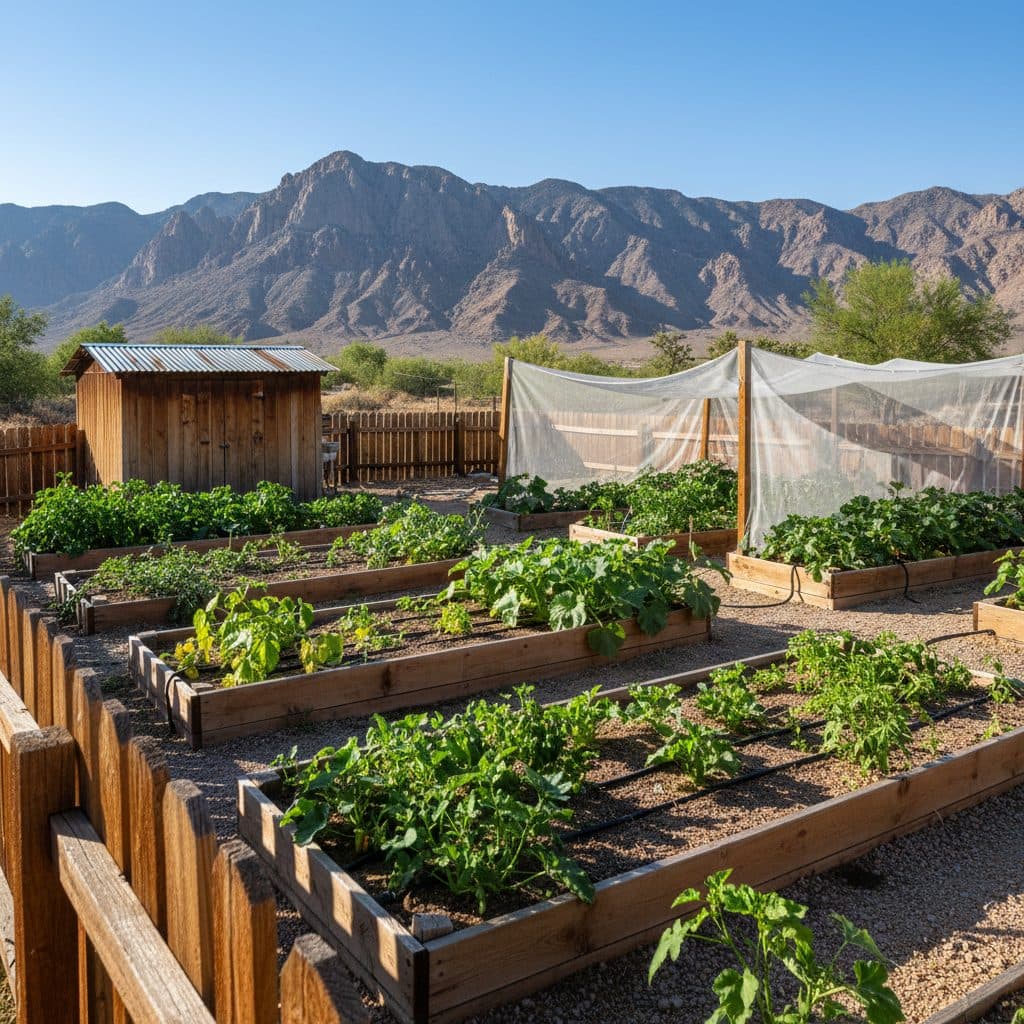
A desert vegetable garden in a US homestead with raised beds, drip irrigation lines, and a partial shade cloth structure against arid mountains.
Key takeaways
- Select heat-tolerant, drought-resistant vegetable varieties suited for USDA zones 8-10, such as Southern peas and okra.
- Implement advanced water conservation strategies like drip irrigation and deep mulching to reduce water use by 30% to 50%.
- Focus on building healthy, organic soil with compost and amendments to improve water retention and nutrient availability by 20,000 gallons per acre.
- Provide shade protection for plants during intense summer heat, especially when temperatures exceed 95°F, to lower soil temperatures by 10°F to 15°F.
- Plan planting schedules around cooler seasons, typically from late fall to early spring, avoiding the extreme heat of June, July, and August in arid regions.
- Utilize raised beds and containers to gain better control over soil composition and drainage in areas with poor native soil.
Quick answer: To grow resilient vegetables in USDA zone 8 deserts, select heat-tolerant varieties, implement advanced water conservation like drip irrigation and mulching, build healthy organic soil, and provide shade protection during intense heat.
Gardening in the American Southwest, particularly in places like Phoenix, Arizona, or Las Vegas, Nevada, presents a unique set of challenges that can deter even experienced growers. With summer temperatures regularly exceeding 100°F for weeks on end and annual rainfall often less than 10 inches, the desert environment demands a different approach to cultivation [1, 2]. The soil itself is frequently sandy or caliche-laden, lacking the organic matter needed for water retention and nutrient cycling.
Growing a productive vegetable garden in an arid climate requires understanding the specific conditions of your USDA zone (whether zone 8, 9, or 10) and adapting your methods to regional conditions. This means selecting appropriate plant varieties, implementing precise water management, and diligently building healthy soil from the ground up.
Understanding your desert environment
Before planting, gardeners must understand the specific environmental factors at play in an arid climate garden. Regions like the Sonoran Desert, for instance, receive an average of 3 to 15 inches of rain annually, a stark contrast to the 30 to 50 inches seen in more humid climates [3]. This scarcity of water dictates nearly every gardening decision. Furthermore, summer temperatures can soar above 100°F for extended periods, often reaching 115°F or higher in July and August, which can scorch tender plants and evaporate precious moisture rapidly [2].
The unique challenges of arid lands
Beyond heat and drought, desert soils often present their own difficulties. Many arid soils contain less than 1% organic matter, significantly lower than the 3% to 6% found in fertile agricultural lands, limiting their ability to hold water and nutrients [4]. High alkalinity, with pH levels often above 7.5, can lock up micronutrients and make them unavailable to plants. Strong, persistent winds are another factor, desiccating plants and eroding topsoil. Addressing these challenges requires a strategic, multi-faceted approach, focusing on resilience and conservation from the outset.
- Extreme temperatures: Summer highs frequently above 100°F.
- Low rainfall: Annual precipitation often below 10 inches.
- Poor soil quality: Low organic matter, high alkalinity.
- Intense sunlight: High UV index and direct sun exposure.
- Persistent winds: Increased evaporation and plant stress.
Dark compost incorporated into sandy desert soil in a raised garden bed.
Building resilient soil from sand
The foundation of any successful desert garden is healthy soil. Given that native desert soils often lack organic matter and struggle with water retention, significant amendment is usually necessary. Starting with raised beds or large containers can provide an excellent way to control your soil composition from the beginning, especially in areas with caliche layers that impede drainage and root growth. Aim for a soil depth of at least 12 to 18 inches for most vegetables to allow strong root development.
The foundation of desert gardening
The primary goal is to increase the soil’s organic matter content, which acts like a sponge, holding water and nutrients. Incorporating generous amounts of compost, well-rotted manure, and other organic materials like shredded leaves or straw can transform sandy soil into a more fertile medium. For instance, increasing soil organic matter by just 1% can boost water holding capacity by 20,000 gallons per acre [4]. Regular additions of organic fertilizers support the microbial life needed for healthy soil, feeding the soil directly instead of just the plant. Consider a soil test to understand your specific pH and nutrient profile, then amend accordingly with gypsum to improve drainage or sulfur to slightly lower pH if necessary. Building living soil is a continuous process, not a one-time fix.
- Compost: Incorporate 4 to 6 inches into the top 12 inches of soil.
- Aged manure: Provides nutrients and improves soil structure.
- Cover crops: Plant during off-seasons to add biomass when tilled under.
- Mulch: Protects soil surface, retains moisture, and adds organic matter as it breaks down.
- Worm castings: Boosts microbial activity and nutrient availability.
A drip irrigation system watering a row of vegetables in a desert garden.
Water-wise irrigation strategies
Efficient water use is paramount in desert gardening, where every drop counts. Traditional overhead sprinklers are highly inefficient, losing significant amounts of water to evaporation before it even reaches plant roots. In contrast, drip irrigation systems can reduce water usage by 30% to 50% compared to overhead sprinklers, delivering water directly to the plant’s root zone [1]. Installing a drip system with emitters spaced appropriately for your plants (typically 6 to 12 inches apart for rows of vegetables) delivers precise, targeted watering.
Maximizing every drop
Beyond drip irrigation, mulching is a non-negotiable practice for desert growers. A 3 to 4 inch layer of organic mulch, such as straw, wood chips, or shredded leaves, can significantly reduce soil moisture evaporation by 25% or more, regulate soil temperature, and suppress weeds that compete for water. Another valuable tool is a soil moisture meter, which helps you determine exactly when and how much to water, preventing both overwatering and underwatering. Deep, infrequent watering encourages roots to grow deeper, making plants more resilient to drought periods. Consider collecting rainwater, if permissible in your area, to supplement your irrigation needs, especially during monsoon seasons.
- Drip irrigation: Delivers water directly to the root zone, reducing evaporation.
- Deep mulching: A 3 to 4 inch layer conserves moisture and regulates soil temperature.
- Soil moisture meters: Prevents overwatering or underwatering, optimizing water use.
- Watering schedules: Water deeply and less frequently to encourage deep root growth.
- Rainwater harvesting: Collect and store rainwater for supplemental irrigation.
A vegetable garden protected by a shade cloth structure in a sunny desert environment.
Choosing the right plants for heat and drought
The success of a desert vegetable garden largely depends on selecting varieties that are naturally adapted to heat, intense sunlight, and periods of drought. Many traditional temperate-zone vegetables struggle or fail entirely when exposed to consistent 100°F+ temperatures. Instead, focus on crops with a proven track record in arid regions, often those with origins in hot climates.
Varieties that thrive in heat
For summer planting in USDA zones 9 and 10, consider heat-loving vegetables like okra, which can produce prolifically even when temperatures exceed 95°F. Southern peas (also known as cowpeas), including black-eyed peas and purple hull peas, are exceptionally drought-tolerant and thrive in full sun. Other resilient choices include sweet potatoes, which handle heat and poor soil well, and certain varieties of eggplant and peppers. Even some desert-adapted grasses, like Desert Bunch Grass, demonstrate the kind of resilience we seek in vegetables. For cooler seasons (typically October through April), a wider range of crops, such as lettuce, spinach, carrots, and broccoli, can be grown successfully, provided they are protected from occasional frosts. Prioritize open-pollinated and heirloom varieties, as they often exhibit greater genetic diversity and adaptability to specific local conditions compared to some hybrids.
- Okra: Thrives in extreme heat, producing pods continuously.
- Southern peas: Drought-tolerant, nitrogen-fixing, and heat-loving.
- Sweet potatoes: Tolerant of heat and less-than-ideal soil conditions.
- Eggplant (some varieties): Can handle high temperatures with adequate water.
- Chili peppers: Many varieties prefer warm climates and full sun.
Protecting plants from extreme desert conditions
Even the most heat-tolerant plants need some protection from the desert’s harshest elements. The intense summer sun, with its high UV index, can cause sunburn on leaves and fruit, leading to reduced yields and plant stress. Daytime temperatures consistently above 95°F can also inhibit pollination and fruit set for many vegetable varieties, even those considered heat-tolerant.
Shade, wind, and temperature management
Providing shade is one of the most effective strategies. Installing shade cloth with 30% to 50% light reduction during the hottest months (June through September) can lower ambient temperatures around plants by 10°F to 15°F and reduce soil temperatures by a similar amount, significantly improving plant health and productivity [1]. This can be particularly beneficial for crops like tomatoes and peppers, which may stop producing in extreme heat. Simple structures made from PVC pipe or rebar can support the shade cloth. Windbreaks, such as strategically placed fences, trellises with climbing plants, or rows of taller, resilient plants like corn or sunflowers, can reduce the desiccating effects of strong winds. Consistent soil moisture through drip irrigation and mulching also helps plants withstand temperature fluctuations and wind stress. For unexpected cold snaps in winter, row covers or old blankets can provide temporary protection against frost, which can occur even in USDA zone 9 deserts.
- Shade cloth: 30% to 50% shade reduces heat stress and sunburn.
- Windbreaks: Protect plants from desiccating winds and soil erosion.
- Row covers: Offer frost protection during cooler desert nights.
- Strategic planting: Place taller plants to naturally shade shorter ones.
- Consistent moisture: Helps plants cope with temperature extremes.
Seasonal planting and harvesting in the desert
Unlike temperate climates with distinct four-season gardening, desert regions often have two primary growing seasons: a long, mild cool season and a shorter, intense warm season. Understanding this rhythm is important for maximizing yields and minimizing plant stress. In many Southwest deserts, the cool season typically runs from October through April, while the warm season spans from May to September.
Timing your garden for success
During the cool season, gardeners in USDA zones 8-10 can successfully grow a wide array of crops that would struggle in summer heat. This includes leafy greens like lettuce, spinach, kale, and Swiss chard, along with root vegetables such as carrots, radishes, and beets. Brassicas like broccoli, cauliflower, and cabbage also thrive in these milder conditions, often maturing before the intense heat arrives. For the warm season, focus on the heat-tolerant varieties discussed earlier, such as okra, Southern peas, and sweet potatoes, planting them in late spring after the danger of frost has passed, usually by mid-March in zone 9. Even then, be prepared to provide shade as summer progresses. Planning your garden around these distinct seasons ensures that plants are growing during their optimal temperature windows, leading to healthier plants and more abundant harvests. Keep a garden journal to track planting dates, harvest times, and specific variety performance in your microclimate, which can vary even within a single USDA zone.
- Cool season (Oct-Apr): Ideal for leafy greens, root vegetables, and brassicas.
- Warm season (May-Sep): Best for heat-loving crops like okra and Southern peas.
- Frost dates: Monitor local forecasts for early fall and late spring frosts.
- Succession planting: Stagger plantings of cool-season crops every 2-3 weeks.
- Harvest timing: Pick vegetables frequently to encourage continued production.
Traditional vs. Desert Gardening Approaches
Aspect | Traditional Gardening | Desert Gardening |
|---|---|---|
Water Use | Often overhead sprinklers, higher evaporation | Drip irrigation, deep mulching, 30% to 50% water reduction [1] |
Soil | Naturally fertile, high organic matter | Sandy/caliche, low organic matter (<1%), requires heavy amendment [4] |
Plant Selection | Wide range of temperate crops | Heat-tolerant, drought-resistant varieties (okra, Southern peas) |
Season | Spring/summer primary, fall secondary | Cool season (Oct-Apr) primary, warm season (May-Sep) secondary |
Protection | Minimal, occasional pest/disease | Shade cloth (30%-50%), windbreaks, frost covers [1] |
Water Reduction: Drip irrigation can reduce water usage by 30% to 50% compared to overhead sprinklers in arid climates [1].
Soil Capacity: Increasing soil organic matter by 1% can increase water holding capacity by 20,000 gallons per acre [4].
Shade Benefits: Providing 30% to 50% shade can reduce soil temperatures by 10°F to 15°F and increase vegetable yields by 20% in arid zones [1].
Frequently asked questions
What are the best vegetables for a desert garden?
For desert gardens, focus on heat-tolerant varieties like okra, Southern peas, sweet potatoes, and certain types of eggplant and chili peppers. During the cooler months from October to April, you can also grow leafy greens, carrots, and broccoli successfully in USDA zone 9.
How much water does a desert garden need?
The exact amount varies, but desert gardens require efficient watering. Drip irrigation can reduce water use by 30% to 50% compared to traditional methods [1]. Aim for deep, infrequent watering cycles, often 2-3 times per week, depending on plant needs and soil moisture readings.
Can I grow a desert garden without raised beds?
Yes, it is possible, but raised beds offer significant advantages in desert environments. They provide better control over soil composition, drainage, and can help mitigate issues with native caliche layers. If not using raised beds, you must heavily amend native soil with several inches of organic matter.
When is the best time to plant in the desert?
The primary planting season in many desert regions, such as USDA zone 9, is the cool season, from late September through early April. Heat-loving crops are planted in late spring (March-May) to mature before the most intense summer heat, which often exceeds 100°F.
How do I protect my plants from desert pests?
Desert pests can be managed through integrated pest management (IPM) strategies. This includes encouraging beneficial insects, using physical barriers like row covers, and applying organic pest controls when necessary. Healthy, resilient plants are often less susceptible to severe pest infestations.
What soil amendments are needed for desert gardening?
The primary amendment for desert soils is organic matter, such as compost and well-rotted manure. These improve water retention, nutrient availability, and soil structure. Adding 4 to 6 inches of compost to your garden beds can significantly improve soil health and water holding capacity by 20,000 gallons per acre [4].
References
- GARDENING IN THE DESERT: (2020). GARDENING IN THE DESERT:.
- Arid and Desert Climates (2020). Arid and Desert Climates.
- Desert Time: A journey through the American Southwest (1995). [Desert Time: A journey through the American Southwest](https://doi.org/10.1016/s0140-1963(05)80096-5).
- APPENDIX 4. (2023). APPENDIX 4..
- Native fishes of arid lands: A dwindling resource of the desert southwest (1991). Native fishes of arid lands: A dwindling resource of the desert southwest.
- Climate Change (2008). Climate Change.