pioneer
Phulai
phulai
Acacia modesta
Also known as Amritsar Gum (India).
- pothohar
- balochistan highlands
- kpk hills
International hardiness
- USDA 9-11
- RHS H2
- AU: Arid / semi-arid, Subtropical
Where it grows — regional guide
| Zones / rating | Regional notes |
|---|---|
USDA 9-11 | No region-specific data yet |
| Zones / rating | Regional notes |
|---|---|
H2 (1 to 5C) | No region-specific data yet |
| Zones / rating | Regional notes |
|---|---|
Arid / semi-arid, Subtropical | No region-specific data yet |
| Zones / rating | Regional notes |
|---|---|
USDA 9-11 (USDA scale) Canada uses its own zone system; Canadian zones run roughly one lower than USDA. | No region-specific data yet |
| Zones / rating | Regional notes |
|---|---|
Pothohar, Balochistan highlands, KPK hills | Pakistan:Valued across the Pothohar and dry hills for gum and fuel; take care with its paired hooked spines, as it is not a human food plant. India:Grown across dry northwestern plains and stony foothills for gum and fodder; handle carefully due to sharp spines, and do not consume. |
Phulai (Acacia modesta) is a small to medium, drought-tolerant deciduous tree in the pea family (Fabaceae, subfamily Mimosoideae), now often placed in the segregate genus Senegalia as Senegalia modesta. It is native to the dry outer Himalaya and the adjoining plains, ranging through parts of Nepal, India, Pakistan, and Afghanistan, and it carries the second common name “Amritsar gum” after the hardened sap it produces. For a homesteader, its appeal is that it colonizes the kind of poor, dry, stony ground where almost nothing else woody will grow, turning a denuded slope into a source of fuelwood, fodder, and gum.
Phulai is usually a small to medium tree, commonly branching low from the base into a bushy, rounded crown with drooping branches. In its native habitat it typically stands about 6 to 9 m tall, though in favourable conditions it can reach 15 to 18 m with a substantial trunk girth, while in harsher sites it may stay as a 3 to 5 m shrub-tree. The bark is grey to greenish-brown, rough, and cracked into narrow irregular fissures, and it is armed with paired, slightly hooked, dark-brown stipular spines. The foliage is bipinnate and compound, with roughly 2 to 3 pairs of pinnae per leaf and about 3 to 5 pairs of small, ovate-oblong, somewhat leathery greyish-green leaflets.
Growing Phulai
Phulai is propagated from seed, which is plentiful and small — dry seed runs at roughly 26,000 seeds per kilogram. Site selection matters far more than pampering: this is a tree of poor, dry, shallow, denuded soils, and it characteristically grows on sandstone, limestone, conglomerate, and rocky outcrops where few other trees survive. It favours hot, dry conditions and does particularly well on warm, south-facing slopes. In its natural range it grows from the plains up to about 1,200 to 1,500 m elevation, on the edges of mixed submontane forest.
Climatic data from forestry sources show how tough it is. It grows where annual rainfall is only about 254 to 1,016 mm, spread across roughly 30 rainy days a year, and tolerates summer maxima in the range of about 37.5 to 42.5 °C. The species is widely recognized as drought-tolerant and adapted to semi-arid conditions; this is a plant for the dry, well-drained corners of a property, not for heavy or waterlogged ground. The primary botanical and floristic sources do not assign a USDA hardiness zone, so none is stated here rather than inventing one. Detailed spacing, sowing dates, and time-to-maturity figures are likewise not consistently documented in these general sources and are intentionally left out instead of given with false precision.
Harvest and uses
Phulai earns its keep across several products rather than a single harvest. It is primarily valued for fuelwood, farm forestry, gum, and fodder, and it has a long-standing role in dryland agroforestry. The hardened sap is traded as a gum (the source of the name “Amritsar gum”), and the foliage is browse for livestock in dry country. Because it is a leguminous tree adapted to degraded land, it is a natural pioneer for stabilizing poor slopes and bringing marginal ground back into productive use.
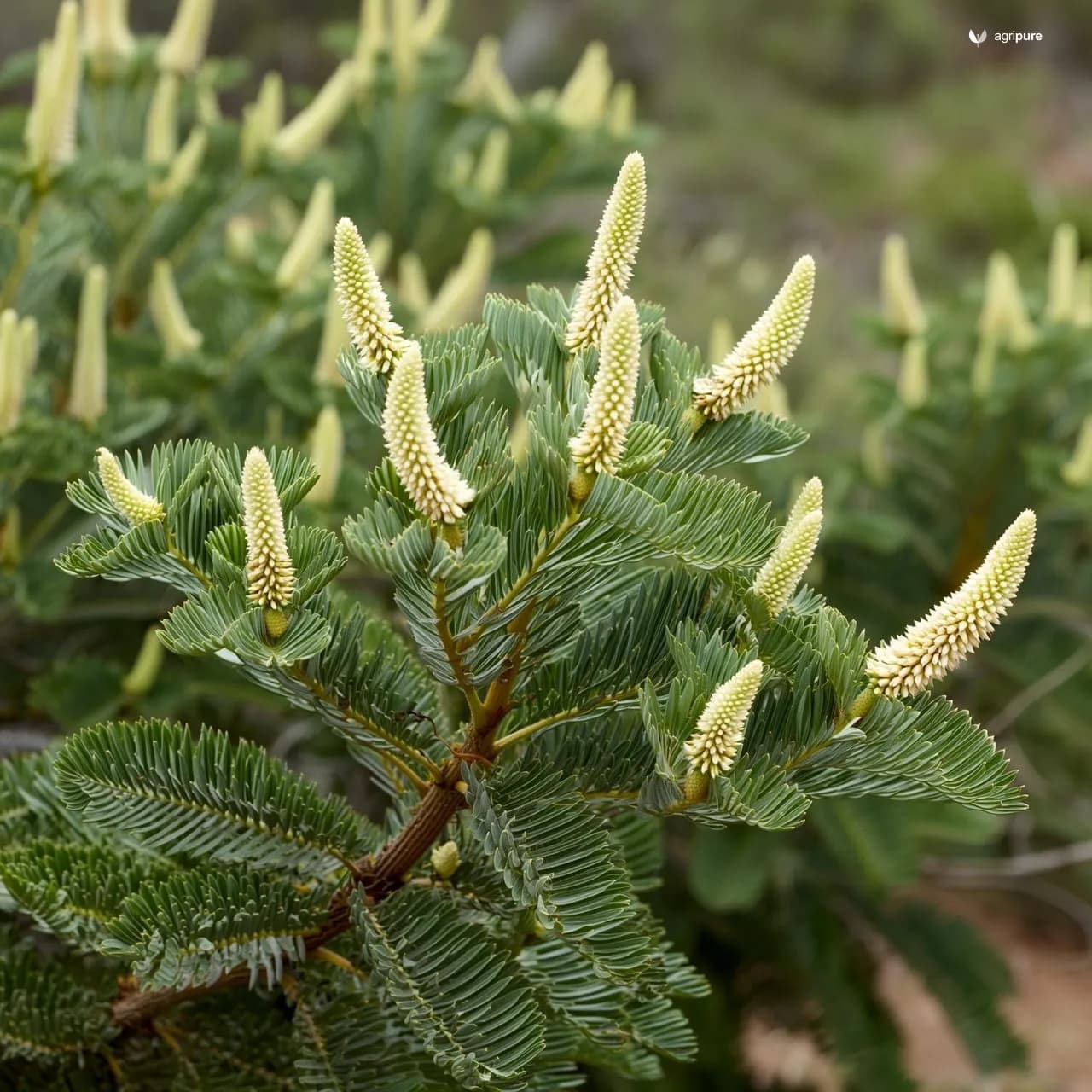
The flowering and fruiting habit gives clear seasonal cues for seed collection. The flowers are white to pale yellow and fragrant, borne in slender, drooping, catkin-like cylindrical spikes, appearing roughly from April to June. These are followed by straight, strap-shaped pods about 4 to 8 cm long and 1 to 1.5 cm wide, each holding around 3 to 6 seeds, which ripen roughly from July to September. Collecting pods in late summer, once they have dried on the tree, is the simplest way to gather seed for raising your own seedlings.
How to identify it
Phulai can be recognized by this combination of features in the field:12
- Habit: A small to medium deciduous tree, often low-branching, with a bushy, rounded crown and characteristically drooping branches.
- Spines: Paired, slightly hooked, dark-brown stipular spines at the nodes.
- Bark: Grey to greenish-brown, rough, and broken into narrow irregular cracks.
- Leaves: Bipinnate and compound, with about 2 to 3 pairs of pinnae and 3 to 5 pairs of small, leathery, greyish-green leaflets.
- Flowers and pods: Fragrant white-to-pale-yellow flowers in drooping cylindrical spikes (April to June), followed by straight, strap-shaped pods with 3 to 6 seeds (July to September).
Safety and cautions
This profile describes a tree valued for fuel, fodder, and gum, not a food crop, and the general botanical sources here do not document it as a human food plant. Acacias as a group are well known to be thorny, so the paired hooked spines warrant care when pruning, coppicing, or harvesting browse. No medicinal dosages or therapeutic claims are made here; where the foliage is used as livestock browse, that is a traditional fodder use rather than a recommendation to consume any part of the plant yourself.
Sources
- Acacia modesta — Haryana Forest Flora
- Acacia modesta (Senegalia modesta) — CABI Digital Library Compendium
- Acacia modesta Wall. — GBIF (Global Biodiversity Information Facility)
- Acacia modesta Wall. — International Plant Names Index (IPNI), Kew