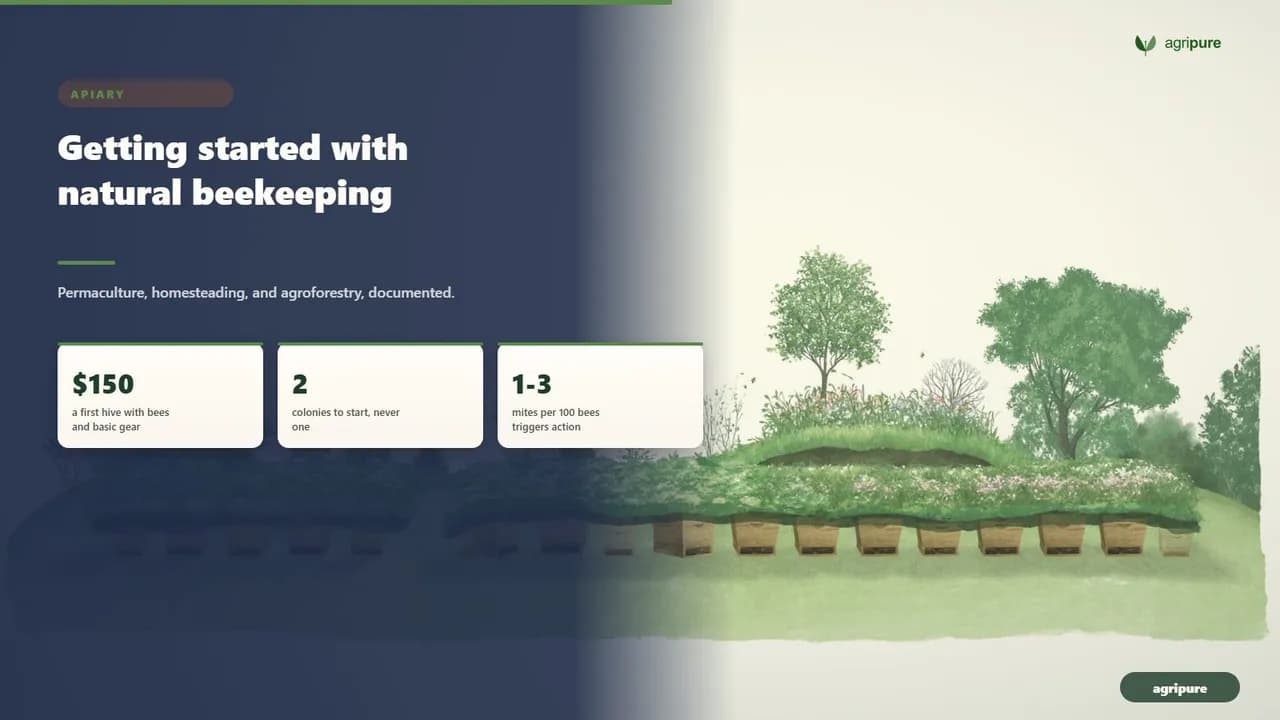
Key takeaways

A starter beehive setup for backyard natural beekeepers to foster honeybee colonies.
- Natural beekeeping means low intervention, not no intervention: foundationless comb and locally adapted bees are fair game, but varroa mites still have to be monitored and managed or the colony dies over winter.
- A first hive with bees and basic equipment runs about $150, and extension services recommend starting with two colonies, not one – a second hive lets you swap frames to fix a queenless or struggling colony.
- The beginner kit is short: a hive (boxes, frames, foundation or none, bottom board, covers), a smoker, a hive tool, a feeder, and protective clothing – everything else is optional.
- Langstroth is the standard (stackable, interchangeable parts, easy to find help); a horizontal top-bar hive is foundationless and easier on your back, lifting a single comb instead of a box that can near 100 lbs.
- Treatment-light management leans on monitoring (an alcohol wash is the most accurate count), drone-brood trapping, brood breaks, and mite-tolerant stock – with a real threshold around 1 to 3 mites per 100 bees that triggers action.
- For a first suit, a ventilated full suit with a fencing veil is the safe beginner pick: the layered mesh holds the stinger off your skin and the airflow keeps you calm in summer heat.
You can get a colony of honey bees working a homestead for about $150 in a first hive and basic gear, and most extension services tell beginners to start with two colonies, not one, so a struggling hive can borrow a frame of brood from its neighbour. Natural beekeeping takes that starting point and strips out the routine chemicals: bees build their own comb, you keep locally adapted stock, and you reach for a miticide only when monitoring says you must. What it does not do (and this is where many first-year colonies are lost) is let you ignore the varroa mite. This guide covers what a beginner kit actually needs, how the hive styles compare, what treatment-light mite management looks like (and its honest limit), and how to pick a bee suit that keeps you calm in the apiary. Bees are also the natural extension of a permaculture garden: the more nectar and pollen you plant, the less a low-input hive leans on you.
What natural beekeeping actually means
The phrase gets used loosely, so it helps to be exact. Natural beekeeping is a low-intervention approach built on 3 habits: let the bees draw comb without plastic foundation, keep locally hardy stock, and treat for pests only when monitoring shows you have to. It is not the same as treatment-free, a distinction worth holding onto, because the difference is what gets a colony through its first 6 months and its first winter.
A long Penn State Extension study put an organic, IPM-first system head to head with conventional and chemical-heavy management and found the organic system was the most successful in keeping bees healthy and productive. But read what that organic system actually did: it scraped capped drone brood off special frames every two weeks to trap mites, requeened colonies with local, hardy stock, and treated the moment a wash crossed a threshold: in their protocol, four mites in a wash, just over 1% infestation. Low intervention is not low attention. The work shifts from spraying on a calendar to watching the colony and acting on what it tells you.
The honest version. “Natural” describes how you manage (foundationless comb, local bees, no prophylactic chemicals), not a promise that the bees fend for themselves. A hive you never open and never count is not natural beekeeping; it is an unmonitored colony, and varroa will usually find it.
What’s in a beginner beekeeping kit
The list of what you genuinely need is short (about 5 categories), and most beginner beekeeping kits sold as a bundle cover it. Strip away the catalogue extras and a first setup is a place for the bees to live, 2 tools to work them, something to feed them, and clothing to keep you calm.

The hive itself is the core. In a standard Langstroth setup that means a bottom board the hive rests on, one or two hive bodies (each a wooden box holding 10 frames of comb where the colony lives), plus the frames (with wax foundation, or none if you go foundationless), an inner cover that stops the bees gluing everything to the lid, and a weatherproof outer cover. To open and work that hive you need exactly two tools: a smoker, the single most valuable tool for working bees, which calms the colony and masks alarm pheromone, and a hive tool for prying apart boxes and frames the bees have propolised shut. Add a feeder to deliver sugar syrup while a new colony draws comb, a soft bee brush, and your protective clothing, and the kit is complete.
Item | What it does | Beginner note |
|---|---|---|
Hive (Langstroth) | Boxes, frames, bottom board, covers: where the colony lives | Each box holds 10 frames; start with one or two boxes |
Smoker | Calms bees, masks alarm pheromone | The most valuable single tool |
Hive tool | Pries apart propolised boxes and frames | Buy two; they are easy to misplace |
Feeder | Delivers sugar syrup while comb is drawn | Most needed in a colony’s first weeks |
Protective clothing | Suit or jacket, veil, gloves | A ventilated full suit is the safe first buy |
Buy the bees twice over. Extension guidance is near-unanimous: start with two colonies, not one. A package is a screened box of workers and a caged queen; a nucleus (“nuc”) is a small running hive of about five frames with brood, food, and a laying queen. Two hives let you compare a healthy colony against a struggling one and move a frame of brood across to rescue the weaker.
Choosing a hive: Langstroth, top-bar, or Warre
The hive style you pick shapes how natural the beekeeping feels and how much you lift (up to about 100 lbs at a time in the wrong design). 3 styles show up in beginner conversations: the Langstroth, the horizontal top-bar, and the vertical Warre. They are not equally easy to start with.

The Langstroth is the standard for a reason: stackable boxes with removable frames, parts that are interchangeable between manufacturers, and the deepest pool of help and used gear, since almost every beekeeper runs one. Its cost is your back: a full deep box can approach 100 lbs, lifted as a unit when you super or harvest. The top-bar hive is the natural-leaning favourite: foundationless by design, worked one comb at a time at a height that suits you, so you lift a single comb instead of a 100-lb box, which is far easier on the back. The trade-offs are real: the comb is unsupported and fragile, parts are not standardised between makers, and you may struggle to find a mentor who runs one. The Warre is a vertical, foundationless “keep it simple” hive admired by natural beekeepers, but its boxes are small and nucleus bees come on Langstroth frames, so transferring a colony in is awkward for a beginner.
Hive | Comb & lifting | Best for |
|---|---|---|
Langstroth | Plastic or wax foundation; lift a full box up to ~100 lbs | Most beginners; standard parts and easy to find help |
Top-bar | Foundationless; lift one comb at a time, easy on the back | Natural-leaning keepers who want low lifting |
Warre | Foundationless, vertical; small boxes | Hands-off enthusiasts; harder to start a colony in |
For most first-year keepers (natural-minded or not), a Langstroth is the path of least resistance, and running it foundationless recovers much of the top-bar benefit while keeping standardised, 10-frame boxes. If a bad back or a hands-off philosophy is the priority, a top-bar is a fair first hive as long as you accept the thinner support network.
Treatment-light mite management, and its honest limit
This is the part natural beekeeping cannot route around. The varroa mite is the single biggest killer of honey bee colonies, and crossing roughly 3 mites per 100 bees unwatched is how most first-year hives are lost. “Treatment-light” works only if it is built on relentless monitoring: you earn the right to use fewer chemicals by counting mites more often.
Start with the count. An alcohol wash is the most accurate method for measuring mites; sample regularly through the season. The action threshold is low: extension IPM guidance aims to keep mites around 2 per 100 bees, and the organic protocol above acted at roughly 1% (about 1 mite per 100). Cross it and you intervene, ideally with the gentlest effective tool. The natural toolkit is mechanical and genetic: trap mites in drone brood (they breed far faster there, producing 2.2 to 2.6 young per drone cell against 1.3 to 1.4 in a worker cell, so cutting out capped drone comb removes a disproportionate share of the mites); force a brood break of about three weeks by caging or replacing the queen, which strands mites with no capped brood to breed in; and requeen with mite-tolerant stock that keeps brood infestation lower on its own.
Where “treatment-free” goes wrong. Skipping monitoring is not a method, it is a gamble: a colony that crosses the mite threshold unwatched usually collapses over winter and can spread mites to neighbours’ hives as it fails. Treatment-light is honest; treatment-blind is not. Count first, and treat when the numbers say so, even if the treatment is the only chemical you use all year.
Choosing a bee suit
Your suit is the gear that decides whether you stay calm at the hive, and calm hands get stung less. Picking the best beekeeping suit for a beginner comes down to 3 choices: coverage, ventilation, and veil, plus 1 fit rule that matters more than any of them.

On coverage, a full suit covers you head to ankle, while a jacket protects only the upper body; jackets are cooler and quicker to put on but leave your legs to thick jeans. For a first season, the head-to-ankle confidence of a full suit is the safer buy. On fabric, cotton suits are sturdy and offer some of the best sting protection but are heavy and hot, while a ventilated suit uses layered mesh thick enough that a stinger cannot reach your skin, with airflow that matters on a 90-degree afternoon. On the veil, a fencing veil sits close to the head, is form-fitting and unlikely to catch on things; a round veil gives a wider view and better airflow but is bulkier and shifts on your head. The beginner default that balances safety and comfort is a ventilated full suit with a fencing veil. Whatever you choose, buy it to fit loosely; a stinger reaches skin that presses against the fabric.
Choice | Beginner pick | Why |
|---|---|---|
Coverage | Full suit | Head-to-ankle protection builds calm; jackets leave legs exposed |
Fabric | Ventilated mesh | Layered mesh stops the stinger and keeps you cool in summer |
Veil | Fencing veil | Form-fitting, good visibility, will not snag; round veils shift around |
Fit | Loose, not tight | Bees sting through fabric pressed against skin |
Starting your first season
Put it together and a natural-leaning start is straightforward. Order 2 colonies of locally adapted bees, not 1, for roughly $150 a hive. Set them in a Langstroth you can run foundationless, or a top-bar if your back or your philosophy wants it. Buy the short kit: hive, smoker, hive tool, feeder, and a ventilated full suit with a fencing veil. Then do the one thing natural beekeeping cannot skip: monitor for mites with an alcohol wash through the season, and lean on drone-brood trapping, a brood break, and hardy genetics to stay under the threshold, reaching for a treatment only when the count crosses it. Manage it that way and the hive becomes a quiet, low-input fixture of a wider sustainable-living practice, pollinating everything around it. The richer the planting (a hedgerow, an orchard, a food forest humming with nectar and pollen), the more the bees feed themselves, and the lighter your hand on the hive can be.
Frequently asked questions
What is natural beekeeping, and is it the same as treatment-free?
Natural beekeeping is a low-intervention approach: you let bees build their own comb without plastic foundation, keep locally adapted stock, and avoid routine prophylactic chemicals. It is not the same as treatment-free. The reliable versions still monitor for varroa mites and intervene when counts cross a threshold; they simply use mechanical and genetic tools first and reach for a chemical only when the numbers demand it. A colony that is never opened or counted is not being kept naturally; it is unmonitored, and varroa usually finds it.
What does a beginner beekeeping kit need, and what does it cost?
A first kit is short: a hive (a bottom board, one or two boxes of frames, and inner and outer covers), a smoker, a hive tool, a feeder for sugar syrup, and protective clothing. A new hive with bees and basic equipment costs about $150 according to university extension guidance, and most extension services recommend starting with two colonies rather than one so you can move a frame of brood between hives to rescue a struggling colony.
Which hive is best for a natural beekeeping beginner: Langstroth, top-bar, or Warre?
For most beginners the Langstroth is the easiest start: stackable boxes, parts that are interchangeable between brands, and the largest pool of help and used equipment, and you can run it foundationless to get much of the natural-comb benefit. A horizontal top-bar hive is the natural-leaning favourite because it is foundationless and you lift a single comb instead of a box that can near 100 pounds, but the comb is fragile and parts are not standardised. A Warre is foundationless and hands-off but harder to start a colony in because its boxes are small and most bees come on Langstroth frames.
How do you manage varroa mites without heavy chemical treatment?
Treatment-light mite management is built on monitoring plus mechanical and genetic controls. Count mites regularly (an alcohol wash is the most accurate method) and act when you cross a threshold, which extension IPM guidance puts around 1 to 3 mites per 100 bees. The natural toolkit is drone-brood trapping (mites breed far faster in drone cells, so cutting out capped drone comb removes many of them), a brood break of about three weeks by caging or replacing the queen, and requeening with mite-tolerant stock. The honest limit: if the count crosses the threshold, you treat – even if it is the only chemical you use all year.
What is the best bee suit for a beginner?
For a first season the safe pick is a ventilated full suit with a fencing veil. A full suit covers you head to ankle, which builds the calm that gets you stung less; ventilated mesh fabric is layered thick enough that a stinger cannot reach your skin while keeping you cool in summer heat; and a fencing veil sits close to the head, gives good visibility, and will not snag. Cotton suits offer excellent protection but run hot, and a jacket is cooler but leaves your legs exposed. Buy any suit to fit loosely, because bees can sting through fabric pressed against skin.
How many beehives should a beginner start with?
Two. University extension services consistently recommend that beginners start with two colonies rather than one. A single colony is hard to read (you have nothing to compare it against), and if it goes queenless or weak you have no way to help it. With two hives you can judge a struggling colony against a healthy one and move a frame of brood or food across to rescue the weaker, which is one of the most useful interventions a new beekeeper has.
References
- Penn State Extension. “An Organic Management System for Honey Bees.” (IPM-first organic system; drone-brood removal, local stock, 1% wash threshold). extension.psu.edu
- Penn State Extension. “Methods to Control Varroa Mites: An Integrated Pest Management Approach.” (alcohol wash, ~2 mites/100 bees, drone-cell math, brood break). extension.psu.edu
- University of Georgia Extension. “Honey Bees and Beekeeping” (Bulletin 1045) – Langstroth parts, equipment, ~$150 first hive, start with two colonies. fieldreport.caes.uga.edu
- Michigan State University Extension. “Getting started with beekeeping in Michigan” (begin with two or three colonies; move frames between hives). canr.msu.edu
- Carolina Honeybees. “Top Bar Hives: A Beginner’s Guide” (foundationless comb, harvest without heavy lifting, easier on the back, lower yield). carolinahoneybees.com
- Talking With Bees. “Top Bar Hives – Pros & Cons” (a deep box near 100 lb vs lifting a single top bar). talkingwithbees.com
- Carolina Honeybees. “How to Choose a Beekeeping Suit: A Beginner’s Guide” (ventilated mesh vs cotton, full suit vs jacket, fencing vs round veil, loose fit). carolinahoneybees.com
- PerfectBee. “A checklist for the new beekeeper” (hive, smoker, hive tool, protective gear, feeder, bee brush). perfectbee.com