pioneer
Desert Cotton
bui
Aerva javanica
Also known as Kapok Bush (Australia).
- sindh coast
- balochistan highlands
- punjab plains
International hardiness
- USDA 9-11
- RHS H2
- AU: Arid / semi-arid, Subtropical
Where it grows — regional guide
| Zones / rating | Regional notes |
|---|---|
USDA 9-11 | No region-specific data yet |
| Zones / rating | Regional notes |
|---|---|
H2 (1 to 5C) | No region-specific data yet |
| Zones / rating | Regional notes |
|---|---|
Arid / semi-arid, Subtropical | Naturalised across arid northern rangelands for dryland forage; it is not an edible plant and is unsafe to eat. |
| Zones / rating | Regional notes |
|---|---|
USDA 9-11 (USDA scale) Canada uses its own zone system; Canadian zones run roughly one lower than USDA. | No region-specific data yet |
| Zones / rating | Regional notes |
|---|---|
Sindh coast, Balochistan highlands, Punjab plains | Pakistan:Grown on arid sandy plains and coastal dunes for fodder and fiber stuffing; it is not safe to eat and must not be consumed. India:A wild desert subshrub of western arid tracts used for stuffing and browse; it is not safe to eat as food. |
Grows alongside
Species that appear with Desert Cotton in 2 of our published guides — a starting list for a guild, not a planting plan.
Desert cotton (Aerva javanica), also called kapok bush, is a drought-hardy, deep-rooted perennial in the amaranth family (Amaranthaceae), native to arid and semi-arid country stretching from across much of Africa, including Madagascar, through south-west and south Asia. It has also spread into northern Australia. For a homesteader working hot, sandy, low-fertility ground, the appeal is straightforward: this is a tough, salt-tolerant shrub that holds soil, feeds livestock, and yields a usable fibre on land where thirstier plants give up. It is not a food crop, so treat its value as fodder, fibre, and traditional medicine rather than the dinner table.
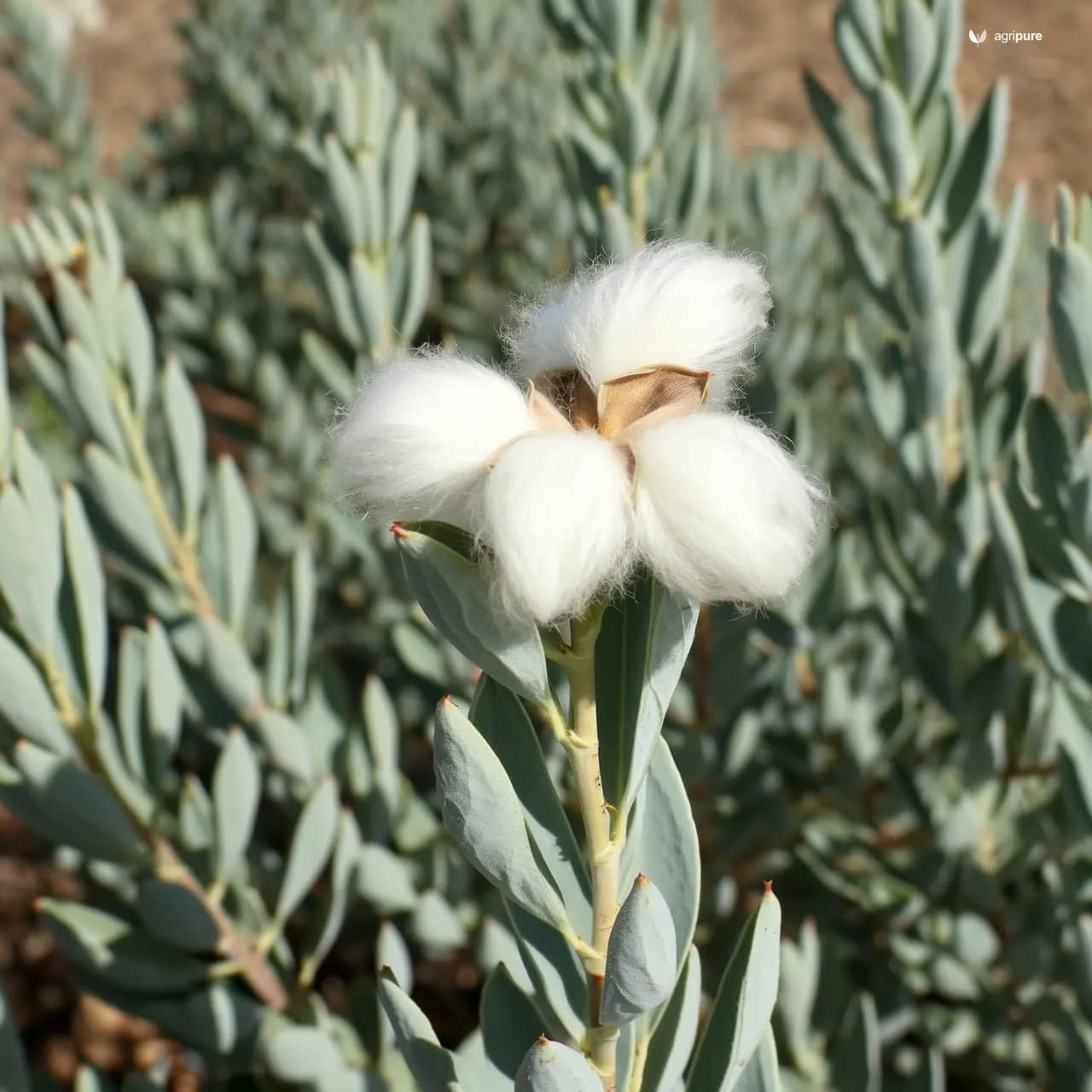
Desert cotton is a multi-stemmed, soft-wooded perennial that grows from herbaceous to semi-woody and reaches roughly 1.5 to 1.6 m (about 5 ft) tall, often erect and many-branched. Its stems are densely woolly and wiry, giving the whole plant a greyish cast, and its leaves are small and lance-shaped (some sources also describe them as broad) and clothed in dense silvery hairs, so the foliage reads silvery-green to grayish in the landscape. That woolly indumentum is a reliable field character in dry terrain. The plant produces thick, white to pinkish-white woolly spikes or panicles at the stem tips, which give it the “cottony” look behind its common name. Underpinning all of this is a deep root system, the trait that lets it ride out drought and also makes it useful as a soil-binder in desert reclamation.
Growing desert cotton
The standard way to start desert cotton is from seed. The seeds germinate well under controlled conditions; one nursery report records maximum germination of about 81% in darkness at a lower temperature, which points to sowing shallowly in a well-drained medium, keeping it evenly moist, and giving it reduced light to start before moving seedlings into full sun. No reliable data on vegetative propagation (cuttings or division) was found, so seed should be considered the standard method.
For site and soil, match its desert origins:
- Soil: It is commonly found on sandy or calcareous (lime-rich) ground, and as a recretohalophyte — a salt-secreting, salt-tolerant plant — in hyper-arid saline regions, it carries significant salt tolerance. Use well-drained sandy or sandy-loam soil; it tolerates poor, low-fertility and even moderately saline soils.
- Sun: It is a plant of open desert habitats, so give it full, unshaded sun.
- Water and heat: It is highly tolerant of drought and heat, thriving where few other plants survive, so keep it lean and dry rather than irrigated.
Spacing, time-to-maturity, and sowing dates are not consistently documented in the sources here, so they are deliberately left out rather than stated with false precision. In practice, treat desert cotton like other warm-climate dryland shrubs: it is best understood as a frost-sensitive desert plant suited to mild or frost-free winters and hot, dry summers, and it should not be expected to survive hard freezes.
Harvest and uses
The headline harvest is the fibre. The soft, white wool of the inflorescence has long been gathered as a kapok-like stuffing for pillows, cushions, and saddle pads in Arabia, and it is still used to stuff pillows today. Beyond fibre, the species earns its place on a homestead as a fodder plant and as a soil-binder in desert reclamation, where its deep roots help stabilise loose, sandy ground. It also has a record of use in traditional medicine. Across all of these, the practical payoff for a grower is dependable cover, forage, and a harvestable stuffing fibre on land too dry and salty to crop conventionally.
Safety and cautions
Desert cotton should be treated as a non-food, medicinal and fodder plant. The sources are explicit that there is no modern food-safety evidence supporting routine human consumption, so it should not be eaten as a vegetable or casually consumed.
It does have a history of use in traditional medicine, but a tradition of use is not the same as a proven treatment, and this profile makes no claim that the plant treats or cures any condition and gives no dosages. Approach any traditional remedy conservatively, and anyone who is pregnant or breastfeeding, or taking prescription medication, should seek qualified medical advice before using a medicinal plant. Grown for what it does well — holding soil, feeding stock, and yielding fibre — desert cotton is a genuinely useful dryland shrub.
Sources
- Aerva javanica — Wikipedia
- Aerva javanica botanical description — Ask-Ayurveda
- Aerva javanica as a C4 recretohalophyte of hyper-arid saline regions — ScienceDirect
- Aerva javanica range and habit — iNaturalist
- Kapok Bush / Desert Cotton seed and germination notes — Quinta dos Ouriques