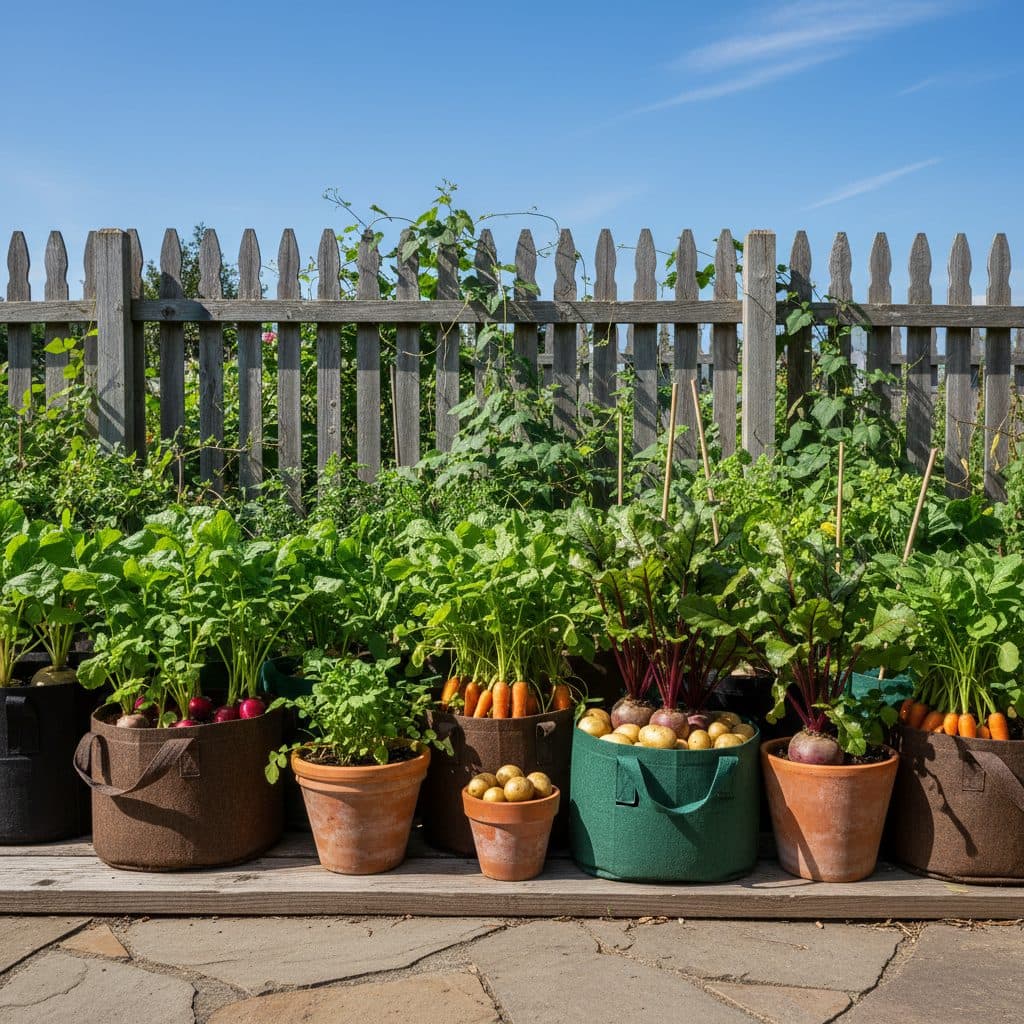
Key takeaways
- Container gardening offers precise control over soil conditions, which is essential for straight root development in crops like carrots.
- Select containers with a minimum depth of 12 to 15 inches and adequate drainage holes for most root vegetables.
- An ideal soil mix for root crops is light, well-draining, and rich in organic matter, with a pH between 6.0 and 6.8.
- Consistent watering, proper thinning, and proactive pest management are essential for a successful container harvest.
- Carrots, radishes, and beets are excellent choices for container growing, with many varieties maturing in 30 to 75 days.
- Utilize grow bags for their portability, aeration, and cost-effectiveness, especially for larger root crops like potatoes.
Quick answer: Growing root vegetables like carrots in containers allows for precise control over soil conditions, moisture, and nutrients, which can lead to higher yields and healthier roots compared to traditional in-ground planting.
For many growers across the United States, from urban balconies in New York City to suburban patios in Southern California, container gardening offers a practical solution for cultivating fresh vegetables. This method is particularly well-suited for root crops, which often struggle in compacted or rocky native soils. With careful planning, a small 2-foot by 2-foot container setup can produce 15 to 20 pounds of carrots over a growing season, a significant yield for limited space.
Growing root vegetables like carrots, radishes, and beets in containers or grow bags provides several distinct advantages. It allows for precise control over soil composition, moisture levels, and nutrient availability, factors that are essential for developing straight, healthy roots. This approach can also extend the growing season in USDA zone 6 by allowing containers to be moved indoors during early frosts, potentially adding an extra month of harvest.
The benefits of container gardening for root vegetables
Cultivating root vegetables in containers offers distinct advantages, especially for growers with limited space or challenging native soil conditions. In regions like the clay-heavy soils of the Midwest, containers allow for the creation of an ideal growing medium that promotes straight root development, preventing the forking often seen in dense ground. A study from 1969 noted that container gardening provides an accessible entry point for new growers, simplifying soil management and pest control [1]. This method can also increase yield per square foot; for example, a well-managed 18-inch diameter container can produce 5 to 7 pounds of carrots, which is comparable to a 3-foot row in the ground.
Controlling soil conditions and pests
One of the primary benefits is the ability to completely control the soil environment. Root crops require loose, well-draining soil to develop properly. With containers, you can craft a custom soil mix to ensure optimal texture and nutrient balance from the start. This is particularly valuable in areas with poor drainage or high alkalinity, such as parts of Nevada, where amending large in-ground plots can be impractical. Furthermore, container gardening can significantly reduce exposure to soil-borne pests like wireworms and nematodes, which can devastate root crops in traditional garden beds. Elevating containers off the ground can also deter slugs and snails, common nuisances in humid climates like Florida, leading to a reduction in crop damage by up to 40%.
- Precise soil composition control
- Reduced soil-borne pest issues
- Flexibility in garden layout and relocation
- Extended growing seasons in cooler climates
- Improved drainage and aeration
Selecting containers and grow bags for root crops
The success of growing root vegetables in containers hinges significantly on selecting the right vessel. For crops like carrots, parsnips, and daikon radishes, depth matters most. A minimum depth of 12 to 15 inches is generally recommended to allow roots to grow long and straight without obstruction. Shorter varieties, such as ‘Paris Market’ carrots, might thrive in 8-inch deep containers, but for most, more depth is better. Consider materials like terracotta, plastic, wood, or fabric grow bags, each offering distinct benefits and drawbacks. Terracotta pots, popular in the Southwest due to their evaporative cooling properties, can dry out quickly, necessitating more frequent watering, sometimes twice daily during summer heat waves exceeding 90°F.
Container materials and drainage
Fabric grow bags are an excellent choice for root vegetables, particularly for their aeration benefits and portability. The porous nature of these bags promotes air pruning of roots, which encourages a denser, healthier root system and prevents roots from circling the pot. A 10-gallon grow bag, measuring approximately 12 inches in diameter and 12 inches deep, can comfortably house 10 to 12 carrot plants. Plastic containers are lightweight and retain moisture well, making them suitable for drier climates like Colorado, but they must have ample drainage holes (at least four 0.5-inch holes per 5-gallon container) to prevent waterlogging. Wooden planters offer good insulation and aesthetic appeal, but untreated wood can rot over 3 to 5 years.
- Fabric grow bags (10-15 gallon capacity)
- Deep plastic pots (12-18 inches deep)
- Wooden planter boxes (at least 12 inches deep)
- Unglazed terracotta pots (ensure sufficient depth)
- Recycled food-grade buckets (with drainage holes added)
Crafting the ideal soil and nutrient mix
The foundation of successful container-grown root vegetables is the soil mix. Unlike garden soil, which can be heavy and compacted, container soil needs to be light, well-draining, and rich in organic matter. A good mix will prevent waterlogging, which can lead to root rot, and allow roots to expand without resistance. A common recipe includes one part compost, one part peat moss or coco coir, and one part perlite or vermiculite. This combination ensures excellent drainage and aeration, important for root crops like carrots, which prefer a soil pH between 6.0 and 6.8 for steady nutrient uptake. In regions with naturally alkaline water, such as parts of California, using peat moss can help slightly lower the pH over time.
Fertilization and organic matter
Root vegetables are not heavy feeders compared to leafy greens, but they do require a consistent supply of nutrients. Incorporating a slow-release granular organic fertilizer at planting, or using a liquid fertilizer at half strength every two to three weeks, can provide the necessary sustenance. Look for fertilizers with a balanced NPK ratio, such as 5-10-10, which supports root development over excessive foliage growth. Over-fertilizing with nitrogen can lead to lush green tops but small, underdeveloped roots. Adding 10% to 20% well-rotted compost to your potting mix not only provides a slow release of nutrients but also improves soil structure and microbial activity and supporting healthier plants and potentially increasing carrot falcarinol content, a beneficial compound [2]. For more general advice on starting your vegetable garden, consult agripure.org’s beginner vegetable gardening FAQs.
- One part high-quality compost
- One part peat moss or coco coir
- One part perlite or vermiculite
- Slow-release organic granular fertilizer
- Optional: one-quarter part aged manure
Planting, watering, and pest management strategies
Proper planting techniques are essential for root vegetables. Seeds should be sown thinly and at the correct depth, typically 0.25 to 0.5 inches deep for carrots and radishes. Overcrowding is a common issue that leads to stunted growth and misshapen roots. Once seedlings emerge and reach about 1 to 2 inches tall, thin them to the recommended spacing (usually 2 to 3 inches apart for carrots, and 1 to 2 inches for radishes). This gives each plant adequate space and resources to develop its root fully. In a 12-inch diameter container, aim for 10 to 12 carrot plants after thinning. Consistent moisture prevents roots from cracking or becoming tough. Water deeply when the top inch of soil feels dry to ensure water drains from the bottom of the container.
Pest prevention and care
Pest management in containers is often simpler than in open ground, but vigilance is still necessary. Common pests like carrot rust flies can be deterred by physical barriers, such as fine mesh netting over the containers, especially during their active flight periods in spring and late summer. Crop rotation, even in containers, can help break pest cycles, though this is less critical than in large beds. For instance, if you grew carrots in a specific container this year, plant beets or radishes in it next year. Biological protection methods, including beneficial nematodes, can be highly effective against soil-dwelling pests and are being researched for their efficiency [5]. Monitoring for aphids or spider mites, particularly on the foliage of beets and turnips, is important; a strong spray of water can dislodge many of these pests, reducing populations by 70% to 80%. For more detailed guidance on growing specific crops, refer to agripure.org’s guide on growing carrots.
- Sow seeds thinly to avoid overcrowding
- Thin seedlings to 2-3 inches apart for carrots
- Water consistently to maintain even soil moisture
- Use row covers or fine mesh for pest protection
- Monitor for aphids and spider mites regularly
Top root vegetables for container cultivation
While many root vegetables can be adapted to container growing, some are particularly well-suited due to their growth habits and relatively compact size. Carrots are a prime example, with numerous varieties thriving in containers. ‘Danvers 126’ and ‘Nantes’ are classic choices, growing 6 to 8 inches long, while ‘Paris Market’ carrots are small, round, and mature quickly in just 60 days. Radishes are another excellent option, maturing in as little as 25 to 30 days, making them ideal for quick succession planting. Varieties like ‘Cherry Belle’ or ‘French Breakfast’ perform well in containers as shallow as 6 inches, producing a continuous harvest throughout the spring and fall in USDA zone 5.
Beets, turnips, and other options
Beets, both for their roots and their nutritious greens, are highly versatile in containers. ‘Detroit Dark Red’ and ‘Cylindra’ are popular choices, requiring a container depth of at least 10 inches to develop their round or cylindrical roots. You can harvest the outer leaves while the root continues to grow, providing a dual-purpose crop. Turnips, similar to radishes, are fast-growing and can be harvested young for tender roots or allowed to mature for a larger crop. ‘Purple Top White Globe’ is a reliable turnip variety that can mature in 50 to 60 days. Even some smaller potato varieties, often called ‘new potatoes,’ can be grown successfully in large grow bags or 15-gallon containers, yielding 3 to 5 pounds per plant. For a comprehensive guide on growing potatoes, including in bags, visit agripure.org’s potato growing article.
- Carrots (‘Danvers 126’, ‘Nantes’, ‘Paris Market’)
- Radishes (‘Cherry Belle’, ‘French Breakfast’)
- Beets (‘Detroit Dark Red’, ‘Cylindra’)
- Turnips (‘Purple Top White Globe’)
- Small potato varieties (‘Yukon Gold’, ‘Red Norland’)
Container vs. grow bag for root vegetables
Feature | Traditional container (e.g., plastic/terracotta) | Fabric grow bag |
|---|---|---|
Cost (10-gallon equivalent) | Typically $10-$30 | Typically $3-$10 |
Drainage & aeration | Good, if holes are sufficient (e.g., 4 x 0.5 in holes) | Excellent, air-prunes roots naturally |
Portability | Moderate (can be heavy when filled) | High (often has handles, lighter material) |
Durability | 5-10 years (plastic), 2-5 years (terracotta) | 3-7 years (depending on material quality) |
Temperature regulation | Can overheat in direct sun (plastic), cool via evaporation (terracotta) | Better insulation, prevents extreme soil temperatures |
Root development | Roots can circle if not air-pruned | Promotes branching, prevents circling for healthier roots |
Soil pH: Maintain soil pH between 6.0 and 6.8 for optimal nutrient absorption by root vegetables, a range where 85% of essential nutrients are available.
Watering Frequency: Container plants may require watering 1.5 to 2 times more frequently than in-ground plants, especially during summer temperatures above 80°F.
Frequently asked questions
What is the minimum container depth for carrots?
For most carrot varieties, a minimum container depth of 12 to 15 inches is recommended. This allows the taproot to grow long and straight without encountering obstructions to ensure a harvest of 6 to 8 inch long carrots.
How often should I water container-grown root vegetables?
Container-grown root vegetables generally require more frequent watering than those in the ground. Check the soil daily, and water deeply when the top 1 inch of soil feels dry, which might be once a day in hot summer conditions above 85°F.
Can I reuse potting soil for root vegetables?
While you can reuse potting soil, it is advisable to refresh it by adding 20% to 30% new compost and a balanced organic fertilizer. Old soil can be depleted of nutrients and may harbor dormant pathogens, potentially reducing yields by 15% to 20%.
What are the best types of containers for radishes?
Radishes, being fast-growing and relatively small, can thrive in containers as shallow as 6 to 8 inches deep. Fabric grow bags, plastic pots, or even repurposed window boxes are suitable, provided they have adequate drainage holes, typically 0.5 inches in diameter.
How do I prevent pests in my container root vegetable garden?
Preventing pests in container root vegetable gardens can be achieved through several methods. Use fine mesh netting to deter flying insects like carrot rust flies, especially during their active periods, which can reduce damage by 75%. Inspect plants regularly, and consider biological controls like beneficial nematodes if soil pests are an issue.
References
- Beginning Gardening Unit I: Growing Vegetables in Containers (1969). Beginning Gardening Unit I: Growing Vegetables in Containers.
- Vegetables as Nutraceuticals – Falcarinol in Carrots and Other Root Crops (2000). Vegetables as Nutraceuticals – Falcarinol in Carrots and Other Root Crops.
- The Floating Growing System and New Growing System<sup>®</sup> to grow leafy vegetables and herbs (2021). The Floating Growing System and New Growing System<sup>®</sup> to grow leafy vegetables and herbs.
- Grow your own vegetables: a practical handbook for allotment holders and those wishing to grow vegetables in small gardens; what to grow, where to grow, when to (1918). Grow your own vegetables: a practical handbook for allotment holders and those wishing to grow vegetables in small gardens; what to grow, where to grow, when to.
- EFFICIENCY OF BIOLOGICAL PROTECTION OF CARROTS AGAINST DISEASES AND PESTS (2026). EFFICIENCY OF BIOLOGICAL PROTECTION OF CARROTS AGAINST DISEASES AND PESTS.