support
Siris
siris
Albizia lebbeck
Also known as Woman's Tongue (India, United States), Lebbeck (Australia).
- punjab plains
- sindh coast
- pothohar
International hardiness
- USDA 9-11
- RHS H1c
- AU: Tropical, Subtropical, Arid / semi-arid
Where it grows — regional guide
| Zones / rating | Regional notes |
|---|---|
USDA 9-11 | Limited to frost-free subtropical zones, where it can naturalise weedily; its pods contain saponins that restrict animal feeding. |
| Zones / rating | Regional notes |
|---|---|
H1c (5 to 10C) | No region-specific data yet |
| Zones / rating | Regional notes |
|---|---|
Tropical, Subtropical, Arid / semi-arid | Grown in the tropical north as a shade and browse tree; it can spread weedily from seed, and pods contain saponins toxic to fish. |
| Zones / rating | Regional notes |
|---|---|
USDA 9-11 (USDA scale) Canada uses its own zone system; Canadian zones run roughly one lower than USDA. | No region-specific data yet |
| Zones / rating | Regional notes |
|---|---|
Punjab plains, Sindh coast, Pothohar | Pakistan:Grown as a fast-growing shade and timber tree across frost-free plains; pods contain saponins and heavy seeding can become weedy. India:Planted across tropical plains for timber, shade and soil fertility; pods carry saponins that limit livestock feeding, and it seeds weedily. |
Grows alongside
Species that appear with Siris in 2 of our published guides — a starting list for a guild, not a planting plan.
Siris (Albizia lebbeck), also known as the lebbeck tree, Indian siris, or “woman’s tongue,” is a fast-growing, nitrogen-fixing legume tree native to the Indian subcontinent and Myanmar that has since spread to a pantropical range across the warm parts of the world. It is grown for timber, fodder, shade, and erosion control, and for a homesteader in a warm, frost-free climate it is one of the most useful multipurpose support trees available: a single tree throws deep shade, feeds the soil through nitrogen fixation, and yields wood and browse while shrugging off drought and poor, salty ground.
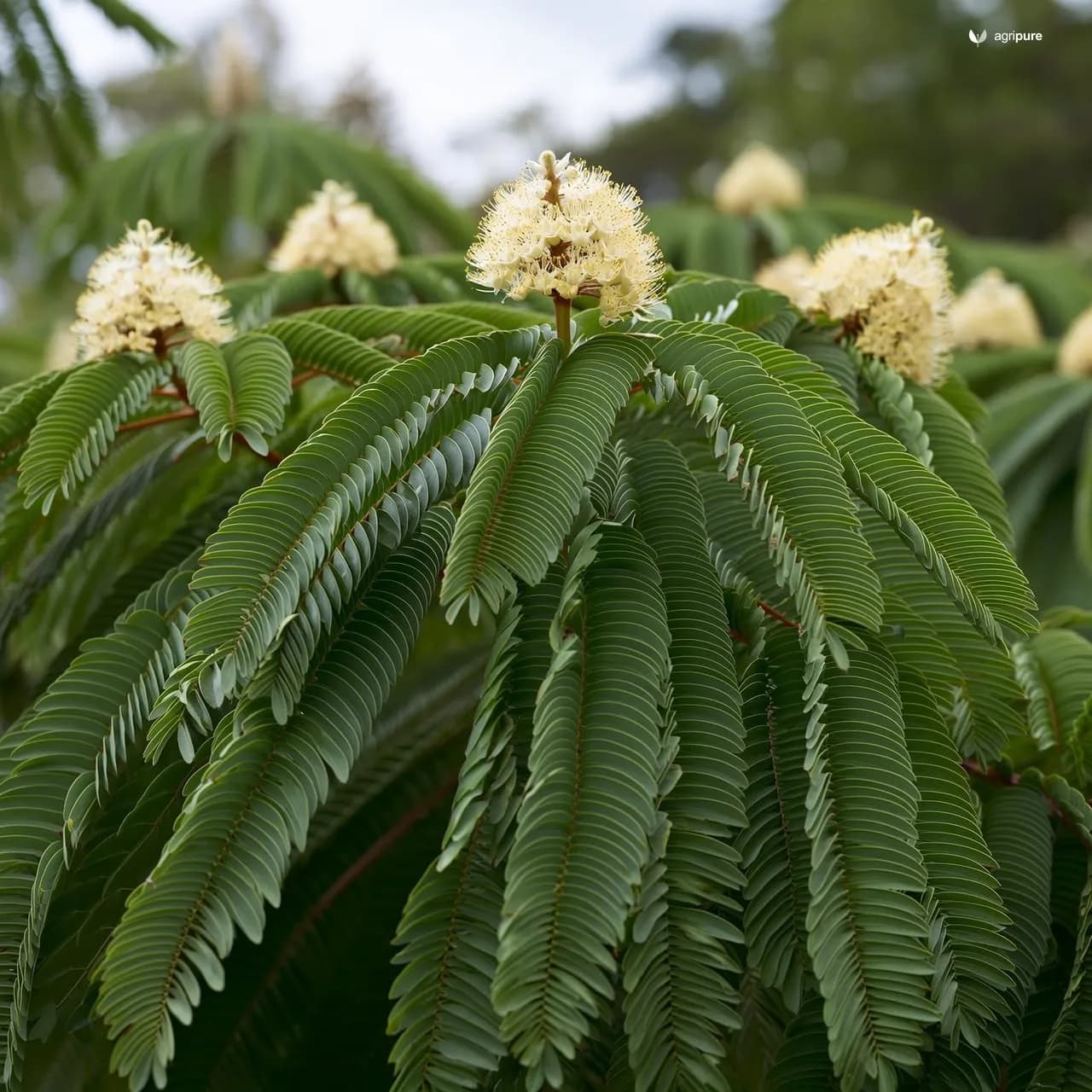
Siris is a perennial, deciduous tree, usually 15 to 20 m tall and reaching up to 30 m in good forest conditions, with a trunk commonly up to about 50 cm across and occasionally as much as 1 m. Grown in the open it develops a broad, spreading crown, sometimes on multiple stems, to roughly 25 m tall and 30 m wide. The bark is grey, rough, fissured, somewhat corky and flaky, with a reddish inner bark. The leaves are bipinnate (twice-divided), 7.5 to 15 cm long, with one to four pairs of pinnae, each carrying 6 to 18 opposite leaflets; the leaflets are oblong, slightly asymmetric and blunt-tipped, about 2.5 to 4.5 cm long.
How to identify Siris
A few features make siris easy to recognise in a warm-climate landscape. It is a tall, spreading deciduous tree with grey, fissured bark and feathery bipinnate foliage. In flower it carries “mimosa-like” blooms in showy, rounded heads near the branch tips, about 5 to 6 cm across, cream to yellowish-white, with numerous long stamens that give each head a silky, puffball look; the flowers are distinctly fragrant. The fruit is the giveaway: flat, linear pods, usually 15 to 30 cm long and 2.5 to 5 cm wide, holding roughly 6 to 12 flat seeds. These papery pods persist on the bare tree after the leaves drop and rattle audibly in the wind through the dry season, which is the origin of the common name “woman’s tongue.”
Growing Siris
Siris reproduces by seed or vegetatively by cuttings or coppicing, and seed is the usual and most abundant means of propagation; the tree sets seed prolifically. It is described as a medium- to fast-growing, drought-tolerant, nitrogen-fixing species adapted to a wide span of conditions, from semi-arid to humid, and is commonly planted in the seasonally dry tropics as a shade and shelter tree. One of its strongest assets for difficult ground is soil tolerance: it copes with saline, alkaline and marginal soils that limit many other trees.
Because it is a tropical to warm-subtropical species intolerant of hard frost, it thrives only where freezing is rare. The primary forestry and botanical references do not assign formal USDA hardiness zones, but its biology is clear, so in the continental U.S. it is best treated as suitable only for frost-free to very light-frost areas, roughly USDA zones 10 to 11 (possibly 9b in warm microclimates). That zone range is an informed inference from the climate behaviour described in the sources, not a figure stated directly in them. Detailed spacing, sowing temperatures and time-to-maturity figures are not consistently documented in these general sources, so they are left out here rather than stated with false precision; in practice, give a tree this large ample room for its eventual broad crown.
Harvest and uses
Siris is grown as a genuine multipurpose tree. Its established uses are timber, fodder, shade and erosion control, alongside a history of traditional medicinal use. The wood is valued as a general-purpose timber, and the foliage is used as livestock browse, though intake by small ruminants is limited by saponins (see Safety below). As a nitrogen-fixing legume it improves the soil it grows in, which is why it is so often used for shade, shelterbelts and rehabilitating degraded or marginal land. The same vigour and heavy seeding that make it easy to establish also make it weedy: its abundant seed production is recognised as an invasive trait, so it should be sited where self-sown seedlings can be managed and kept away from sensitive natural areas.
Safety and cautions
Siris carries several real cautions that a homesteader should respect. The pods contain saponins, which limit how much of the plant small ruminants will or should eat, so the foliage is a supplementary browse rather than an unlimited feed. The bark has been used traditionally as a fish poison, a sign that parts of the plant contain compounds toxic at the right concentration. While the tree has a long record of use in traditional medicine, modern safety data are limited, and any human medicinal use should be treated as experimental and undertaken only under qualified supervision. This profile makes no claim that the plant treats or cures any condition and offers no dosage; the safe takeaway is to grow it for its proven roles as shade, fodder, soil-builder and timber, and to handle its medicinal and feed uses conservatively.
Sources
- Albizia lebbeck (Indian siris) — CABI Compendium
- Siris Tree — Flowers of India
- Albizia lebbeck — Tropical Forages
- Albizia lebbeck — Wikipedia
- Siris (Albizia lebbeck) — The Outdoor Circle Exceptional Tree Library