Key takeaways
- Identify poorly drained soil through simple tests like the percolation test, observing standing water after 24 hours.
- Implement passive irrigation earthworks such as swales and berms to redirect and store excess water, reducing runoff by up to 30%.
- Utilize wicking beds and ollas for efficient water delivery directly to plant roots, potentially cutting irrigation needs by 50%.
- Select plants specifically adapted to wet conditions, like bald cypress or cardinal flower, which thrive in saturated soil in USDA zones 4-9.
- Improve soil structure with organic matter, aiming for 5% or more, to enhance drainage and aeration in heavy clay soils.
- Harvest rainwater to supplement irrigation needs, storing hundreds of gallons for dry periods and reducing reliance on municipal water.
Quick answer: To manage waterlogged soil, implement passive irrigation earthworks like swales, utilize wicking beds and ollas for efficient water delivery, improve soil structure with organic matter, and select plants adapted to wet conditions.
In many parts of the United States, from the low-lying coastal plains of the Southeast to the heavy clay soils of the Midwest, gardeners and farmers contend with waterlogged, poorly drained soil. This condition, often characterized by standing water after a 1-inch rain event, can severely limit plant growth and reduce yields by 20% or more. For instance, in parts of the Ohio River Valley, seasonal rainfall can saturate the ground for weeks, creating anaerobic conditions that suffocate plant roots.
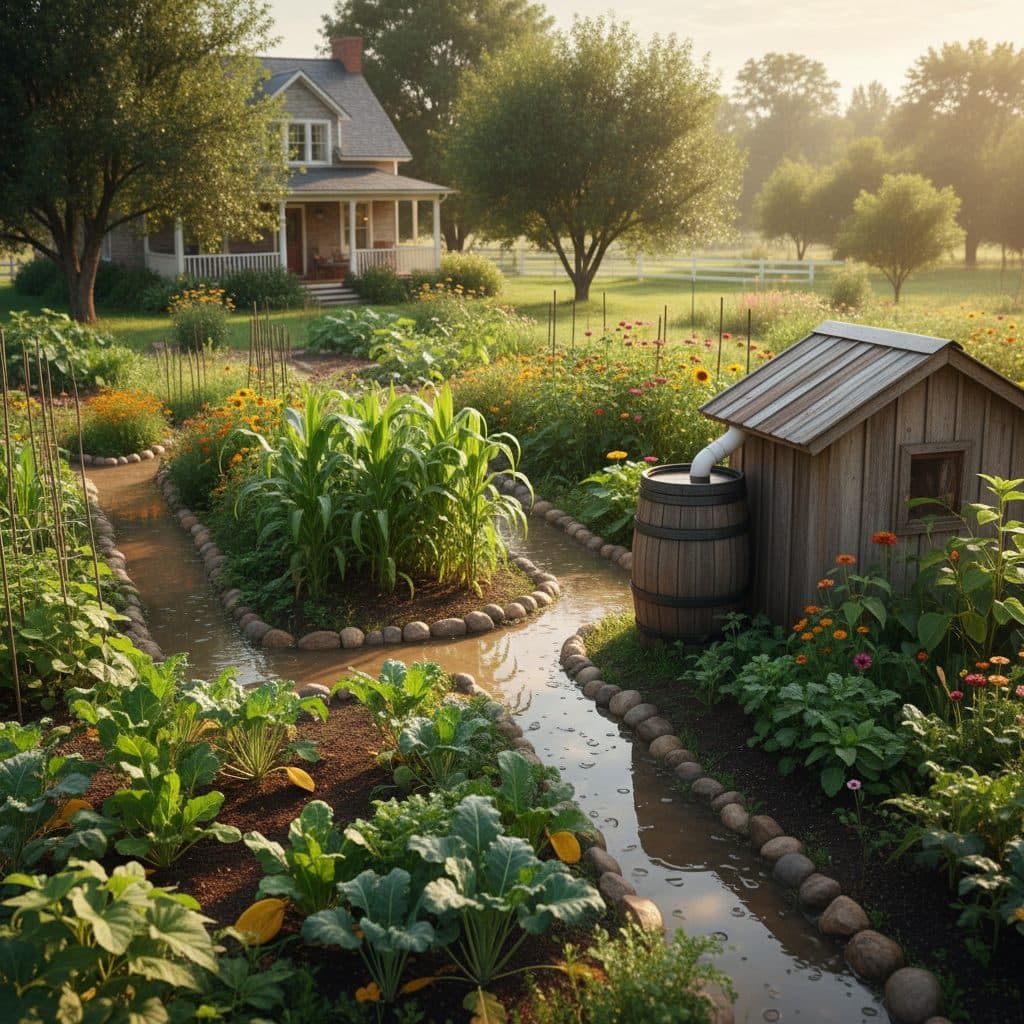
Addressing poorly drained soil involves a coordinated approach to water management. Integrating strategies like water harvesting, passive irrigation earthworks, ollas, and wicking beds helps manage excess moisture during wet periods and store it for drier spells. These methods give plants consistent access to water without root drowning, potentially increasing crop success rates by 25% in difficult conditions.
Understanding poorly drained soil
Poorly drained soil is a common issue across the US, particularly in regions with heavy clay content or a high water table. This type of soil retains excessive moisture because water cannot move through it effectively, leading to anaerobic conditions where oxygen is scarce. For example, a poorly drained Bladen loam soil in North Carolina can exhibit significantly reduced loblolly pine biomass accumulation compared to better-drained soils [4]. When soil pores are saturated with water, oxygen, essential for root respiration, is displaced, causing roots to suffer and eventually die.
The science behind soggy soil
The problem often stems from soil structure. Clay particles, which are less than 0.002 mm in diameter, pack together tightly, leaving minimal space for water percolation. In a typical poorly drained soil, the rate of water infiltration might be less than 0.1 inch per hour, compared to 1-2 inches per hour in a sandy loam. Research indicates that organic carbon and nitrogen mineralization, processes required for nutrient availability, are significantly altered in poorly drained mineral soils under transient waterlogged conditions [1]. This means not only are roots struggling for air, but nutrient cycling is also compromised, reducing overall soil fertility by 15% or more.
- Heavy clay content restricts water movement.
- High water table keeps the root zone saturated.
- Compaction from machinery or foot traffic reduces pore space.
- Hardpan layers create impermeable barriers beneath the surface.
- Low organic matter diminishes soil aggregation and drainage.
Assessing your site and soil
Before implementing solutions, assess the site carefully. Observe the property after a significant rain event, such as 2 inches of rain in 24 hours, noting where water pools, how long it stands, and which areas dry out slowly. This visual assessment provides practical information about drainage patterns. You can also use a 3-in-1 soil pH, moisture, and light meter to get a more precise reading of moisture levels at different depths, helping to identify specific problem spots.
Improving soil structure and aeration
One of the most effective long-term strategies for poorly drained soil is to significantly increase its organic matter content. Incorporating 3-6 inches of compost, aged manure, or leaf mold can transform heavy clay into a more workable, aerated medium. This organic material helps aggregate clay particles, creating larger pore spaces for water and air. For instance, adding 5% organic matter to a clay soil can improve its water infiltration rate by 50% within a growing season. This practice improves drainage, boosts microbial activity, and increases nutrient availability, which strengthens soil resilience.
- Conduct a perc test to quantify drainage rates.
- Observe standing water after heavy rainfall for 24-48 hours.
- Dig test pits to identify hardpan layers or a high water table at 18-24 inches.
- Use a soil probe to check compaction at various depths.
- Send a soil sample to your local extension office for detailed analysis, often for less than $20.
Passive water management earthworks
Passive irrigation earthworks are designed to slow, spread, and sink water into the landscape instead of letting it run off. This approach is particularly useful in areas with slopes or where sheet flow of water is a problem. Swales, for example, are level ditches dug along contours, often with a berm on the downhill side. They intercept runoff and allow it to slowly infiltrate the soil, effectively increasing the amount of usable water in your landscape by storing hundreds of gallons after a significant rain event. In a typical USDA zone 6 garden, a 50-foot swale 2 feet deep and 3 feet wide can hold over 200 gallons of water.
Designing swales and berms
When designing swales, ensure they are perfectly level to prevent water from rushing to one end and overflowing. The berm can be planted with water-tolerant species or used as a raised bed for plants that prefer slightly drier conditions. Another earthwork strategy involves creating rain gardens, which are depressions planted with native species that can tolerate both wet and dry conditions. These features can capture 50-75% of stormwater runoff from impervious surfaces like rooftops, preventing it from overwhelming your poorly drained areas. For larger scale water collection, consider rainwater harvesting systems that can store thousands of gallons.
- Swales slow and sink water along contours.
- Berms create raised planting areas and direct water flow.
- Rain gardens absorb stormwater runoff from roofs and driveways.
- Keyline design uses contour lines to guide water across the landscape efficiently.
- Terracing on slopes reduces erosion and creates level planting areas, decreasing water velocity by 40%.
Active water management: ollas and wicking beds
For more targeted water delivery, especially in raised beds or container gardens, active water management techniques like ollas and wicking beds are highly effective. Ollas are unglazed clay pots buried in the soil, filled with water, and allowed to slowly release moisture directly to plant roots through capillary action. This method can reduce water usage by 50-70% compared to surface irrigation, as evaporation is minimized. A single olla holding 1 gallon of water can effectively irrigate a 2-foot diameter area for several days, depending on soil type and plant needs.
Building wicking beds for consistent moisture
Wicking beds are essentially self-watering raised beds. They consist of a sealed reservoir at the bottom, typically 6-12 inches deep, filled with water, and a layer of soil above it. A wicking medium, often sand or gravel, connects the water reservoir to the soil, drawing moisture upwards to the plant roots. This provides a consistent water supply, making them ideal for areas prone to drought or for busy gardeners. A 4×8 foot wicking bed can hold 50-80 gallons of water, providing weeks of irrigation for thirsty plants like tomatoes or squash in USDA zone 7. These systems can also be integrated with expandable hoses for easy refilling.
- Ollas provide slow, targeted root-zone irrigation.
- Wicking beds offer consistent, bottom-up moisture for raised gardens.
- Rain barrels collect rooftop runoff for later use, storing 50-100 gallons.
- Drip irrigation delivers water directly to the plant base, reducing waste by 30-50%.
- Porous soaker hoses distribute water evenly along rows without significant evaporation.
Plants for wet feet
While soil amendment and water management are key, selecting the right plants for challenging conditions is equally important. Some plants are naturally adapted to thrive in wet, even waterlogged, soils. These species often have specialized root systems that can tolerate low-oxygen environments or even benefit from abundant moisture. For instance, the bald cypress (Taxodium distichum) is a deciduous conifer that flourishes in swamps and along riverbanks in USDA zones 4-10, often growing 70-100 feet tall. Its ‘knees’ are thought to aid in gas exchange in saturated soils.
Selecting species for soggy sites
When choosing plants, look for those native to wetlands, bogs, or riparian areas. In the Pacific Northwest, plants like skunk cabbage (Lysichiton americanus) thrive in consistently wet, boggy conditions. For a garden setting in the Southeast, cardinal flower (Lobelia cardinalis) produces bright red blooms and tolerates consistently moist to wet soil in USDA zones 3-9, often reaching 3-4 feet in height. Even some edibles, like certain varieties of rice or watercress, can be grown in perpetually wet conditions. If you’re looking for plants that can handle less-than-ideal drainage, researching drought tolerant plants might seem counterintuitive, but understanding their root systems can offer insights into how different plants cope with water stress, both excess and deficit.
- Bald cypress (Taxodium distichum) thrives in standing water.
- Cardinal flower (Lobelia cardinalis) prefers consistently moist to wet soil.
- Willow (Salix species) tolerates wet conditions and helps stabilize banks.
- Sweet flag (Acorus calamus) is a wetland perennial for zones 4-10.
- Buttonbush (Cephalanthus occidentalis) is a shrub that loves wet feet, growing 5-12 feet tall.
Comparison of water management techniques for poorly drained soil
Technique | Primary benefit | Water savings potential | Best use case |
|---|---|---|---|
Organic matter addition | Improves soil structure and aeration | Indirect (better infiltration) | Overall soil health in any garden |
Swales & berms | Reduces runoff, increases infiltration | Captures 30% more runoff | Sloping landscapes, large garden areas |
Ollas | Targeted root-zone irrigation | 50-70% reduction | Container gardens, individual plants |
Wicking beds | Consistent, self-watering moisture | 40% reduction | Raised beds, intensive vegetable gardens |
Rain gardens | Stormwater absorption, habitat | Captures 50-75% runoff | Near impervious surfaces, landscape features |
Soil Improvement: Adding 4 inches of compost to a heavy clay soil can increase its water infiltration rate by 50% in the first year.
Water Storage: A 100-foot swale, 2 feet deep and 3 feet wide, can store over 400 gallons of water after a 1-inch rain event.
Frequently asked questions
How can I quickly improve drainage in a small garden bed?
For a small bed, incorporating 3-4 inches of coarse organic matter like compost or pine bark fines can significantly improve drainage within a few months. This increases pore space and allows water to move through the soil more effectively, often improving drainage by 20% or more.
Are raised beds a good solution for waterlogged soil?
Yes, raised beds are an excellent solution, especially when filled with a well-draining soil mix. They elevate the root zone above the saturated ground, preventing waterlogging. A raised bed 12 inches high can provide a completely new, well-drained growing environment, improving yields by 30%.
What is the best way to test my soil’s drainage?
The simplest method is a percolation test: dig a 12-inch deep hole, fill it with water, let it drain, then refill and measure how quickly the water level drops. If it drains less than 1 inch per hour, your soil has poor drainage. This test takes about 4 hours to complete accurately.
Can I grow vegetables in waterlogged soil?
Most common vegetables do not tolerate waterlogged soil well, as their roots need oxygen. However, you can grow certain water-loving crops in modified systems, like watercress in shallow, flowing water or some taro varieties. For typical garden vegetables, improving drainage or using wicking beds is essential for a 75% success rate.
How much organic matter should I add to my soil?
For poorly drained clay soils, aim to incorporate 3-6 inches of organic matter annually for the first few years. This can increase the soil’s organic content from 1-2% to a healthier 5% or more, significantly enhancing drainage and soil structure over time.
References
- Organic carbon and nitrogen mineralization in a poorly‐drained mineral soil under transient waterlogged conditions: an incubation experiment (2015). Organic carbon and nitrogen mineralization in a poorly‐drained mineral soil under transient waterlogged conditions: an incubation experiment.
- poorly drained perched water gley soil (2014). poorly drained perched water gley soil.
- 4471 poorly drained soil [n] (2010). [4471 poorly drained soil \n].
- BIOMASS, N, AND P ACCUMULATION IN FIRST AND SECOND ROTATION LOBLOLLY PINE PLANTATIONS ON A POORLY DRAINED BLADEN LOAM SOIL AND SOMEWHAT POORLY DRAINED LYNCHBURG (2023). BIOMASS, N, AND P ACCUMULATION IN FIRST AND SECOND ROTATION LOBLOLLY PINE PLANTATIONS ON A POORLY DRAINED BLADEN LOAM SOIL AND SOMEWHAT POORLY DRAINED LYNCHBURG.
- Penetration of Dry Soil by Roots of Dactylis glomerata L. Clones Derived from Well-Drained and Poorly Drained Soils (1987). Penetration of Dry Soil by Roots of Dactylis glomerata L. Clones Derived from Well-Drained and Poorly Drained Soils.
- Peatlands and Global Change: Response and Resilience (2016). Peatlands and Global Change: Response and Resilience.