support
Fourwing Saltbush
Atriplex canescens
- balochistan highlands
- punjab plains
International hardiness
- USDA 4-9
- RHS H6
- AU: Arid / semi-arid, Cool temperate, Warm temperate, Mediterranean
Where it grows — regional guide
| Zones / rating | Regional notes |
|---|---|
USDA 4-9 | Native to arid western shrublands for rangeland browse; windborne pollen triggers hay fever, and salty foliage warrants caution. |
| Zones / rating | Regional notes |
|---|---|
H6 (-20 to -15C) | No region-specific data yet |
| Zones / rating | Regional notes |
|---|---|
Arid / semi-arid, Cool temperate, Warm temperate, Mediterranean | Cultivated in arid pastoral country for saltland forage; wind-blown pollen triggers hay fever, and high salt load warrants caution. |
| Zones / rating | Regional notes |
|---|---|
USDA 4-9 (USDA scale) Canada uses its own zone system; Canadian zones run roughly one lower than USDA. | No region-specific data yet |
| Zones / rating | Regional notes |
|---|---|
Balochistan highlands, Punjab plains | Pakistan:Planted in arid trials across highland Balochistan for saline rangeland browse; its salty foliage and airborne pollen carry health cautions. |
Grows alongside
Species that appear with Fourwing Saltbush in 3 of our published guides — a starting list for a guild, not a planting plan.
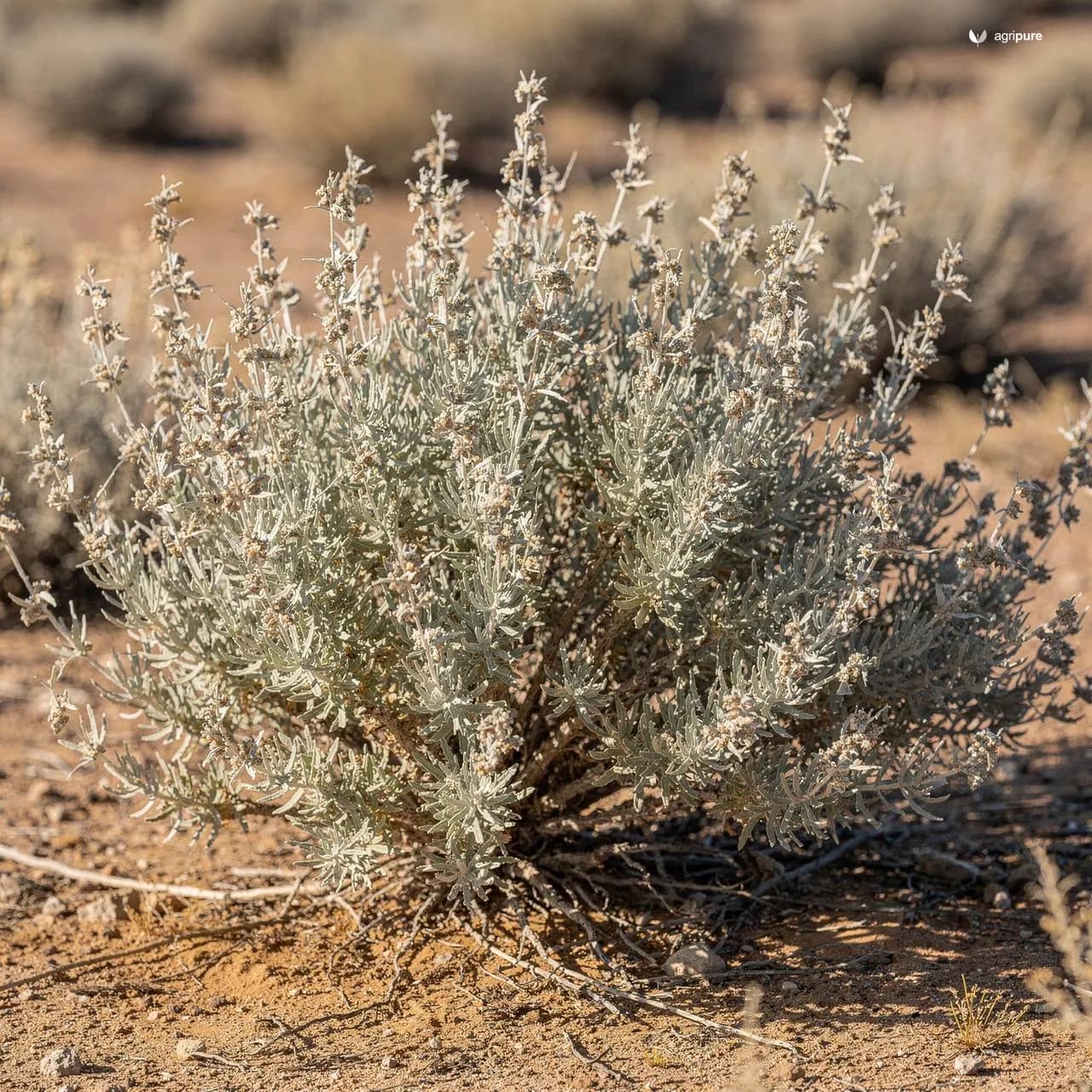
Fourwing saltbush (Atriplex canescens) is a long-lived, salt-tolerant shrub native to the arid western United States and northern Mexico. It is a chenopod (the goosefoot family, alongside spinach and quinoa) that earns its keep on the toughest ground a property has to offer. For a homesteader working dry, sandy, or saline corners where most plants sulk, this is a workhorse: a tough evergreen-to-semi-evergreen shrub used widely for livestock and wildlife forage, habitat, erosion control, and land restoration, and one that also carries documented traditional food and medicinal uses.
The plant is a woody, usually semi-evergreen shrub that forms an erect, rounded, informal mound, typically about 0.9 to 1.5 m (3 to 5 ft) tall and wide, though it can reach roughly 2.4 m (8 ft) in favorable conditions. Its rigid, somewhat brittle stems are densely covered in fine silvery hairs, and the narrow, alternate, simple leaves are generally 2.5 to 5 cm (1 to 2 in) long; the National Park Service records them at 10 to 40 mm long and 2 to 8 mm wide, grey to bluish, and dusted with small scales. Both the leaves and mature trichomes accumulate salt on the leaf surface, which is what gives the whole shrub its distinctive grey-silvery cast.
How to identify fourwing saltbush
The surest field cue is the fruit. The shrub produces small, one-seeded fruits (utricles) wrapped in a pair of bracts that form four prominent wings — the feature that gives the plant its common name. The fruiting bracts are about 9 to 25 mm wide, with the four wings running their length, and the fruits themselves are less than 3.8 mm (0.15 in) long with distinctly square, four-winged bracts. Combine that with the silvery, salt-dusted, narrow grey-blue foliage and you have a confident identification.
Fourwing saltbush is mostly dioecious: male and female flowers grow on separate plants, and it is only rarely monoecious. The flowers are small and inconspicuous, borne in clusters — male (staminate) flowers yellowish, and female (pistillate) flowers in panicles 5 to 40 cm long. Because it is dioecious, you need both male and female plants nearby to set seed.
Growing fourwing saltbush
This shrub is usually propagated by seed. The seeds carry both physical and physiological dormancy, so scarification and stratification are needed for reliable germination. Before sowing, remove the papery “wings” from the seed. Plant about 1.3 cm (0.5 in) deep in fine soil, or about 2 cm (0.75 in) deep when direct-sowing outdoors into coarser or gravelly ground. Sow when temperatures are around 15 °C (low 60s °F); germination usually follows within 7 to 21 days. Worth knowing for seed-savers: the seed is orthodox and remarkably durable, staying viable for 10 to 20 years in storage and likely in the soil seed bank as well.
As its name and salty leaves suggest, this is a plant for hard, dry sites. In the wild it favors sandy, commonly non-saline sites across desert shrub, sagebrush, greasewood, blackbrush, mountain brush, and pinyon-juniper communities, growing from below sea level up to about 2,590 m (8,500 ft) in elevation. Its spread from low desert basins into cold, high-elevation shrublands points to a shrub built for hot, dry summers and cold, frosty, sometimes snowy winters. Primary sources do not assign a USDA hardiness zone, so any exact number would be guesswork; treat it instead as a hardy, xeric shrub for dry, sunny, free-draining ground rather than for rich or waterlogged beds.
Harvest and uses
Fourwing saltbush is grown far more for what it does on the land than for a single harvest. Its principal value is as forage for livestock and wildlife, habitat, and land restoration, and it has documented traditional food and medicinal uses as well. On degraded, sandy, or salty ground it is a restoration and cover shrub, supporting wildlife and helping hold soil where little else will establish. For a homestead, the practical payoff is a permanent, low-input shrub that turns marginal land into useful browse and habitat instead of bare dirt.
Safety and cautions
Fourwing saltbush is generally considered safe as forage, but it is a high-salt plant, so any culinary or medicinal use calls for moderation and care. The sources specifically flag attention to kidney, heart, and pregnancy-related cautions given the salt load. Traditional food and medicinal uses are documented, but a long history of use is not the same as a proven treatment, and this profile makes no medical claims and gives no dosages. One further practical note: the plant is wind-pollinated, and its wind-dispersed pollen can cause hayfever in sensitive people. Anyone who is pregnant or has kidney or heart concerns should treat the plant conservatively and seek qualified guidance before consuming any part of it.
Sources
- Atriplex canescens (Fourwing Saltbush) — Utah Valley University Native Plants
- Atriplex canescens, Fourwing Saltbush — U.S. National Park Service (Arches)
- Atriplex canescens — University of Arizona Arboretum
Sourcing notes
An introduced rangeland shrub rather than a native; source seed or seedlings from AZRI Quetta or similar trial stock adapted to local salinity. De-wing and after-ripen seed before sowing.