Compost tea & liquid fertilizers: free homemade plant feeds
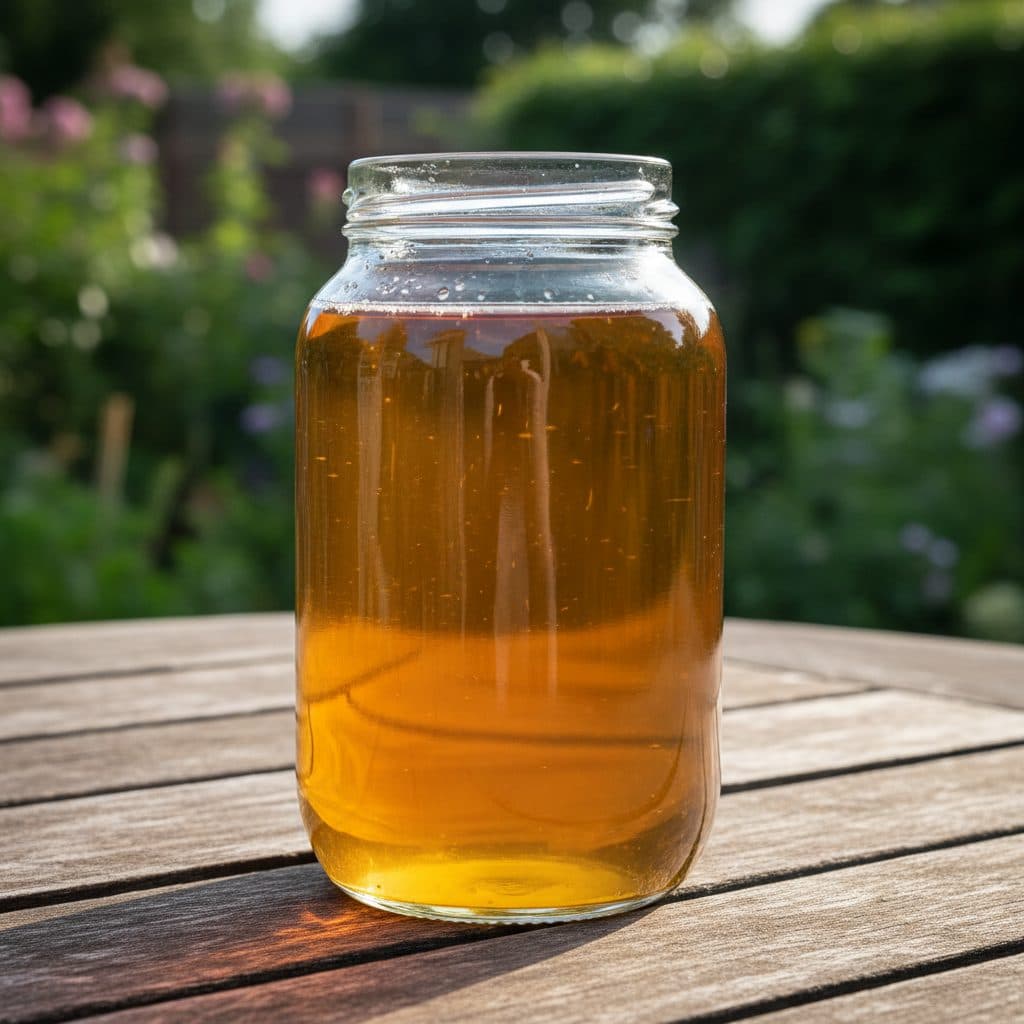
A glass jar filled with amber-colored compost tea resting on a clean wooden garden table, with sunlight streaming through the jar.
Key takeaways
- Brewing time parameters: Steep aerated compost tea for 24 to 36 hours; brewing longer than 48 hours depletes oxygen and creates anaerobic bacteria.
- Dilution ratio formula: Dilute finished compost tea to the color of weak tea, typically using a 1:5 ratio with non-chlorinated water.
- Pathogen safety guidelines: Strictly avoid adding simple sugars like molasses, which can multiply harmful Salmonella and E. coli by 1000% within 24 hours.
- NOP harvest intervals: Apply untested compost tea at least 90 to 120 days before harvesting edible crops to comply with federal organic rules.
- Water quality check: Use non-chlorinated water, allowing tap water to sit in an open container for 24 hours to dissipate chlorine.
- Application techniques: Soil-drench seedlings and mature roots; do not spray liquid extracts directly onto foliage of leafy green crops.
Quick answer: Compost tea and liquid fertilizers are made by steeping finished compost in non-chlorinated water, either with continuous aeration for 24-36 hours or passively for 5-14 days, to create a microbial inoculant for plants. This process recycles organic nutrients, providing a mild, organic fertilizer that supports soil biology and plant roots.
The Environmental Protection Agency (EPA) estimates that the average American generated 328 pounds of food waste in 2016, with households accounting for 40% to 50% of the nation’s 26.5 million tons of annual food waste. While dry compost improves soil structure over several months, home gardeners in urban and suburban spaces often need rapid, water-soluble nutrients. Compost tea — a liquid extract made by steeping finished compost in water — offers a highly concentrated microbial inoculant that feeds both the soil biology and the plant roots.
By brewing these liquid extracts at home, you can supply your garden with billions of active, beneficial bacteria and fungi per milliliter. This process allows you to recycle up to 100% of kitchen organic nutrients directly into your vegetable planters.
Understanding aerated and non-aerated extracts
These liquid plant feeds are prepared using two primary brewing methods. Aerated compost tea (ACT) utilizes an electric air pump to bubble oxygen continuously through the water for 24 to 36 hours. Non-aerated compost tea (NCT) relies on passive steeping in a container for 5 to 14 days, requiring occasional stirring.
A DIY aerated compost tea setup in a 5-gallon bucket showing bubbles and an air pump.
Microbe selection through oxygenation
Continuous aeration keeps dissolved oxygen above six parts per million. Aerobic bacteria, fungi, and protozoa thrive in this oxygen-rich environment, reproducing rapidly while anaerobic pathogens are suppressed. In non-aerated systems, oxygen levels drop within 24 hours, shifting the microbial population toward anaerobic species that require longer decay timelines.
Efficacy and nutrient delivery
Steeping extracts soluble humic substances, plant hormones, and trace minerals from the compost solids. While aerated teas provide a highly active microbial wash, non-aerated teas contain up to 3 times higher concentrations of mineralized plant nutrients. Both extracts act as mild, organic fertilizers that do not burn sensitive roots.
Pathogen risks and federal organic regulations
Homemade liquid extracts present food safety challenges that gardeners must manage. When organic matter is suspended in water for 24 to 36 hours, the environment becomes ideal for bacterial growth.
Microbial amplification hazards
Warm water can multiply human pathogens like Salmonella and E. coli if the starting compost is not 100% sanitized. Adding simple sugars (like unsulfured blackstrap molasses) to feed beneficial fungi can backfire, increasing pathogen counts by up to 1,000 times in 24 hours. To prevent contamination, never add molasses or simple sugars to your brewer.
National Organic Program rules
The USDA National Organic Program (NOP) regulates these microbial safety hazards under federal rule 7 CFR Part 205. If an organic grower uses compost tea brewed with additives (like kelp or molasses), they must test the tea to verify it contains fewer than 126 E. coli colony-forming units per 100 milliliters. Untested teas are classified as raw manure, requiring a 90-day harvest interval for crops that do not touch the soil (such as sweet corn) and a 120-day interval for soil-contact crops (such as carrots or strawberries).
Sizing and building a DIY compost tea brewer
You can build this home brewing system with simple, inexpensive components. To meet the needs of a typical backyard garden, a 5-gallon system is the standard size.
System dimensions
A standard 5-gallon plastic bucket is sufficient to brew enough tea to treat up to 1,000 square feet of garden beds. To run the aerator, you will need a commercial aquarium air pump rated for at least 40 gallons, which delivers a minimum of 15 liters of air per minute.
- Air stones: Heavy-duty, 6-inch air stones placed at the bottom of the bucket ensure even bubble distribution.
- Compost bag: A 400-micron mesh bag or a simple clean burlap sack holds 2 to 4 cups of finished compost, preventing fine particles from clogging your sprayer.
Preparing the brew and dilution ratios
Brewing compost tea requires clean water and high-quality finished compost with a neutral pH between 6.5 and 7.5. Chlorine in standard municipal tap water will kill the beneficial microbes, rendering the tea ineffective.
A visual of the 5 steps to brew compost tea including de-chlorination and pump setup.
Step-by-step brewing process
- Fill a clean 5-gallon bucket with tap water.
- Let the water sit uncovered for 24 hours to allow all chlorine gas to evaporate.
- Place 4 cups of active, finished worm castings or thermophilic compost into the 400-micron mesh bag.
- Suspend the compost bag in the bucket and turn on the electric aquarium air pump delivering 15 liters of air per minute.
- Bubble the mixture continuously for 24 to 36 hours in a shaded area between 60°F and 80°F.
Parameter | Aerated Compost Tea (ACT) | Non-Aerated Compost Tea (NCT) |
|---|---|---|
Water Type | Non-chlorinated (sit 24 hours) | Non-chlorinated (sit 24 hours) |
Compost-to-Water | 1 part compost to 20 parts water | 1 part compost to 5 parts water |
Brew Duration | 24 to 36 hours | 5 to 14 days |
Aeration Pump | Required (aquarium air stone) | None (stir passively daily) |
Dilution and application ratios
Apply the finished tea to the soil within four hours of turning off the pump. If left without aeration, the dissolved oxygen will drop, causing the microbes to die off within 60 minutes.
Dilution Formula: Strain the finished tea through a fine mesh cloth. Dilute 1 part compost tea with 5 parts non-chlorinated water (a 1:5 ratio). The liquid should have a light amber or weak tea color before application.
Applying compost tea in your garden
Applying compost tea directly to plant root zones is highly beneficial. The active bacteria colonize the rhizosphere, building a barrier that suppresses soil-borne pathogens by up to 80%.
- Soil drenching: Pour 2 cups of diluted tea around the root zone of tomatoes (Tomato) and sweet basil (Basil) every 14 days.
- Seedling treatment: Drench seedling plugs grown in a 24-Cell Seedling Propagation Tray with Dome to prevent damping-off disease by 80%.
- Checking conditions: Monitor soil moisture before and after applying liquid feeds using a 3-in-1 Soil pH, Moisture & Light Meter.
- Sprayer application: Apply the liquid feed evenly across garden beds using our Delixi Electric Garden Sprayer (3 / 5 / 8 L).
Troubleshooting compost tea issues
Brewing compost tea requires strict sanitation and oxygen management to prevent toxic bin conditions, which affect up to 20% of first-time brewers.
Putrid, rotten egg odor
- Cause: The air pump has failed, or the tea has brewed for more than 48 hours, causing anaerobic conditions.
- Solution: Discard the smelly tea immediately; never apply anaerobic tea to your plants as it contains toxic phytotoxins. Clean the bucket with a 10% bleach solution before restarting.
Bubbles and excessive foam
- Cause: Heavy proteins and organic matter from compost or worm castings are binding with air, creating a foam layer over 2 inches thick.
- Solution: A thin layer of white foam is normal. However, if foam overflows the bucket, reduce the air pump pressure by 20% or remove 1 cup of compost.
Stalled plant growth after application
- Cause: The tea was brewed with chlorinated water, which killed 99% of the soil microbes, or applied to dry soil.
- Solution: Always verify your municipal tap water has sat for 24 hours, and drench the soil before applying the tea.
Sanitation rule: Always wash your 5-gallon bucket, air tubing, and air stones with soap and hot water after every single brew. Microscopic biofilms will form on the plastic walls within 12 hours, contaminating subsequent batches with harmful bacteria.
Frequently asked questions
What is the difference between aerated and non-aerated compost tea?
Aerated compost tea (ACT) uses an air pump to supply oxygen, breeding aerobic microbes within 24 to 36 hours. Non-aerated compost tea (NCT) is steeped passively for 5 to 14 days and has lower oxygen levels, leading to slower microbial growth.
Why should I avoid adding molasses to my compost tea?
Molasses and other simple sugars act as a fuel source for bacteria. If the starting compost is contaminated with E. coli or Salmonella, adding sugars can cause these harmful pathogens to multiply up to 1,000 times in 24 hours.
How long can I store finished compost tea?
Finished aerated compost tea must be used within 4 hours of turning off the air pump. Without active aeration, oxygen levels drop quickly, causing the beneficial microbes to die off within 60 minutes.
Does compost tea comply with organic gardening rules?
Yes, but with restrictions. Under National Organic Program guidelines, compost tea brewed with additives is classified as raw manure unless tested. It must be applied at least 90 days before harvest for crops not touching the soil, and 120 days before harvest for soil-contact crops.
References
- Rutgers Cooperative Extension. (2021). Composting at Home. Rutgers Extension.
- University of Illinois Extension. (2020). Compost Tea Questions. Illinois Extension.
- UConn Extension. (2022). Food Safety and Backyard Composting. UConn Extension.
- University of Vermont Extension. (2023). Organic Regulations for Soil Amendments. UVM Extension.
- University of Arizona Extension. (2021). Liquid Compost Extracts. UA Extension.