secondary
Grape
angoor
Vitis vinifera
Also known as Angoor (Pakistan, India).
- pothohar
- balochistan highlands
- kpk hills
International hardiness
- USDA 6-10
- RHS H5
- AU: Warm temperate, Cool temperate, Mediterranean
Where it grows — regional guide
| Zones / rating | Regional notes |
|---|---|
USDA 6-10 | Hardy across much of the country as a deciduous vine trained on a sturdy trellis and pruned while dormant, though hot humid summers in the southeast work against it; grapes and raisins are toxic to dogs, so keep them from pets. |
| Zones / rating | Regional notes |
|---|---|
H5 (-15 to -10C) | Fully hardy, but summer warmth is the limit: dessert grapes are usually grown against a warm south-facing wall or under unheated glass, while wine grapes crop in open vineyards in the south; grapes and raisins are toxic to dogs. |
| Zones / rating | Regional notes |
|---|---|
Warm temperate, Cool temperate, Mediterranean | A major vineyard crop and a classic pergola climber across Mediterranean and temperate districts, suited to hot dry summers with winter rain; grapes and raisins are toxic to dogs, so keep the harvest away from pets. |
| Zones / rating | Regional notes |
|---|---|
USDA 6-10 (USDA scale) Canada uses its own zone system; Canadian zones run roughly one lower than USDA. | Cold-limited: realistic only in the mildest sheltered fruit-growing districts, and even there vines are often hilled up or otherwise protected before severe winter freezes; grapes and raisins are toxic to dogs, so keep them from pets. |
| Zones / rating | Regional notes |
|---|---|
Pothohar, Balochistan highlands, KPK hills | Pakistan:Grown in the upland valleys and foothills, where cold winters give it a proper dormancy and dry summers suit it far better than the humid plains; grapes and raisins are toxic to dogs, so keep the harvest away from pets. India:Grown mainly as a table grape in the drier peninsular and northwestern districts, trained on trellises and pruned each season to keep the canopy open; grapes and raisins are toxic to dogs, so keep them away from pets. |
Grows alongside
Species that appear with Grape in 34 of our published guides — a starting list for a guild, not a planting plan.
The common grape vine (Vitis vinifera) is a woody, deciduous climbing vine grown worldwide for wine, table grapes, and raisins. It is native to the Mediterranean region, Central Europe, and southwestern Asia, ranging from Morocco and Portugal north to southern Germany and east to northern Iran, with genetic and archaeological evidence pointing to domestication in Transcaucasia, the South Caucasus around modern Armenia, Georgia, and Azerbaijan. For a grower it is a long-lived, high-value crop: a single species that, depending on cultivar, yields fresh fruit, dried raisins, or wine, and rides a trellis to fill vertical space that would otherwise sit empty.
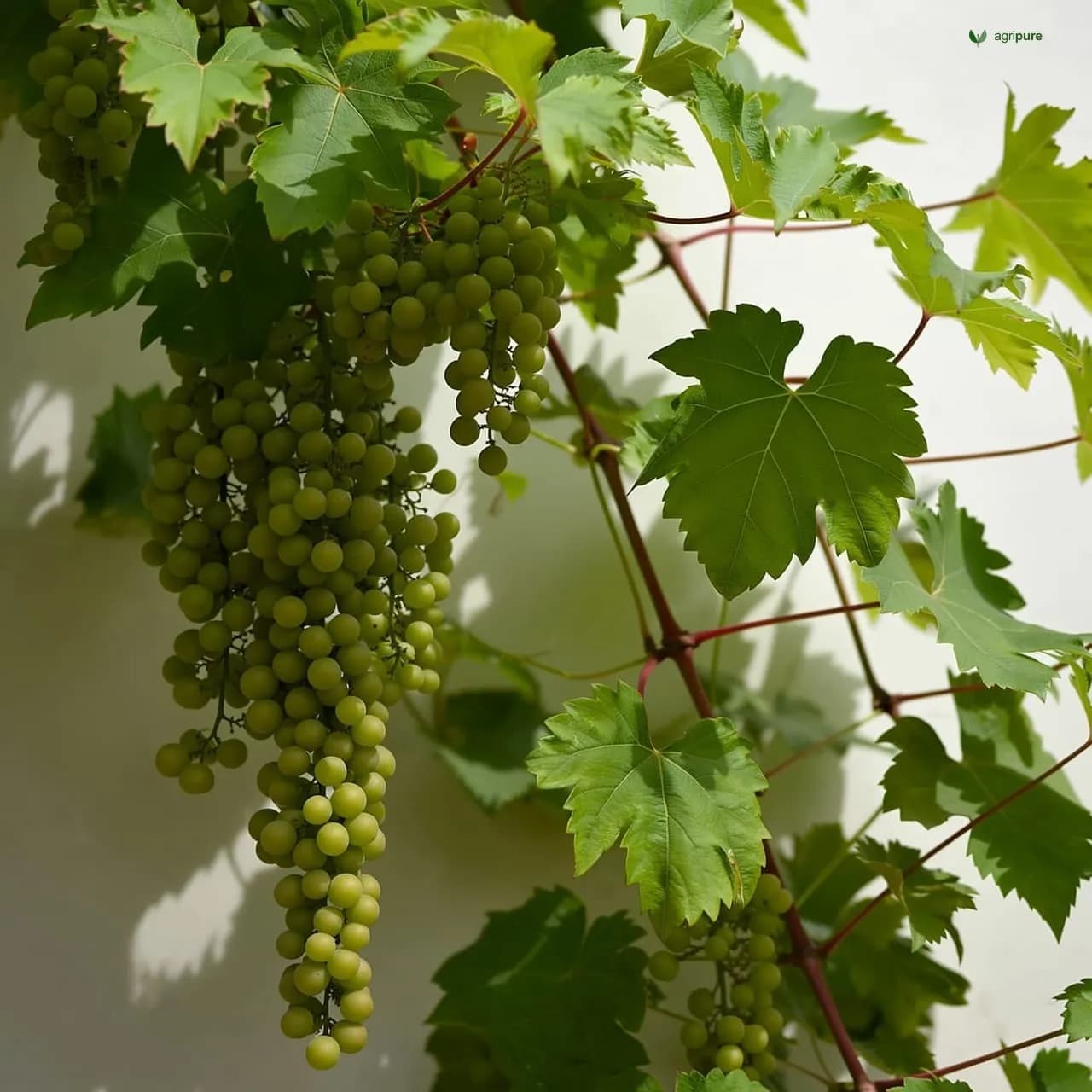
The vine is a woody, deciduous climber that uses branched tendrils, set opposite the leaves, to haul itself up a support, and over time it can reach 40 to 60 feet (12 to 18 m) in length where it has something to climb. The leaves are alternate, simple, typically three to five lobed, and toothed along the margin; together with the shoot tips and fruit they are the features used to tell cultivars apart in the practice of ampelography. The flowers are small, greenish, and inconspicuous, carried in panicles. The fruit is the familiar cluster, or bunch, of berries, and this one species contains the classic wine and table grapes. Older stems turn woody and the bark tends to peel or shred with age, another trait used in identification. Because there are an estimated 5,000 to 10,000 cultivars of V. vinifera, leaf shape, bunch size, and berry color vary enormously within the single species.
Growing Grapes
The common grape vine is hardy in roughly USDA zones 6 to 10, and it performs best in temperate, relatively dry-summer climates of the Mediterranean type. It should be grown in full sun and protected from winter winds and frost, and hot, humid summers, such as those of parts of the southeastern United States, work against good fruit production. That preference for warmth without humidity is why the vine suits cool, dry uplands: it wants the heat that ripens the bunch but resents the damp air that breeds disease.
Grapevines are propagated vegetatively rather than from seed, because that is how the traits of a named cultivar are kept true to type, and the vast system of thousands of distinct cultivars depends on it. In practice this means starting new plants from cuttings or from grafted nursery stock rather than sowing pips. Many V. vinifera cultivars are in fact grafted onto rootstocks taken from American Vitis species, a standard defense against phylloxera, a root pest to which V. vinifera is particularly susceptible. Choosing clean, true-to-type cutting or grafted stock at the outset therefore matters as much for grapes as the planting site itself.
For site and soil, the common grape prefers full sun and requires well-drained soil, and it needs good air circulation around the plant to stay healthy. It should be sited where it is protected from winter winds and frost. Because it is a climber, it must be given support and training, on a trellis, arbor, or pergola, to carry its long woody growth. On watering, the species-level horticultural sources do not give a fixed irrigation schedule; they stress instead that excess moisture worsens fungal disease, so the sound, sourced rule is to keep the soil well drained and avoid constant wetness, which feeds gray mold, downy mildew, and powdery mildew. As a long-lived perennial vine, grapes take a few seasons to establish their framework before they crop in earnest, so the first years are about building structure on the trellis rather than chasing fruit.
Harvest and uses
The crop is the ripe bunch of berries, and the same species, through its thousands of cultivars, supplies the three classic products: table grapes eaten fresh, raisins made by drying, and wine made by pressing and fermenting. Which one a given vine is best for is decided by the cultivar, since V. vinifera spans the dedicated wine grapes, the table grapes, and the drying types. The fruit and leaves are widely eaten by people, but the crop is not harmless to everything: grapes and raisins can be toxic to dogs and some other animals, and grape seed extract or juice can interact with medications in humans, so the harvest is best kept away from pets. The dried-raisin route is worth noting for storage, since it turns a perishable fresh bunch into a stable, keepable product, while fresh table grapes are the short-window crop eaten straight off the vine.
Pruning and training
Grapes fruit on a managed framework of woody growth carried on a support, not on a free tangle, which is why the species is described as needing support and training onto a trellis, arbor, or pergola. The branched tendrils that climb opposite the leaves are the vine’s own grip, but it is the grower’s trellis that decides the shape of the fruiting wall. Keeping that wall open also serves the disease side: good air circulation is part of a healthy plant, and an open, well-trained canopy dries faster and gives the mildews and rots less of a foothold than a dense, still one. Training onto a sunny, airy frame therefore does double duty, presenting the fruit to the sun that ripens it while keeping the foliage dry enough to limit fungal attack.
Common diseases and pests
The chief threats flagged for the common grape are fungal: gray mold, downy mildew, and powdery mildew, all favored by excess moisture and humid conditions. This is the practical reason humidity is the vine’s real enemy and why a dry-summer climate and a well-drained, well-ventilated site are protective rather than incidental. The major insect-side concern is phylloxera, a pest to which V. vinifera is especially vulnerable, which is precisely why so many vines of this species are grafted onto resistant American Vitis rootstocks. Choosing a dry, sunny, breezy site, keeping the canopy open through training, avoiding waterlogged soil, and using an appropriate rootstock where phylloxera is a risk handles most of the vine’s worst problems at the level of the planting decision itself.
Sources
- Wine Australia. “Vine identification.” (PDF)
- GBIF. “Vitis vinifera L.” Global Biodiversity Information Facility.
- Missouri Botanical Garden. “Vitis vinifera.” Plant Finder.
- NC State Extension. “Vitis vinifera (Common Grape).” North Carolina Extension Gardener Plant Toolbox.
- Ridge Vineyards. “How to Identify Types of Wine Grapes.”
- Oregon State University Extension. “Grape variety identification.”
- Lodi Winegrape Commission. “The 9,000-year history of Vitis vinifera.”
- Vitis Vinifera Authority. “Vitis vinifera grape varieties.”