climax
Himalayan Box
shamshad
Buxus wallichiana
Also known as Shamshad (Pakistan).
- kpk hills
International hardiness
- USDA 7-10
- RHS H5
- AU: Warm temperate, Cool temperate, Mediterranean
Where it grows — regional guide
| Zones / rating | Regional notes |
|---|---|
USDA 7-10 | No region-specific data yet |
| Zones / rating | Regional notes |
|---|---|
H5 (-15 to -10C) | No region-specific data yet |
| Zones / rating | Regional notes |
|---|---|
Warm temperate, Cool temperate, Mediterranean | No region-specific data yet |
| Zones / rating | Regional notes |
|---|---|
USDA 7-10 (USDA scale) Canada uses its own zone system; Canadian zones run roughly one lower than USDA. | No region-specific data yet |
| Zones / rating | Regional notes |
|---|---|
KPK hills | Pakistan:An evergreen understory tree of moist northern hill forests; plant in established shade rather than open ground for dense carving wood. India:Native to moist-temperate mixed broadleaf forests of the western Himalaya; plant under mature canopy shade for slow-grown timber. |
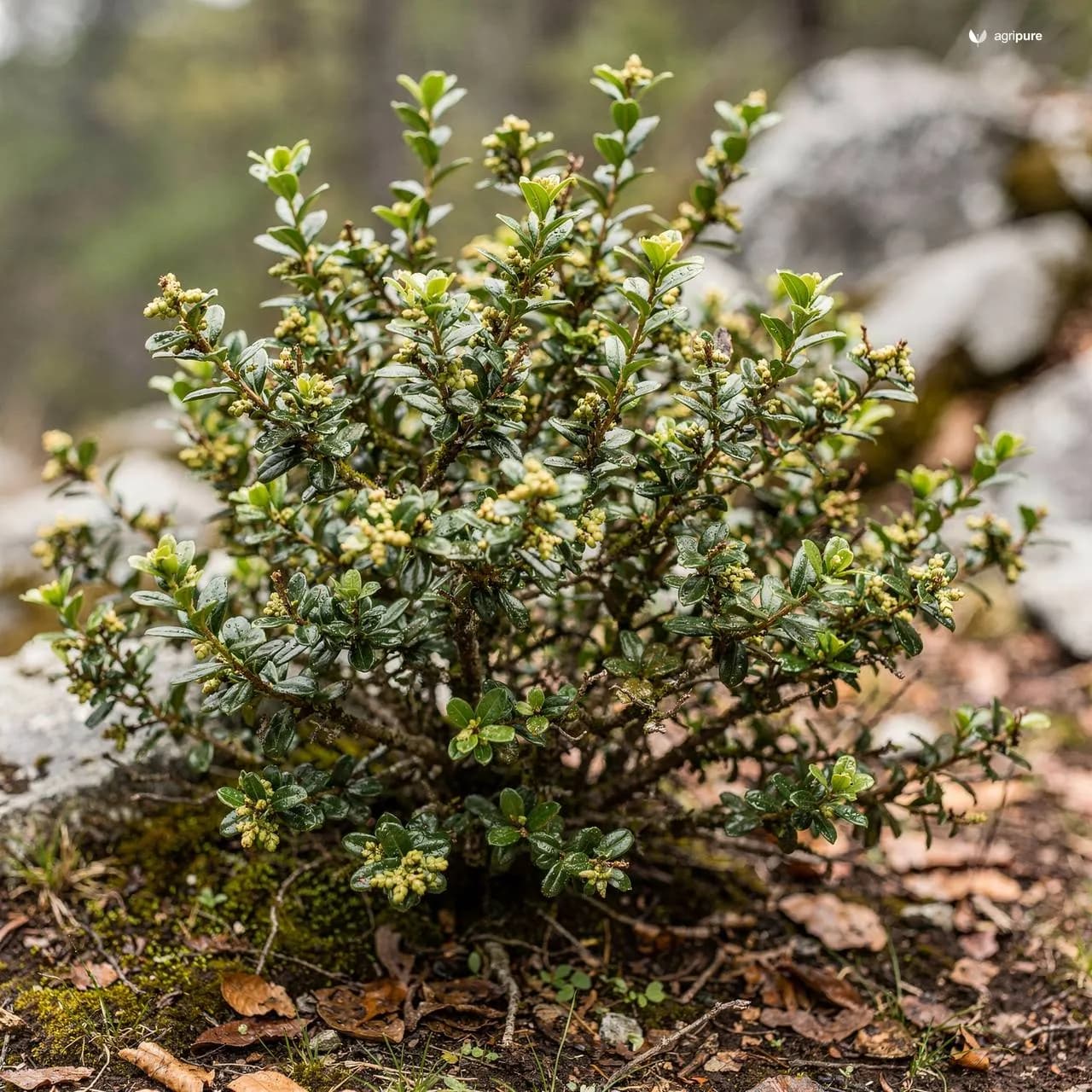
Himalayan box, Buxus wallichiana, known as shamshad, is the slow, shade-loving evergreen of mature hill forests in Khyber Pakhtunkhwa. It grows for decades in the understory of a closed canopy and lays down some of the densest, finest-grained wood in the region. In syntropic terms it is a true climax-stratum species: you plant it for the next century, as the patient occupant of the deep shade other trees create.
Where it thrives
Shamshad is a much-branched evergreen shrub or small tree, reaching 4 m or more in the wild, and it is recorded in moist-temperate mixed broadleaf forest from roughly 1,200 to 3,000 m. The defining trait is shade. It prefers shady habitat, avoids exposed slopes and direct sun, and grows as an associate under taller forest trees. That ties it to the the KPK hills zone — the cool, humid hill forests of the north, not the open plains. It is genuinely slow-growing, but it regenerates well where the forest floor is undisturbed, in one Himalayan survey contributing the highest seedling and sapling densities of the stand.
Role in the system
This is a climax understory species, and that is exactly how to use it. It does not pioneer bare ground and it does not fix nitrogen. Its job is to occupy the deep, stable shade of a mature planting once faster pioneers and secondary trees have built the canopy above it. Because it tolerates heavy shade better than almost anything else, it fills the lowest woody layer where light is scarce, holding that niche for a very long time. Its slow growth adds long-lived structure and biodiversity to the mature phase without competing with the productive layers for light. Where the forest floor is left undisturbed it regenerates well from seed, recruiting new seedlings and saplings into the understory rather than needing to be replanted. That makes it a self-renewing component of a restored hill forest.
What you get
The payoff is wood, decades out. Box is harvested from the wild for its high-quality timber — extremely hard, dense, and fine-grained, the classic material for carving, turning, combs, and small tool handles. The same density that makes it valuable makes it slow, so this is a heritage asset rather than a cash crop on any short horizon. The foliage has a minor place in local medicine, and the neat evergreen form is also grown clipped as a hedge. Wild box is over-harvested and slow to replace, so the honest reason to plant it is restoration and a long-term timber reserve.
Sourcing notes
Buy nursery-raised seedlings or take cuttings rather than lifting plants from native KPK forest, where wild stands are under pressure. Plant it into established shade, not open ground, and expect to wait — this is a multi-decade tree.
Sources
- Useful Temperate Plants. “Buxus wallichiana.” (form, shade preference, altitude, wood, and uses).
- Vegetos. “Buxus wallichiana Baill., an emerging forest stand of Garhwal Himalaya.” (regeneration and ecological traits).
Sourcing notes
Buy nursery-raised seedlings or take cuttings rather than lifting plants from native KPK forest, where wild stands are under pressure; plant into established shade, not open ground.