pioneer
Bermuda Grass (Bahama Grass)
khabbal / dhub
Cynodon dactylon
Also known as Khabbal (Pakistan), Doob (India), Couch Grass (Australia).
- punjab plains
- sindh coast
- pothohar
International hardiness
- USDA 7-11
- RHS H4
- AU: Tropical, Subtropical, Arid / semi-arid, Warm temperate, Mediterranean
Where it grows — regional guide
| Zones / rating | Regional notes |
|---|---|
USDA 7-11 | A durable warm-season turf grass across the south that turns brown in winter frost and spreads persistently into garden borders. |
| Zones / rating | Regional notes |
|---|---|
H4 (-10 to -5C) | No region-specific data yet |
| Zones / rating | Regional notes |
|---|---|
Tropical, Subtropical, Arid / semi-arid, Warm temperate, Mediterranean | Widely planted for drought-tolerant lawns in warm zones, requiring regular edging to prevent stolons invading ornamental borders. |
| Zones / rating | Regional notes |
|---|---|
USDA 7-11 (USDA scale) Canada uses its own zone system; Canadian zones run roughly one lower than USDA. | No region-specific data yet |
| Zones / rating | Regional notes |
|---|---|
Punjab plains, Sindh coast, Pothohar | Pakistan:A tough, drought-hardy lawn and pasture grass of the sunny plains that spreads by runners and goes dormant in cold winter spells; keep it well away from vegetable beds, as it is very hard to remove once established. India:A durable warm-season turf and sacred groundcover that withstands trampling and heat, though it invades cultivated garden beds. |
Grows alongside
Species that appear with Bermuda Grass (Bahama Grass) in 5 of our published guides — a starting list for a guild, not a planting plan.
Bermuda grass (Cynodon dactylon), also called Bahama grass and, in some English-speaking regions, couch grass, is a perennial, warm-season (C4) turf and pasture grass that forms dense, low-growing mats. Most sources place its native range in tropical Africa or possibly southern Asia, but it has since naturalized throughout the tropical and warm-temperate parts of the world, roughly between 45° N and 45° S latitude. For the homesteader, it is a plant with two faces: an exceptionally tough, drought-hardy ground cover and grazing grass on one hand, and a tenacious, hard-to-remove weed on the other. The grower's job is to know which face is in play, and to place the grass on purpose.
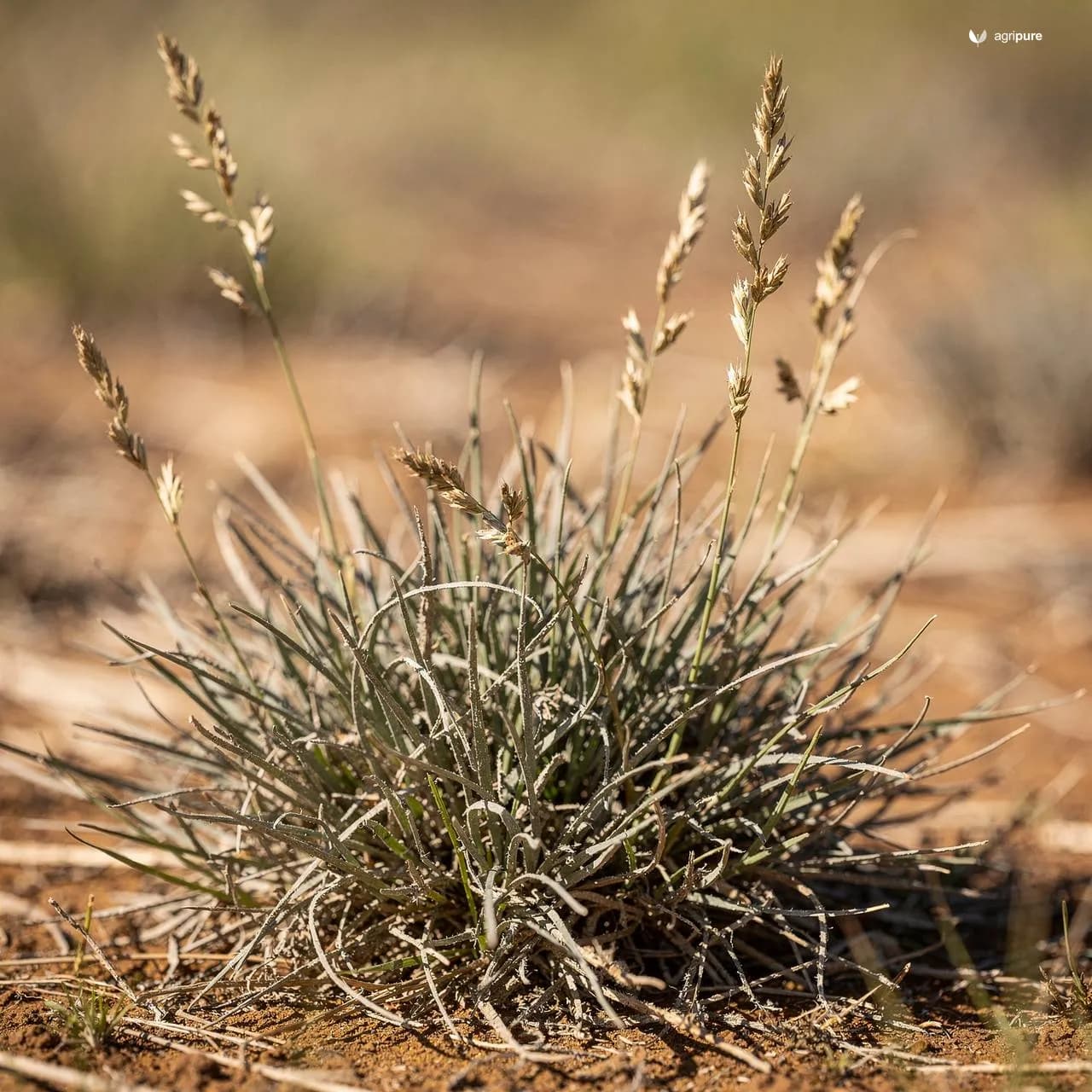
It is a prostrate, mat-forming grass that spreads aggressively by both stolons (above-ground runners) and rhizomes (underground stems), rooting at the nodes as it goes. Flowering stems are slightly flattened in cross-section and typically reach about 0.5 m (roughly 1.6 ft) tall, rising from the creeping runners. The leaf blades are linear, about 5 to 16 cm long and 2 to 3 mm wide, usually smooth or only sparsely hairy, and the plant carries a fringe of hairs in place of a membranous ligule. Overall it reads as a fine-textured turfgrass.
How to identify Bermuda grass
The most reliable field cue is the seed head. Three to nine slender spikes, each about 3 to 10 cm (1.2 to 4 in) long, radiate from a single point at the end of a stem, giving a distinctive “bird-foot” or bird’s-foot appearance. The spikelets are small and awnless, 2 to 3 mm long, each bearing a single flower that produces a light-brown, egg-shaped seed. Put together, the diagnostic combination for a homestead is a dense, low mat of creeping runners that root at the nodes, deep and tough rhizomes underground, and that unmistakable bird-foot seedhead with three to five (sometimes more) spokes from one point.
Growing Bermuda grass
Bermuda grass can be established either by seed or vegetatively. It forms viable seed, and many cultivars — such as ‘Arizona Common’, ‘Sahara’, and ‘Yukon’ — are sold as seeded varieties. It is also commonly planted from sprigs, stolons, and sod, taking direct advantage of its natural creeping habit.
It is a warm-climate grass that grows rapidly given warm temperatures and adequate moisture, which is exactly why it dominates lawns and pastures across subtropical and warm-temperate regions. It is widely valued as turf because it is extremely drought-hardy, durable, and versatile, holding up across many different settings. It grows on a broad range of soils and is found on disturbed sites, in agronomic crops, orchards, turf, landscaped ground, and forestry areas, indicating tolerance for many soil textures. Detailed pH and soil-texture optima are not specified in the sources used here, so they are not stated.
On hardiness, the primary extension and floristic literature does not assign a single set of USDA-zone numbers. The distribution data give the bounds: Bermuda grass occurs throughout the United States except for some of the most northern parts of the Midwest and New England, and is most common in subtropical regions from southern California across the Gulf Coast and southeastern states. A reasonable horticultural reading of that range is roughly USDA zones 7 to 11, with survival possible — but with risk of winter-kill or thinning — in milder parts of zone 6 and warmer microclimates farther north. That zone interpretation is an inference from latitude and distribution maps, not a figure taken directly from the cited sources.
Harvest and uses
Bermuda grass earns its keep as a ground cover and forage rather than as a once-a-season harvest. Its dense, creeping mat and tough rhizomes make it a strong soil-binder on disturbed and erodible ground, and the same vegetative vigor that lets it be established from sprigs and stolons lets it knit bare earth together quickly. As a warm-season turf it is a standard, low-input choice for lawns, paths, and high-traffic ground precisely because it is drought-hardy, durable, and recovers well. The sources used here document it primarily as a turf and pasture grass and as a widespread weed; they do not provide forage protein figures or yield numbers, so none are stated.
Common problems: a weed first, a crop second
The single most important thing to understand about Bermuda grass is how hard it is to get rid of once it is in the wrong place. Its deep, tough rhizomes and aggressive stolons make it very difficult to eradicate, and it is treated as a serious invasive weed across many regions. It readily colonizes disturbed sites, agronomic crops, and orchards, where it competes with the plants you actually want. For a homestead this means a clear rule: site it deliberately as ground cover or pasture where its spreading habit is an asset, keep it well away from vegetable beds and crop rows, and use hard borders or edging, because fragments of stolon and rhizome can re-establish the stand. Never sow it into land you intend to crop.
Sources
- Bermudagrass — UC IPM (University of California Agriculture and Natural Resources)
- Cynodon dactylon — Fire Effects Information System, USDA Forest Service
- Cynodon dactylon — Wikipedia
- Bermudagrass — AggieTurf, Texas A&M University
- Bermudagrass weed profile — Cornell University, CALS
- Cynodon dactylon — NatureServe Explorer
- Cynodon dactylon (invasive plant) — Native Plant Society of Texas
Sourcing notes
Spreads readily from runners and seed and is usually already present; establish from sprigs or sod rather than buying seed. Easy to start, hard to remove — place it deliberately.