pioneer
Safflower
kusum
Carthamus tinctorius
Also known as Kusum (Pakistan).
- punjab plains
- sindh coast
- balochistan highlands
International hardiness
- USDA 8-11
- RHS H3
- AU: Arid / semi-arid, Warm temperate, Mediterranean
Where it grows — regional guide
| Zones / rating | Regional notes |
|---|---|
USDA 8-11 | Grown as a drought-hardy summer annual in arid western plains; handle spiny heads with care, and avoid if using blood thinners. |
| Zones / rating | Regional notes |
|---|---|
H3 (-5 to 1C) | No region-specific data yet |
| Zones / rating | Regional notes |
|---|---|
Arid / semi-arid, Warm temperate, Mediterranean | Suits dry and mediterranean farming regions as a summer oilseed; gloves protect against spiny foliage, and avoid during pregnancy. |
| Zones / rating | Regional notes |
|---|---|
USDA 8-11 (USDA scale) Canada uses its own zone system; Canadian zones run roughly one lower than USDA. | No region-specific data yet |
| Zones / rating | Regional notes |
|---|---|
Punjab plains, Sindh coast, Balochistan highlands | Pakistan:Grown on arid plains as a drought-tolerant seed crop; wear gloves against spiny leaves, and avoid medicinal use when pregnant. India:Cultivated on dry plains for seed oil and dye petals; handle prickly heads with gloves, and avoid during pregnancy. |
Grows alongside
Species that appear with Safflower in 1 of our published guides — a starting list for a guild, not a planting plan.
Safflower (Carthamus tinctorius) is a thistle-like annual in the daisy family (Asteraceae), grown above all for the oil pressed from its seed and for the red and yellow pigments held in its flowers. It is a branched, herbaceous plant with spiny leaves and globular flower heads, and the petals are the part traditionally harvested for dye. The reliable sources place its origins in the arid country stretching between northern India and the Near East, a heritage that shows in its hardiness: it is described as drought resistant and well adapted to arid climates, which makes it a sensible choice for a homesteader looking to turn a dry, sun-baked corner into a useful oil, dye, and seed crop rather than fighting it with irrigation.
Identifying safflower
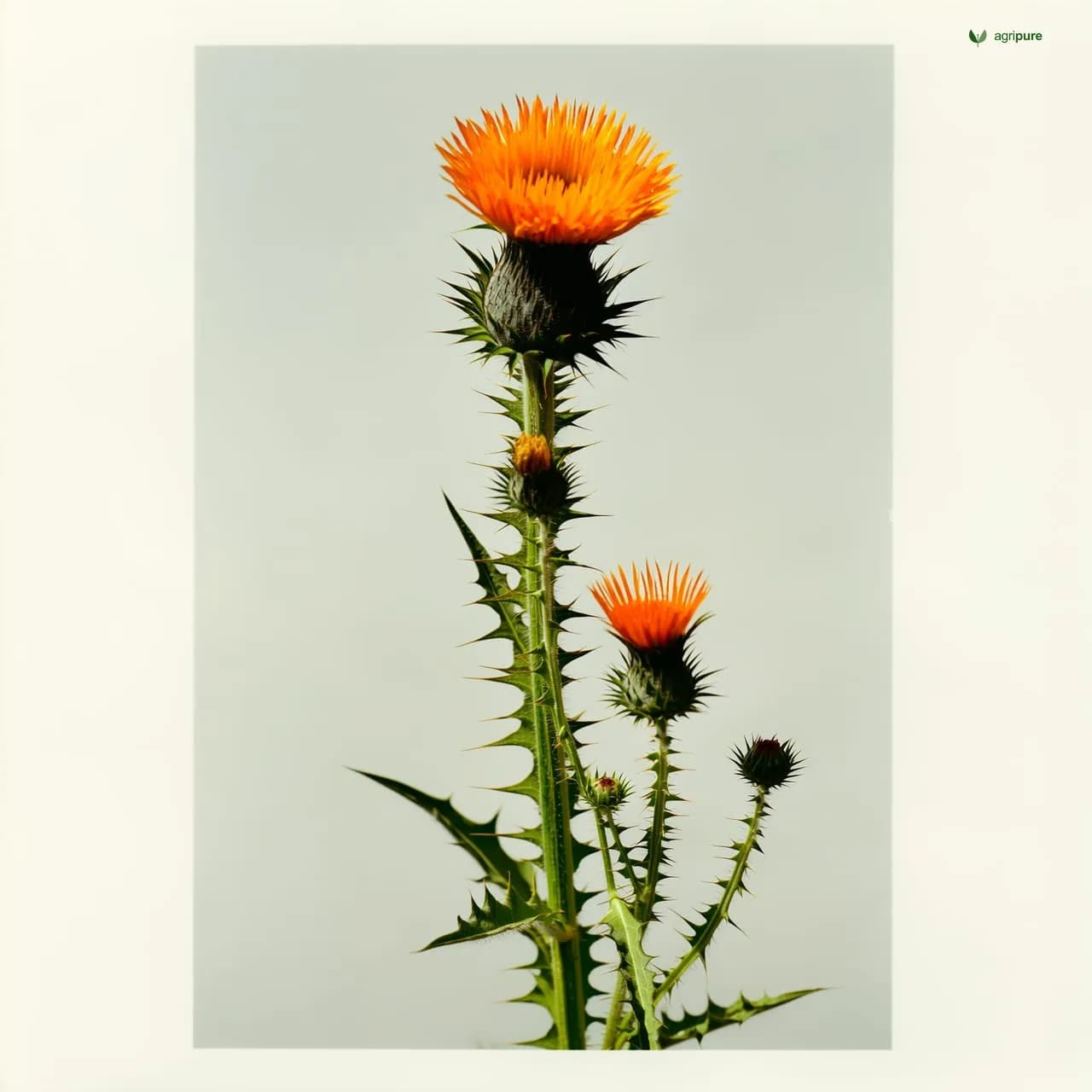
Safflower is an annual, spiny, highly branched herb. Depending on conditions it can reach about 1 m tall or more, carrying globular heads of yellow to orange-red flowers. The spiny leaves and the round, thistle-like heads are the clearest field cues, and it is those colourful petals — not the seed — that have long been gathered as a dye material. Each branch typically bears 1 to 5 flower heads, and each head contains roughly 15 to 20 seeds, so a single well-branched plant can carry a surprising amount of seed for its size.
Growing safflower
Safflower is an annual and is propagated by seed, in keeping with its status as a seed-sown annual oil crop. Its great practical virtue is that it is drought resistant and suited to arid conditions, so it earns its place on the lean, dry ground where thirstier crops sulk.
Beyond that, honest sourcing requires some restraint. The reliable references gathered here do not pin down species-specific figures for soil pH and fertility, ideal sunlight exposure, an irrigation schedule, or row and plant spacing, and they do not give a dependable, citable time-to-maturity for the crop. Rather than invent numbers, those details are left out here. In practice, treat safflower as the dryland oilseed it is: sow seed into open ground, keep it on the dry side, and let its drought tolerance do the work it is built for.
Harvest and uses
Safflower is harvested for two distinct products: the seed, which is pressed for oil, and the flowers and petals, which are used as dye material. With 1 to 5 heads per branch and 15 to 20 seeds per head, the seed harvest comes from those dried globular heads once they mature.
In the kitchen, safflower has a long record of use for flavouring and colouring foods. Its seed oil is used as a cooking oil, in salad dressing, and in margarine, while the flower petals have served as a food colouring agent. The petals are the source of the natural dye carthamin, used to colour textiles and in cosmetics, and safflower oil also finds its way into cosmetic products.
Safflower also carries a long thread of medicinal tradition. The ethnomedicinal and pharmacological literature describes its use for complaints such as menstrual disorders, pain, inflammation, and cardiovascular issues; these are traditional and experimental observations, however, not proof of clinical effect, and this profile makes no claim that it treats or cures any condition.
Safety and cautions
The sources do not describe safflower as a broadly poisonous plant, and they do not single out any particular plant part as toxic. That said, a few grounded cautions are worth respecting, especially if the plant is used medicinally rather than just for oil or dye:
- The pharmacological literature reports undesirable effects on male and female fertility, and notes that safflower has historically been used in traditional medicine with caution.
- Because of those reported fertility effects, it should be treated cautiously by anyone who is pregnant, trying to conceive, or concerned about reproductive effects.
- Reviews also discuss anticoagulant-like (blood-thinning) activity, so caution is warranted for anyone on blood-thinning therapy; no direct clinical interaction study is cited here, so this is offered only as a conservative note rather than a specific medical claim.
As with any plant used medicinally, the sensible course is to enjoy safflower freely for its oil, seed, and dye, but to seek qualified medical advice before using it as a herbal remedy, particularly when pregnancy, fertility, or prescription medication is involved.
Sources
- [Safflower (Carthamus tinctorius) — CAMEO, Museum of Fine Arts, Boston](https://cameo.mfa.org/wiki/Safflower_\(Carthamus_tinctorius\)_LC)
- Carthamus tinctorius L. review — PMC (National Library of Medicine)
- Carthamus tinctorius overview — ScienceDirect Topics
- Safflower — Wikipedia
- Carthamus tinctorius (safflower) plant profile — USDA PLANTS Database
- Carthamus tinctorius datasheet — CABI Digital Library
- Safflower (Carthamus tinctorius) research — Annals of Applied Biology (Wiley)