secondary
Broom Creeper (Ink Berry Vine)
parwati / jal-jamni
Cocculus hirsutus
Also known as Jal-jamni (Pakistan), Patalgarudi (India).
- punjab plains
- sindh coast
International hardiness
- USDA 9-11
- RHS H1c
- AU: Tropical, Subtropical, Arid / semi-arid
Where it grows — regional guide
| Zones / rating | Regional notes |
|---|---|
USDA 9-11 | No region-specific data yet |
| Zones / rating | Regional notes |
|---|---|
H1c (5 to 10C) | No region-specific data yet |
| Zones / rating | Regional notes |
|---|---|
Tropical, Subtropical, Arid / semi-arid | No region-specific data yet |
| Zones / rating | Regional notes |
|---|---|
USDA 9-11 (USDA scale) Canada uses its own zone system; Canadian zones run roughly one lower than USDA. | No region-specific data yet |
| Zones / rating | Regional notes |
|---|---|
Punjab plains, Sindh coast | Pakistan:Scrambles over dry plains hedges; pick leaves to make a traditional cooling summer jelly, and prune to keep off young trees. India:Grown on dry borders and scrub across the plains; leaves are soaked in cold water to make a cooling drink during hot weather. |
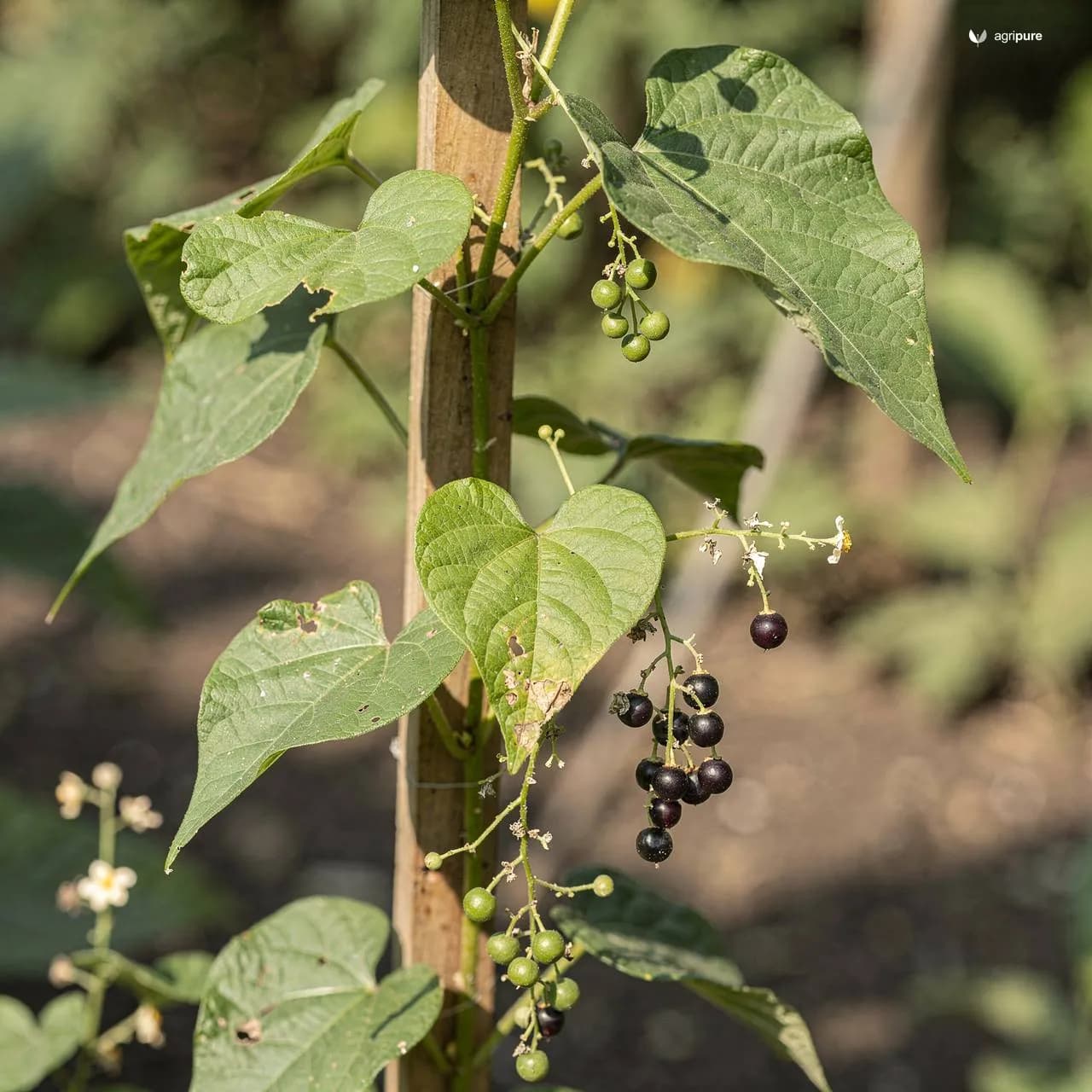
Broom creeper (Cocculus hirsutus, parwati or jal-jamni) is a hardy twining moonseed of plains hedges, a long-lived climber that scrambles over scrub and fence lines on dry ground in the the Punjab plains and along the coastal Sindh. Its leaves are set into a cooling green jelly and the plant is widely used for urinary and other complaints across Pakistan and India. On a syntropic site it works as a secondary-stage vine: a tough, undemanding climber that covers hedges and rough edges and doubles as a household medicine and drink plant.
Where it thrives
It is a dioecious scrambling shrub or liana reaching up to 15 m, growing in bushland and semi-desert scrub up to about 1,200 m on sandy and gravelly soils. Its range runs across eastern and southern Africa to India, Myanmar, Thailand, and southern China, taking in the dry plains of Pakistan. This is a plant of hot, dry, open country rather than shade or wet ground, climbing over hedges and low cover wherever it can get a hold, which is what makes it a familiar hedge vine on the plains.
Role in the system
Treat broom creeper as a secondary climbing layer on the dry edges of a planting. It scrambles over hedges and scrub to give cover on hard ground, and its dense habit forms a protective drape over other vegetation. As a long-lived perennial it is hardy and undemanding, so it earns its place by thriving where the soil is sandy and the season is dry, holding rough edges and hedge lines that more demanding plants will not take. Its leaves come within easy reach along a fence, which matters because the foliage is the useful part — a drink, a medicine, and a little browse all cut from the same low growth. Cut it back if it climbs into young trees you want kept in the open, and otherwise let it run along the fence line, where its cover and its leaves both pay their way. It is a vine to keep at the margins rather than the centre of a planting.
Uses
The plant pulls triple duty. The leaves, soaked in cold water, set into a cooling jelly drunk in the hot season, and they are eaten occasionally as a potherb. Medicinally it is one of the better-known plains remedies in Ayurveda, Siddha, and Unani practice, used for fever, skin complaints, inflammation, and especially urinary problems; leaf extracts show diuretic activity in animal studies, and the leaves and roots are used as a tonic and diuretic.2 Its dense foliage is also browsed by stock. As a vine that gives a drink, a medicine, and a little fodder off dry hedge ground, it is a practical fit for the plains.
Sources
- Sangeetha, K. S. S., et al. (2020). “Cocculus hirsutus (L.) W.Theob. (Menispermaceae): a review on traditional uses, phytochemistry and pharmacological activities.” Medicines / PMC (Pakistan and India use, urinary remedies).
- Schmelzer, G. H. (PROTA). [“Cocculus hirsutus.”](https://plantuse.plantnet.org/en/Cocculus_hirsutus_\(PROTA\)) PROTA, PlantUse (liana habit, range, cooling leaf jelly, edible leaves, diuretic).
Sourcing notes
Strikes readily from cuttings or wild-lifted rooted stems along plains hedges; the leaf jelly is a household use rather than a market crop, so a few vines on a fence line are usually enough.