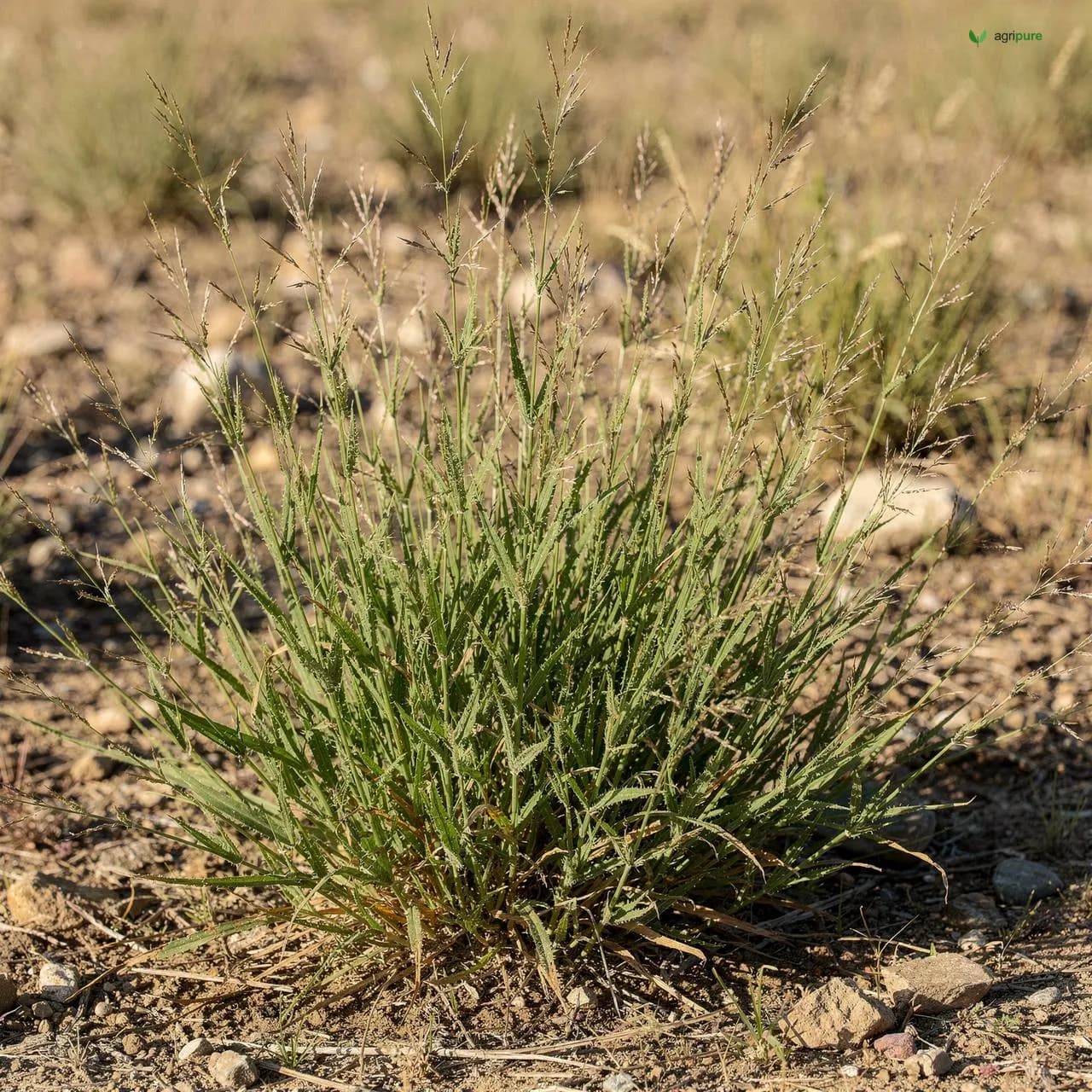
secondary
Ringed Dichanthium
palwan
Dichanthium annulatum
Also known as Palwan (Pakistan), Marvel Grass (India, Australia), Kleberg Bluestem (United States).
- punjab plains
- sindh coast
International hardiness
- USDA 8-11
- RHS H3
- AU: Tropical, Subtropical, Arid / semi-arid
Where it grows — regional guide
| Zones / rating | Regional notes |
|---|---|
USDA 8-11 | Established in southern pastures as a drought-hardy perennial forage; it is grown for grazing and is not safe to eat. |
| Zones / rating | Regional notes |
|---|---|
H3 (-5 to 1C) | No region-specific data yet |
| Zones / rating | Regional notes |
|---|---|
Tropical, Subtropical, Arid / semi-arid | Grown in warm, dry northern rangelands for cattle grazing; it is a tough soil-cover grass and is not documented as food. |
| Zones / rating | Regional notes |
|---|---|
USDA 8-11 (USDA scale) Canada uses its own zone system; Canadian zones run roughly one lower than USDA. | No region-specific data yet |
| Zones / rating | Regional notes |
|---|---|
Punjab plains, Sindh coast | Pakistan:Hardy perennial pasture grass of the plains, tolerating drought and salinity; it is not safe or documented for human food. India:Native warm-season pasture grass valued for heavy grazing tolerance; it is livestock forage and is not human food. |
Ringed dichanthium (Dichanthium annulatum) is a perennial, tufted grass in the grass family (Poaceae), known by a string of common names including marvel grass, Kleberg bluestem, Hindi grass, and sheda grass. Its native range runs in a broad belt from Malesia and India westward to the Middle East and West Africa, and it has since spread far beyond that, now recorded across Africa, temperate and tropical Asia, Australasia, the Pacific, and both North and South America. For a homesteader, the appeal is durability: this is a tough, sun-loving warm-season grass that holds dry, salty, hard-grazed ground where fussier pasture species give out, which makes it a practical forage and soil-cover grass for harsh corners of a property.
It is a clumping perennial whose culms (stems) are decumbent (they lean or sprawl along the ground before turning up) and reach roughly 25 to 100 cm tall. The mid-culm nodes are bearded, and a tuft of hairs often (though not always) sits at the stem nodes; this ring of hairs is what gives the plant its “ringed” common name. The leaf blades are 3 to 30 cm long and 2 to 7 mm wide, with a membranous ligule at the base of the blade. A reliable field cue is the seed head: the spikelets are borne in pairs, one a sessile fertile spikelet and the other a stalked (pedicelled) companion spikelet, and the grain itself is only about 1.5 mm long. In some regions the plant flowers through much of the year.
Growing ringed dichanthium
This is a warm-climate forage grass that is sometimes cultivated, but the botanical and floristic sources gathered here do not provide reliable, species-specific propagation methods, seeding rates, plant spacing, irrigation schedules, or time-to-maturity figures. Rather than state those with false precision, this profile leaves them out and sticks to the site conditions the sources do support.
What is well documented is its tolerance. Ringed dichanthium grows on almost all kinds of soil and is notably tolerant of both salinity and drought, which is why it persists on saline and dry ground that limits other grasses. The one clear limit is light: it cannot deal with shade and needs an open, sunny position. It is also remarkably resilient to disturbance — in Asia it stands up to heavy grazing and fire, recovering and persisting where lighter-built grasses would be lost. In practice, treat it as a full-sun, low-input grass for open, well-grazed or marginal land rather than a pampered crop.
Harvest and uses
The sources gathered here do not give reliable species-specific yield, biomass, seed-yield, or harvest-timing figures for homestead use, so this profile does not invent them. Its documented value is as a grass rather than a measured crop.
Ringed dichanthium is described as an important forage plant in Asia, valued precisely because it tolerates heavy grazing and fire and keeps producing leaf under hard use. Its ability to persist through drought and on saline soils also points to a role as ground cover for harsh, marginal sites, holding soil and providing grazing where little else will grow, though that is a reasonable extension of its documented tolerances rather than a formal agroforestry recommendation in the sources. No reliable source in this set supports culinary, material, or medicinal uses for the species, so none are claimed here.
Where it grows
Beyond its Old World native belt, ringed dichanthium is now firmly part of New World floras: the USDA Plants Database records it as present in Hawaii, the lower 48 states, and Puerto Rico. Kew’s distribution data likewise places it across Africa, temperate and tropical Asia, Australasia, the Pacific, and North and South America — a global spread that reflects both deliberate introduction as forage and its own ability to colonize disturbed, open ground. A dependable USDA hardiness-zone statement was not found in these sources, so no zone range is asserted here.
Safety and cautions
In the sources reviewed, there is no direct evidence of toxicity or poisonous parts for Dichanthium annulatum. Equally, there is no reliable evidence that it is edible for people, so it should not be treated as a human food plant without species-specific confirmation. No source here reports drug interactions, pregnancy or lactation cautions, or other medicinal safety issues for the species; with no medicinal use documented, none of those questions arises from this profile. As with any wild grass, identify it carefully before grazing livestock on unfamiliar stands, and confirm forage suitability through local agricultural advice.
Sources
- Dichanthium annulatum field notes — Backyard Nature
- Dichanthium annulatum — AusGrass2 (Lucidcentral)
- Dichanthium annulatum — Wikipedia
- Dichanthium annulatum — Plants of the World Online, Royal Botanic Gardens, Kew
- Dichanthium annulatum plant profile — USDA PLANTS Database
Sourcing notes
Sown from seed before the monsoon or established by splitting clumps; seed is produced freely and is the usual route. Tolerant of poor and saline soils, so it establishes on plains and coastal ground that limits other pasture grasses.