secondary
Wild Himalayan Strawberry
jangli-strawberry
Fragaria nubicola
Also known as Jangli Strawberry (Pakistan).
- kpk hills
International hardiness
- USDA 5-8
- RHS H5
- AU: Cool temperate, Warm temperate
Where it grows — regional guide
| Zones / rating | Regional notes |
|---|---|
USDA 5-8 | No region-specific data yet |
| Zones / rating | Regional notes |
|---|---|
H5 (-15 to -10C) | Hardy under RHS H5 in cool, moist, shaded borders; spreads by runners to provide dense groundcover and small fragrant berries. |
| Zones / rating | Regional notes |
|---|---|
Cool temperate, Warm temperate | No region-specific data yet |
| Zones / rating | Regional notes |
|---|---|
USDA 5-8 (USDA scale) Canada uses its own zone system; Canadian zones run roughly one lower than USDA. | No region-specific data yet |
| Zones / rating | Regional notes |
|---|---|
KPK hills | Pakistan:Native perennial groundcover of moist hill forests; spreads by stolons to form a soil-holding mat bearing aromatic wild berries. India:Native across Himalayan temperate forests; forms an edible living mulch in shaded clearings, yielding small aromatic berries. |
Grows alongside
Species that appear with Wild Himalayan Strawberry in 1 of our published guides — a starting list for a guild, not a planting plan.
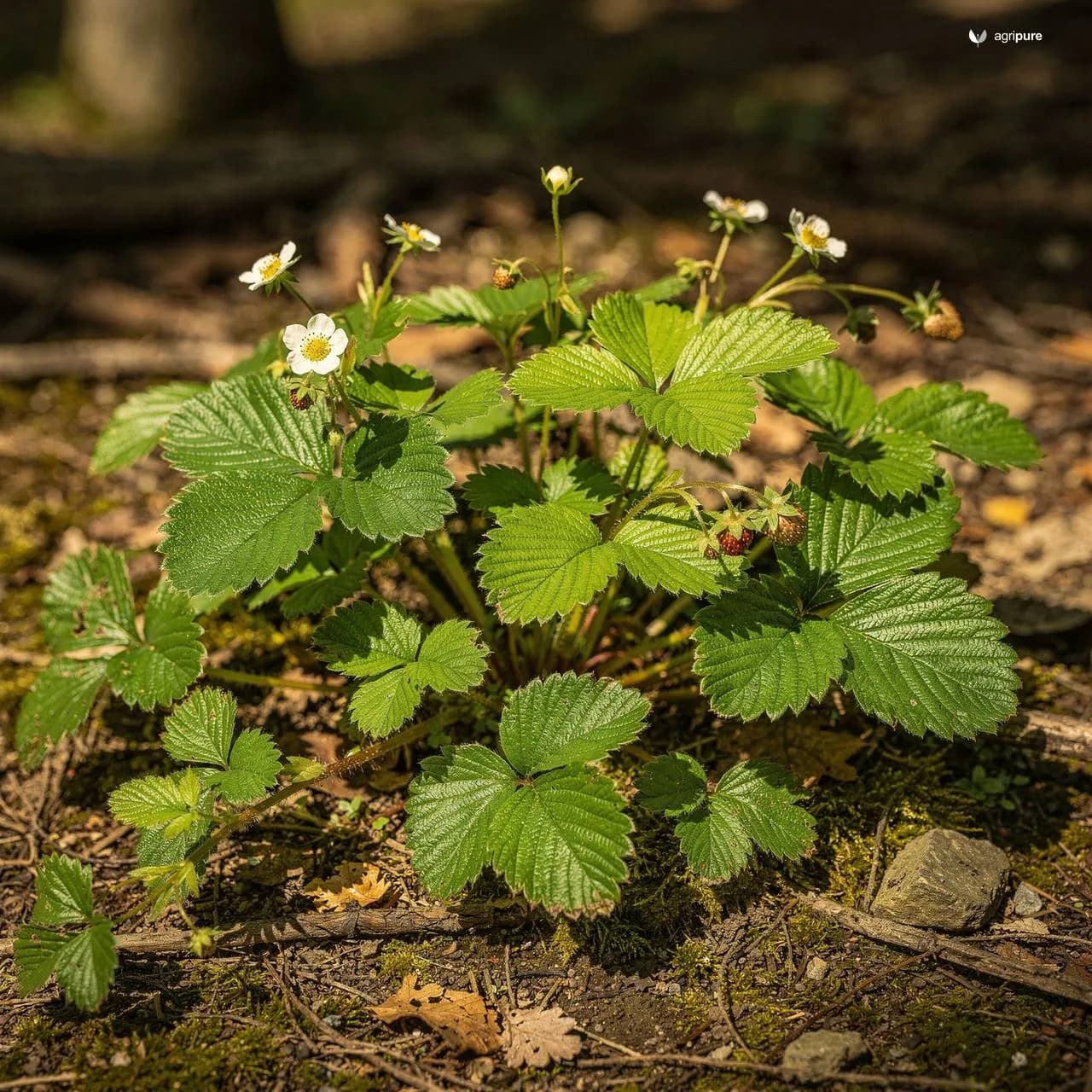
Wild Himalayan strawberry (Fragaria nubicola, jangli-strawberry) is the small wild strawberry that carpets forest clearings in the the KPK hills, sending out runners that knit into an edible living groundcover. It is the true wild ancestor type rather than a garden plant, native across the Himalaya and found from Afghanistan through Pakistan to Tibet and north India. On a syntropic site it works as a low secondary-stage cover under the shelter of taller layers, holding the soil surface while it fruits.
Where it thrives
It is a plant of the cool, moist hill forest. Its range spans Afghanistan, Pakistan, Bhutan, China, Myanmar, and Nepal, and on the Himalayan slope it climbs from subtropical to alpine ground, recorded as high as about 4,300 m.2 That wide altitude band puts it firmly in the KPK hills, where it favours the shaded, humus-rich floor of clearings and forest edges rather than open dry ground. It is a diploid wild strawberry (the true ancestral type, with 14 chromosomes), not a cast-off from the cultivated garden plant, so it breeds true from its own seed and runners. It is a low, runner-forming perennial herb, spreading by stolons that root where they touch down, which is how a single plant becomes a patch and then a carpet.
Role in the system
Use it as a living groundcover in the lowest layer of a shaded guild. The runners spread to form a continuous mat that shades the soil surface, slows moisture loss, and protects the ground under taller plants, doing the work of a cover crop while yielding fruit at the same time. As leaves and runners die back they return as fine mulch that feeds the soil floor, and the close mat crowds out the weeds that would otherwise take bare ground. It asks for shade and moisture, so it is a fit for the understorey of an establishing hill planting rather than an exposed bed. Because it spreads on its own once started, a few plants set into a shaded, moist patch will close the gap between larger plants without further work.
What you get
The return is fruit and ground cover. The small berries are a gathered wild food across the hills, smaller and more aromatic than the garden strawberry, and they carry a useful load of polyphenols — phenolics, flavonoids, flavonols, tannins, and proanthocyanidins with antioxidant activity. The plant also has a long record in local medicine: in Pakistan the juice is used for heavy menstruation, mouth and stomach ulcers, wounds, children’s diarrhoea, and urinary infections, and more widely it is taken for inflammation, coughs, colds, and fever. For a shaded hill site, it gives an edible carpet that earns its keep as cover first and a small harvest second, with a household remedy on top.
Sources
- Flora of Pakistan. “Fragaria nubicola.” eFloras.org, Missouri Botanical Garden & Harvard University Herbaria.
- Wikipedia contributors. “Fragaria nubicola — distribution and elevation.”
- Sharma, P., et al. (2019). “Fragaria nubicola (Rosaceae): a review of medicinal uses, phytochemistry and pharmacology.”
Sourcing notes
Propagate from rooted runners lifted from a forest-clearing patch rather than seed; it spreads on its own once a few plants take in a shaded, moist bed.