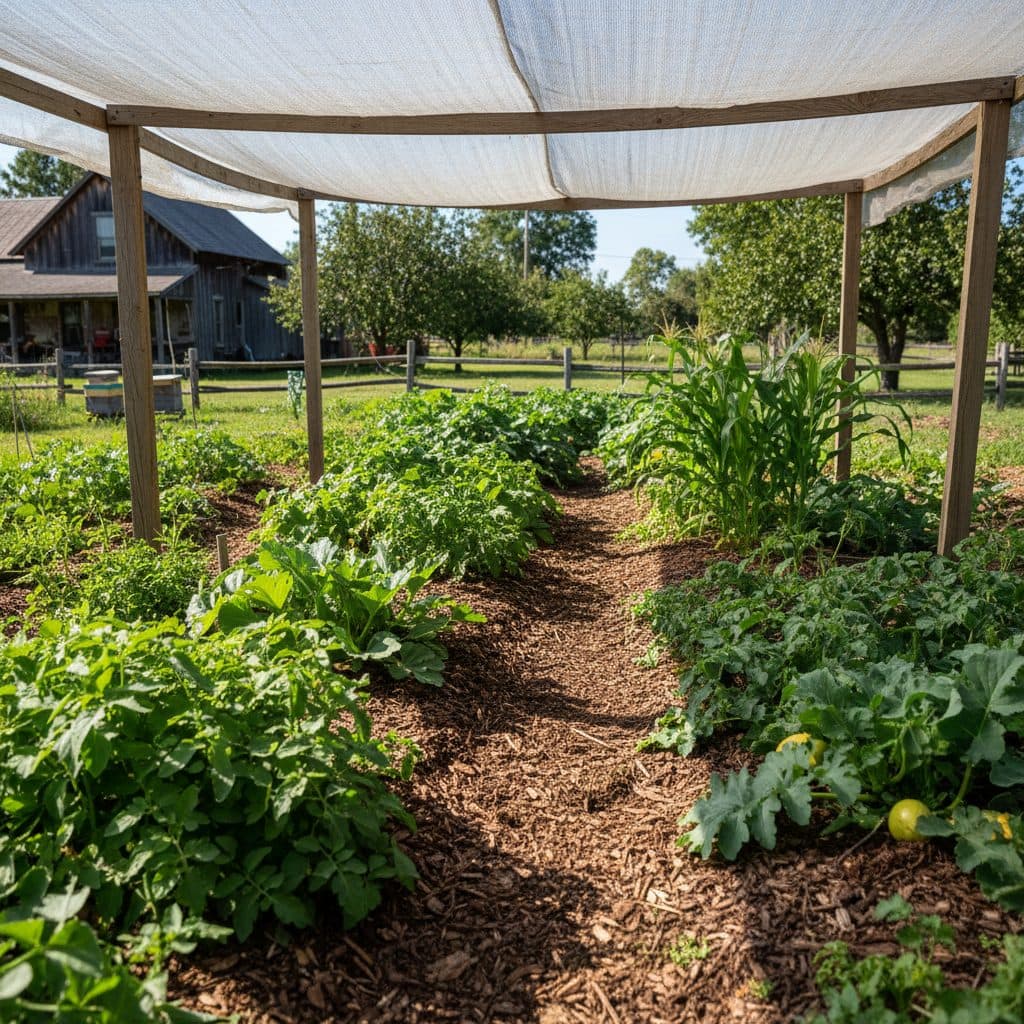
a resilient vegetable garden thriving under a heatwave with shade cloth
Key takeaways
- Build soil organic matter to retain 15-20 times its weight in water, enhancing drought resilience.
- Implement strategic mulching with 3-4 inches of organic material to cut evaporation by 35-50%.
- Utilize drip irrigation for 90% water efficiency, focusing water directly at plant roots and saving 30-50% over sprinklers.
- Select heat-tolerant varieties and provide shade with 30-50% shade cloth during peak heat, reducing sun exposure.
- Incorporate cover crops to lower soil temperatures by 10-20 degrees Fahrenheit and improve soil structure.
- Harvest rainwater to supplement irrigation needs, reducing potable water use by 30-50% for many US households.
Quick answer: To prepare a vegetable garden for extreme heat and drought, focus on building soil organic matter, implementing efficient drip irrigation, strategic mulching, and selecting heat-tolerant plant varieties. These methods enhance water retention, reduce evaporation, and protect plants from high temperatures.
In many parts of the United States, from the arid Southwest to the humid Southeast, gardeners are increasingly facing prolonged periods of extreme heat and drought. In 2023, for instance, over 40% of the contiguous U.S. experienced moderate to severe drought conditions for at least eight weeks, impacting vegetable yields for countless home growers by as much as 30%. These challenging conditions, combined with nutrient-depleted or compacted soils that struggle to hold moisture, demand a proactive approach to garden management, especially when summer temperatures consistently hit 90 degrees Fahrenheit or higher.
As an experienced grower who has gardened through 100-degree Fahrenheit summers in USDA Zone 6, I’ve seen firsthand how a little preparation can make a big difference when the thermometer stays high for days on end. Preparation helps a vegetable garden keep producing when temperatures stay high for days on end. Managing soil organic matter, irrigation timing, and plant selection maintains yields through prolonged summer heat.
Understanding the triple threat: heat, drought, and poor soil
For gardeners across the US, the growing season now often includes weeks of intense heat, prolonged dry spells, and the persistent challenge of maintaining healthy soil. In states like Arizona, summer temperatures regularly exceed 100 degrees Fahrenheit for 30 or more consecutive days, while regions like the Midwest can experience flash droughts that rapidly deplete soil moisture, sometimes dropping soil water content by 50% in just a week. These conditions stress plants, reduce yields by 20-30% in sensitive crops, and can even lead to crop failure if not addressed proactively. When soil lacks sufficient organic matter, it struggles to retain moisture, exacerbating drought impacts and leading to rapid temperature swings of 15-20 degrees Fahrenheit between day and night.
The consequences of climate stress
Healthy soil acts as a sponge, holding vital water and nutrients. According to the USDA Natural Resources Conservation Service, soil rich in organic matter can hold 15 to 20 times its weight in water [1]. Conversely, compacted, low-organic-matter soils shed water quickly and offer little buffer against temperature extremes, often heating up 10 degrees Fahrenheit hotter than well-amended soil. Addressing these foundational issues is the first step in building a resilient garden. Understanding how these factors interact (for example, how high temperatures increase plant water demand by 15-25% and how poor soil limits water availability by 40%) is necessary for effective planning. We’re talking about more than just watering; it’s about creating an environment where plants can cope with a 30% increase in average summer temperatures.
- Increased plant transpiration rates in 90-degree Fahrenheit heat.
- Reduced nutrient uptake due to stressed root systems.
- Soil microbial activity decline in dry, hot conditions.
- Blossom drop and poor fruit set in sensitive crops like tomatoes.
thick layer of wood chip mulch protecting garden soil
Building resilience from the ground up: soil health
The foundation of a resilient garden lies beneath your feet, in the soil itself. Rich, organic-matter-laden soil is your best defense against heat and drought. According to the USDA Natural Resources Conservation Service, healthy soil can hold 15 to 20 times its weight in water [1]. This incredible capacity means less frequent watering and a more stable environment for plant roots, even during extended dry spells that can last for two to three weeks. Improving soil structure also enhances drainage, preventing waterlogging after heavy rains, which can be just as damaging as drought, especially in areas receiving 2-3 inches of rain in a single storm.
Boosting soil organic matter
To achieve this, focus on consistent organic matter addition. This isn’t a one-time fix; it’s an ongoing process. Incorporating compost, aged manure, or planting cover crops annually will steadily build your soil’s resilience, increasing organic matter content by 0.5% to 1% per year. For example, a 3-inch layer of compost worked into the top 6 inches of soil can significantly boost water retention and nutrient availability, potentially reducing the need for synthetic fertilizers by 25%. In USDA Zone 7, where both summer heat often exceeding 90 degrees Fahrenheit and winter freezes are common, high soil organic matter is particularly important for buffering temperature fluctuations by as much as 10 degrees. Using a tool like a Wooden-Handle Garden Fork & Lawn Rake can help incorporate amendments without excessive compaction, ensuring good air and water penetration.
- Compost: adds diverse microbes and slow-release nutrients.
- Aged manure: provides nitrogen, phosphorus, and potassium.
- Cover crops: protect soil, add biomass, and suppress weeds.
- Biochar: improves water retention and nutrient cycling over decades.
drip irrigation system watering tomato plants
Smart water management for dry spells
When drought hits, every drop of water counts. Efficient irrigation practices keep plants hydrated without waste. Drip irrigation systems, for example, can achieve water efficiency rates of 90% or more, delivering water directly to the plant’s root zone with minimal evaporation [4]. This is a significant improvement over overhead sprinklers, which often lose 30% to 50% of water to evaporation and runoff, especially when ambient temperatures are above 85 degrees Fahrenheit. Installing a drip system can seem like an upfront investment, often costing $50-$200 for a small garden, but it pays dividends in water savings of up to 50% and healthier plants, potentially increasing yields by 10-15%.
Precision watering techniques
Beyond the method, the timing and depth of watering are critical. Water deeply and less frequently, encouraging roots to grow deeper into the soil where moisture persists longer, sometimes 12-18 inches down. A good rule of thumb is to aim for 1 inch of water per week, either from rain or irrigation, especially for fruiting vegetables like peppers and squash. In regions like California’s Central Valley, where water conservation is critical and summer temperatures routinely hit 100 degrees Fahrenheit, many growers use soil moisture meters to precisely gauge when to water, avoiding both over and under-watering. A soil moisture meter helps track moisture levels so plants receive adequate water without over-saturating the soil.
- Deep watering: promotes extensive root systems for drought tolerance.
- Early morning watering: minimizes evaporation and allows leaves to dry.
- Rainwater harvesting: collects free water for irrigation, reducing municipal water use.
- Greywater recycling: reuses household water for non-edible plants where permitted.
Plant selection and protection strategies
Choosing the right plants and providing adequate protection are vital during heatwaves. Many traditional vegetable varieties struggle when temperatures consistently exceed 95 degrees Fahrenheit for several days, leading to blossom drop and reduced fruit set. Instead, look for heat-tolerant and drought-resistant cultivars specifically bred for challenging climates. For example, certain varieties of okra, sweet potato, and southern peas (Vigna unguiculata) thrive in conditions that would cause lettuce to bolt in a week or tomatoes to stop setting fruit above 85 degrees Fahrenheit. Even within common species, there’s variation; some ‘cherry tomato’ varieties are more heat-set than others, continuing to produce fruit when others fail.
Strategic plant placement and shading
Beyond selection, physical protection is key. Shade cloth, which can reduce solar radiation by 30% to 50%, is an invaluable tool for sensitive crops during the hottest parts of the day, typically between 11 AM and 4 PM [4]. Suspend it over your plants to provide relief from intense sun and reduce leaf temperatures by several degrees Fahrenheit, sometimes 5-10 degrees. Another strategy is succession planting: staggering plantings so that some crops mature before peak heat, or are planted to mature in the cooler fall, often yielding a second harvest 60-90 days later. Consider also planting taller, more resilient crops like corn on the south side of your garden to provide natural afternoon shade for smaller, more sensitive plants, reducing their direct sun exposure by up to 25%. For instance, growing Garden Pea in early spring or late fall avoids their heat-sensitive period, as they prefer temperatures below 75 degrees Fahrenheit.
- Okra (Abelmoschus esculentus): thrives in 90+ degree Fahrenheit heat.
- Sweet Potato (Ipomoea batatas): tolerates dry conditions once established.
- Southern Peas (Vigna unguiculata): productive in hot, humid climates.
- Malabar Spinach (Basella alba): a heat-loving alternative to traditional spinach.
Adapting to the new normal: long-term strategies
Building a truly resilient garden means looking beyond the immediate season and adopting long-term strategies that adapt to changing climate patterns. One powerful approach is agroforestry, which integrates trees and shrubs into agricultural systems [5]. These perennial elements provide shade, reduce wind speeds by 10-20%, and improve soil moisture retention over many years, often increasing soil organic matter by 0.1-0.2% annually. For a home garden, this could mean strategically planting a fruit tree or a nitrogen-fixing shrub like Vegetable Hummingbird on the south or west side to cast afternoon shade on sensitive annuals, reducing their heat exposure by 20-30%. Agroforestry systems have been shown to reduce ambient air temperatures by 5 to 10 degrees Fahrenheit in their immediate vicinity, creating cooler microclimates [5].
Cultivating a diverse and adaptable garden
Another crucial long-term strategy is diversification. Planting a wider range of crops, including perennial vegetables and herbs, reduces the risk of total crop failure if one species struggles, perhaps due to a specific pest or disease outbreak that targets a monoculture. Consider native plants that are naturally adapted to your local climate and require less intervention, often needing 50% less water once established. For instance, in the arid Southwest, native desert gourds or tepary beans (Phaseolus acutifolius) are far more resilient than many common garden vegetables, tolerating temperatures up to 105 degrees Fahrenheit. Observing bed performance and making adjustments based on seasonal results helps maintain productive growing space and reliable yields in hot summers.
- Perennial vegetables: asparagus, rhubarb, artichokes, requiring less annual disturbance.
- Native herbs: garden sage (Salvia officinalis) for drought tolerance and pollinators.
- Fruit trees: provide shade, food, and long-term soil benefits.
- Windbreaks: reduce evaporative stress on garden beds.
Irrigation methods: efficiency and application
method | efficiency | best use case |
|---|---|---|
drip irrigation | 90-95% | targeted watering for rows, containers, and individual plants |
soaker hoses | 70-85% | slow, even watering for dense plantings and raised beds |
overhead sprinklers | 50-70% | broad coverage for lawns, less efficient for vegetables due to evaporation |
hand watering | variable (50-90%) | small areas, seedlings, or precise plant needs, can be time-consuming |
Soil moisture: Healthy soil can hold 15-20 times its weight in water, drastically improving drought resilience [1].
Shade cloth: Using 30-50% shade cloth can reduce heat stress and prevent sunscald on sensitive crops during peak summer heat [4].
Frequently asked questions
How much water do my vegetables need during a heatwave?
During a heatwave, most fruiting vegetables need at least 1 to 1.5 inches of water per week, delivered deeply to encourage root growth. Monitor soil moisture with a meter to ensure the top 6-8 inches of soil remain consistently damp, especially when temperatures exceed 90 degrees Fahrenheit.
What is the best type of mulch for heat and drought?
Organic mulches like straw, wood chips, or shredded leaves are best. A 3-4 inch layer can reduce soil temperature by 10-20 degrees Fahrenheit and cut evaporation by 35-50%, conserving significant moisture [4].
Can I still plant new vegetables during a heatwave?
It’s generally not recommended to plant new, tender seedlings directly into a heatwave. If you must, choose heat-tolerant varieties, plant in the late afternoon, and provide immediate shade and consistent moisture for the first 10-14 days.
How do I know if my plants are suffering from heat stress?
Signs of heat stress include wilting leaves (even with adequate water), yellowing foliage, stunted growth, blossom drop, and sunscald on fruits. These symptoms often appear when temperatures consistently exceed 90-95 degrees Fahrenheit.
Are there any vegetables that prefer hot weather?
Yes, several vegetables thrive in hot weather, often above 85 degrees Fahrenheit. These include okra, sweet potatoes, southern peas, Malabar spinach, and certain varieties of eggplant and peppers.
How can I improve my soil’s water retention for next season?
To significantly improve water retention, consistently incorporate organic matter. Add 2-3 inches of compost or aged manure to your garden beds each fall or spring, and consider planting cover crops like clover or vetch after harvest. Healthy soil can hold 15-20 times its weight in water [1].
References
- USDA Natural Resources Conservation Service (2024). USDA Natural Resources Conservation Service.
- EPA — Soak Up the Rain (2024). EPA — Soak Up the Rain.
- SARE — Sustainable Agriculture Research & Education (2023). SARE — Sustainable Agriculture Research & Education.
- ATTRA / NCAT Sustainable Agriculture (2023). ATTRA / NCAT Sustainable Agriculture.
- USDA National Agroforestry Center (2023). USDA National Agroforestry Center.