pioneer
Soybean
soya bean
Glycine max
Also known as Soya Bean (UK & Ireland, Australia, Pakistan, India).
- punjab plains
- pothohar
- kpk hills
International hardiness
- USDA 10-11
- RHS H2
- AU: Subtropical, Warm temperate, Tropical
Where it grows — regional guide
| Zones / rating | Regional notes |
|---|---|
USDA 10-11 | Grown in warm summer soils as a major grain and livestock fodder legume; raw beans carry toxins and must be cooked clean. |
| Zones / rating | Regional notes |
|---|---|
H2 (1 to 5C) | Tender under RHS H2; sown in late spring under cover for summer pod production; raw beans contain toxins and must be thoroughly cooked. |
| Zones / rating | Regional notes |
|---|---|
Subtropical, Warm temperate, Tropical | Grown as a summer grain legume and forage crop across warm irrigated districts; raw beans carry toxins and must be cooked. |
| Zones / rating | Regional notes |
|---|---|
USDA 10-11 (USDA scale) Canada uses its own zone system; Canadian zones run roughly one lower than USDA. | Grown as a summer annual legume in southern provinces; raw beans contain toxins and must be thoroughly cooked before eating. |
| Zones / rating | Regional notes |
|---|---|
Punjab plains, Pothohar, KPK hills | Pakistan:Grown across the plains as a kharif summer pulse and livestock forage; raw beans contain toxins and must be cooked before eating. India:Cultivated widely as a major kharif oilseed and protein legume; raw beans carry toxic compounds and must be cooked thoroughly. |
Grows alongside
Species that appear with Soybean in 65 of our published guides — a starting list for a guild, not a planting plan.
The soybean (Glycine max) is an annual legume in the pea family, Fabaceae, grown worldwide for its high-protein, high-oil seeds, which feed people, livestock, and a long list of industrial uses. It is native to East Asia, where the domesticated crop was developed from its wild relative Glycine soja, and it now grows across temperate and tropical farming regions on every inhabited continent. For the homesteader, soybean is a single-season summer crop that does two jobs at once: as a nitrogen-fixing legume it helps build soil fertility, and as a seed crop it delivers one of the most concentrated sources of plant protein and oil you can grow in a garden bed.
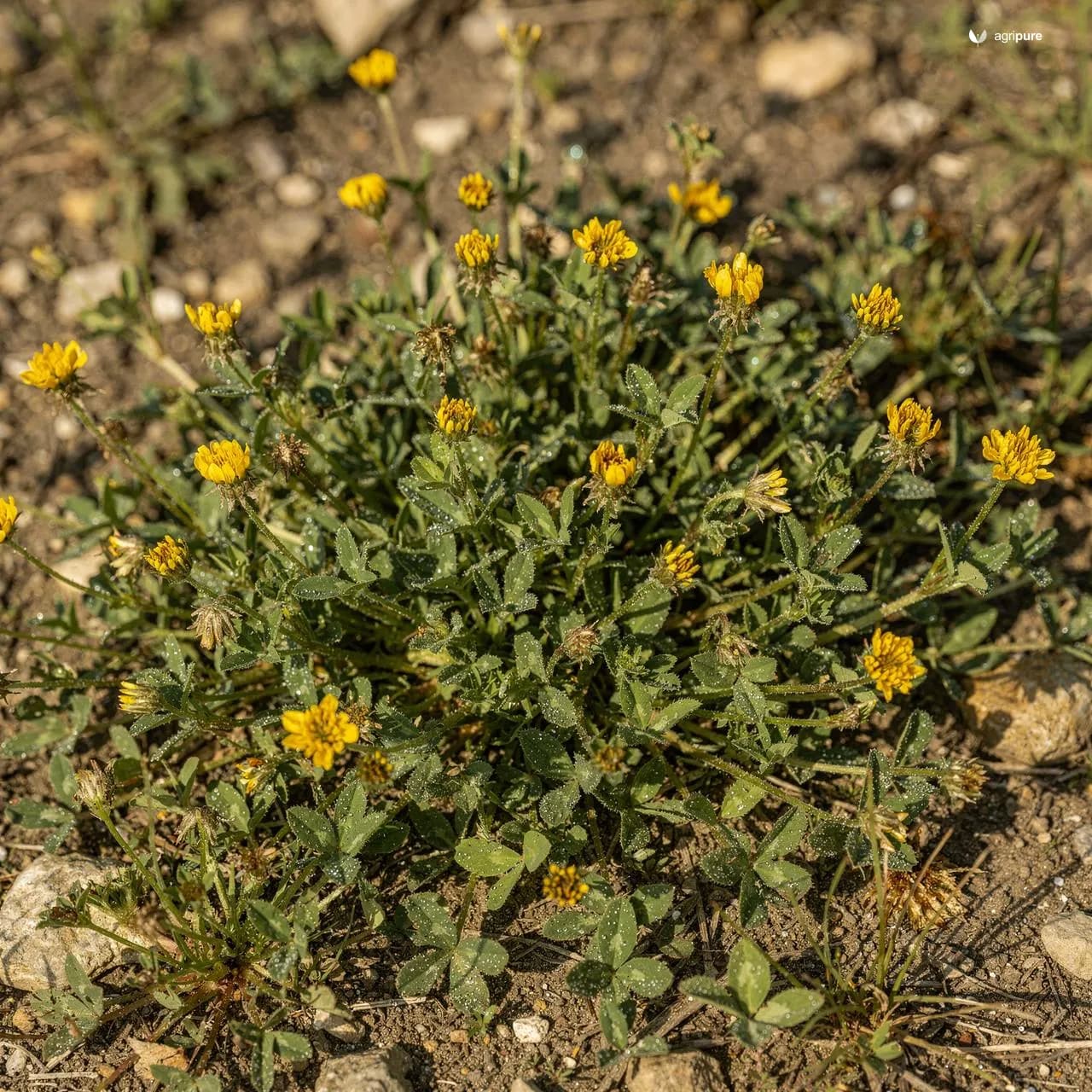
Soybean grows as an erect, bushy herbaceous annual, usually between about half a metre and one and a half metres tall. Its leaves are borne alternately along the stem and are compound and trifoliate, meaning each leaf carries three leaflets, and both the leaflets and the stems are noticeably hairy. The flowers are small and easy to overlook, white to pink or shading to blue and purple depending on the variety, and they are carried in racemes, or clustered flower stalks. Each fertilised flower develops into a dry, hairy pod, roughly 30 to 70 millimetres long, that splits open when ripe and typically holds two to four seeds. The beans themselves come in yellow, black, brown, or green depending on the cultivar. Taken together, the trifoliate hairy leaves, the bushy upright habit, and the small inconspicuous flowers followed by fuzzy pods are the features that set soybean apart from many other legumes.
Growing soybean
Soybean is propagated by seed only; it is a true annual that does not overwinter, so it is sown fresh each season. It is a warm-season crop that thrives in warm, frost-free conditions, with growth favoured by temperatures of roughly 20 to 30°C, and it is sensitive to frost. In temperate regions the seed is sown after the last frost, once the soil has warmed enough to allow rapid emergence; forage-crop guidance for the southern United States, for example, recommends planting in May or June. Because it is frost-tender and needs a growing season of several months to mature, it is treated as a warm-season annual planted after the last spring frost and harvested before the first fall frost rather than as a permanent planting.
Give soybean a position in full sun; ample sunlight is needed for successful cultivation. It is adapted to well-drained soils and dislikes waterlogging, since overly wet ground and poor drainage predispose the plants to root diseases. The crop is fairly drought tolerant but performs best on fertile soils, and extension guidance advises avoiding acid, infertile ground and liming to keep the soil pH in the range of about 5.5 to 7.0.3 As a legume that forms nitrogen-fixing root nodules, soybean usually needs little nitrogen fertiliser, though phosphorus and potassium should be applied according to a soil test. For water, the plant tolerates some dryness overall, but consistent moisture during flowering and pod-filling makes the biggest difference to the crop’s yield. For plant spacing, forage plantings can be grown at densities comparable to grain soybean, on the order of 100,000 plants per acre, and narrow rows of about 7.5 inches have been used in trials.
Harvest and uses
Soybean is harvested for its seed, the dry pods splitting open when fully ripe. The crop is grown worldwide as a major oilseed and protein source, and the beans are used extensively as food, as animal feed, and as an industrial raw material. Beyond the grain harvest, the whole plant is also grown as forage, cut and fed to livestock, which is why much of the agronomic guidance treats it as both a seed and a fodder crop. Different cultivars produce beans in a range of colours, yellow, black, brown, or green, suited to different end uses. As a nitrogen-fixing legume, soybean also contributes to the cropping system itself, building fertility for the crops that follow it and reducing the need for added nitrogen.
Safety and cautions
Soybean is generally safe to eat when it is properly cooked or processed, and it is one of the most widely consumed legumes in the world. However, raw beans and certain highly processed extracts carry specific toxicity and safety considerations, so the beans should not be eaten raw and should be cooked or processed before consumption. Treat soybean as a food crop to be prepared conventionally, and do not rely on it as a medical treatment.
Sources
- “Glycine max (soybean)” – Go Botany, Native Plant Trust
- Review on Glycine max – National Center for Biotechnology Information (PMC)
- “Soybean (Glycine max)” – Mississippi State University Extension
- “Glycine max (L.) Merr.” – Global Biodiversity Information Facility (GBIF)
- “The Biology of Glycine max (L.) Merr. (Soybean)” – Canadian Food Inspection Agency
- Glycine max research article – ScienceDirect