secondary
Damask Rose
gulab
Rosa damascena
Also known as Desi Gulab (Pakistan, India).
- punjab plains
- pothohar
- kpk hills
International hardiness
- USDA 4-9
- RHS H6
- AU: Cool temperate, Warm temperate, Mediterranean
Where it grows — regional guide
| Zones / rating | Regional notes |
|---|---|
USDA 4-9 | A fully hardy heritage shrub rose across most of the country, grown as a perennial in full sun on well-drained ground; it gives one main flush of intensely fragrant pink blooms in late spring or early summer. |
| Zones / rating | Regional notes |
|---|---|
H6 (-20 to -15C) | Fully hardy cottage garden shrub prized for perfume, bearing fragrant pink blossoms during early summer in sunny borders. |
| Zones / rating | Regional notes |
|---|---|
Cool temperate, Warm temperate, Mediterranean | Suited to cool temperate, warm temperate and Mediterranean districts as a hardy deciduous shrub for full sun and well-drained ground, with one main spring flush of fragrant blooms. |
| Zones / rating | Regional notes |
|---|---|
USDA 4-9 (USDA scale) Canada uses its own zone system; Canadian zones run roughly one lower than USDA. | Hardy through most settled parts of the country as a once-flowering old rose, though it can suffer cane dieback in the coldest prairie winters; it flowers in early summer in full sun. |
| Zones / rating | Regional notes |
|---|---|
Punjab plains, Pothohar, KPK hills | Pakistan:Grown commercially for petals and rose water on the plains and in the foothills; it is pruned while dormant and gives its main flush of fragrant blooms in spring. India:Cultivated in traditional northern rose tracts for essential oil and gulkand, blooming abundantly in early spring after winter dormancy. |
Grows alongside
Species that appear with Damask Rose in 1 of our published guides — a starting list for a guild, not a planting plan.
The Damask rose (Rosa damascena, often written Rosa × damascena) is a highly fragrant old garden rose in the genus Rosa of the rose family, Rosaceae. It is a deciduous, prickly shrub grown not for showy form but for the intense scent of its pink, double blooms, which are processed into rose oil, rose water, and rose concrete for perfumery and food. Described as a temperate plant indigenous to Europe and to Iran and Turkey in the Middle East, it has long been associated with the Damascus region and later cultivation across Europe. For a homesteader, the appeal is a hardy, sun-loving flowering shrub that turns a single spring flush into a small but high-value aromatic crop you can distill, infuse, or simply enjoy for its perfume.
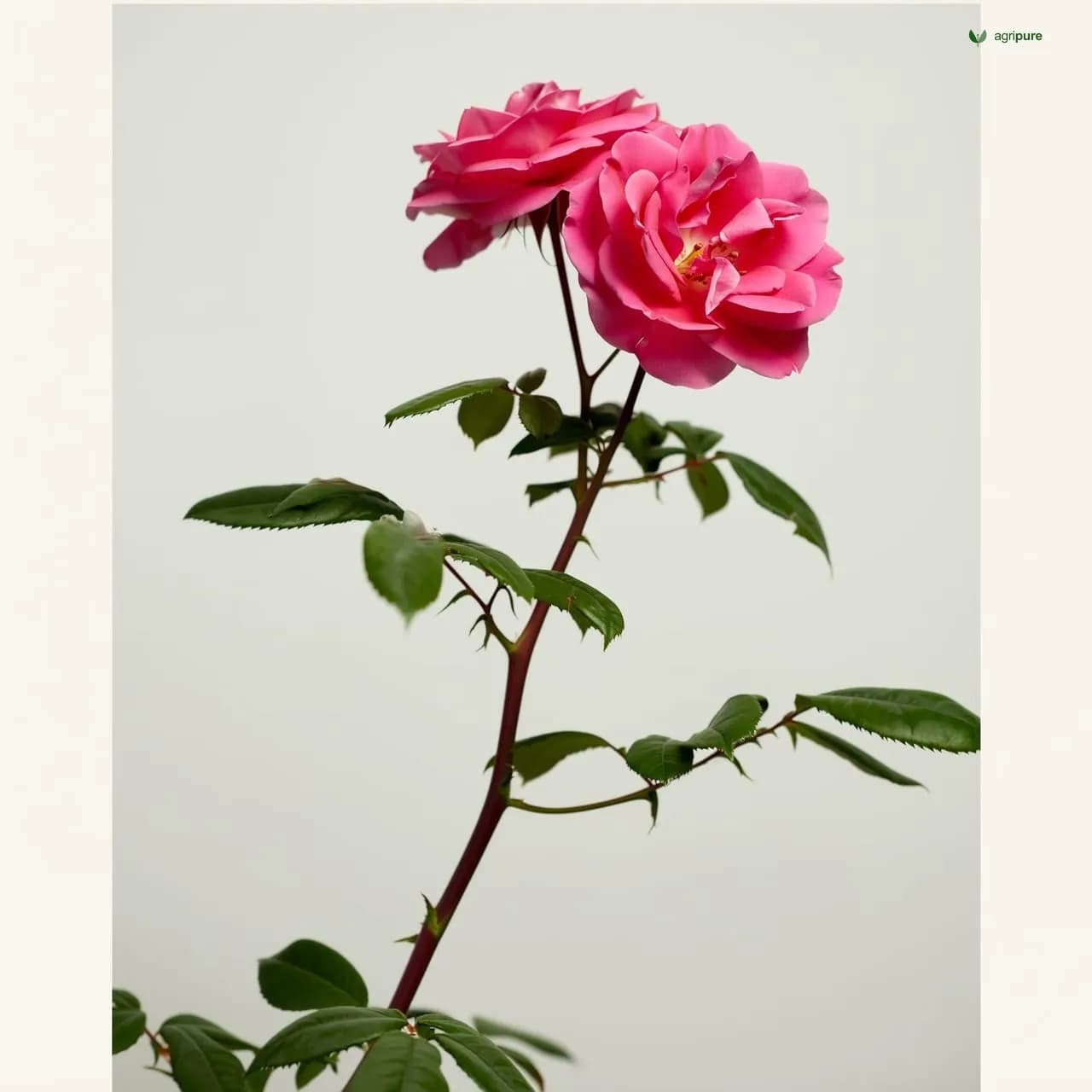
Damask rose is a deciduous shrub that can reach roughly 2.2 m (about 7 ft) tall, with stems densely armed with stout, curved prickles and stiff bristles. Its leaves are pinnate, made up of five (rarely seven) leaflets. The flowers are light to moderate pink, sometimes verging on light red, relatively small, and carried in clusters; garden descriptions emphasize their full, double form and strong fragrance. It is widely recognized as a classic old-rose type and an important parent in the history of rose breeding.
Growing Damask rose
Damask rose is a temperate-climate plant. Horticultural sources place it in roughly USDA zones 4 through 9, where it tolerates genuinely cold winters while preferring climates with plenty of sunlight. It is grown successfully in temperate rose-producing countries such as France, Bulgaria, Iran, and Turkey, all consistent with that temperate preference.
- Sun: Give it full sun, with one source recommending at least six hours of direct light a day.
- Soil: Plant in well-draining soil; a cultivation source suggests neutral to slightly acidic ground improved with compost or well-aged manure.
- Water: Keep the soil evenly moist during the growing season — watering moderately during active growth and more sparingly during the plant’s rest.
- Spacing and airflow: Give plants room and good air circulation; open sites or raised beds and borders are recommended for airflow, though the sources do not specify an exact spacing distance.
- Pruning: Prune during dormancy. The shrub flowers on a spring flush, and some varieties rebloom later in the season.
The supplied sources do not give a reliable, species-specific propagation method, nor a verifiable time-to-maturity figure, so both are intentionally left out rather than stated with false precision.
Harvest and uses
The crop is the flower, harvested chiefly for its fragrance and processed into rose oil, rose water, and rose concrete used in perfumery and related fragrance products. The best time to pick is the early morning, when the oil concentration in the petals is at its highest. The provided sources do not give a consistent, verifiable yield figure for petals or oil from home-scale plants, so no numeric yield is claimed here.
Beyond perfume, the petals have culinary uses: they are used to flavor food and to make tea, and one source describes them as considered safe for human consumption. Extracts and essential oils from R. damascena have also been studied for a range of pharmacological effects (including anti-inflammatory, antioxidant, and antimicrobial activity), but these are research findings, not established home remedies.
Safety and cautions
The sources provided do not identify Rosa damascena as poisonous; on the contrary, one source specifically states that the petals are used in food and tea and are safe for human consumption. No species-specific poisoning warning for any part of this rose was found in the supplied research, so none is claimed.
The medicinal effects noted above come from research summaries rather than clinical guidance, so they should not be treated as established treatment advice, and this profile makes no claim that the plant treats or cures any condition. As a general principle with any concentrated herbal preparation, those who are pregnant or breastfeeding, and anyone taking prescription medication, should seek qualified medical advice before use. The most practical note for a homesteader is mechanical: the canes are densely armed with stout, curved prickles, so handle and prune with thick gloves.
Sources
- Rosa damascena — Plants Rescue
- Rosa damascena (overview and uses) — ScienceDirect Topics
- Damask Rose: A Tradition Worth Growing — Jackson & Perkins
- Rosa damascena — NatureServe Explorer