support
Wild Indigo (Oblong-Leaf Indigo)
jhil / kathi
Indigofera oblongifolia
Also known as Jhil (Pakistan).
- punjab plains
- sindh coast
International hardiness
- USDA 10-11
- RHS H1c
- AU: Tropical, Subtropical, Arid / semi-arid
Where it grows — regional guide
| Zones / rating | Regional notes |
|---|---|
USDA 10-11 | No region-specific data yet |
| Zones / rating | Regional notes |
|---|---|
H1c (5 to 10C) | No region-specific data yet |
| Zones / rating | Regional notes |
|---|---|
Tropical, Subtropical, Arid / semi-arid | No region-specific data yet |
| Zones / rating | Regional notes |
|---|---|
USDA 10-11 (USDA scale) Canada uses its own zone system; Canadian zones run roughly one lower than USDA. | No region-specific data yet |
| Zones / rating | Regional notes |
|---|---|
Punjab plains, Sindh coast | Pakistan:Native perennial legume of dry plains and riverbanks; browsed on rangelands and builds soil, but carries livestock toxicity warnings. India:Native to arid and semi-arid tracts on deep black soils; fixes nitrogen and provides browse, but excessive feeding carries toxicity risks. |
Wild indigo (Indigofera oblongifolia), also called oblong-leaf indigo, is a small, many-branched perennial shrub in the pea family (Fabaceae). It is a plant of dry and semi-arid country, with a native range spanning North and East Africa, the Arabian Peninsula, and South and South-East Asia — turning up across Sudan, Ethiopia, Yemen, Oman, Saudi Arabia, Pakistan, India, Sri Lanka, and Indonesia. For a homesteader working hot, low-rainfall ground, its appeal is that of a tough, legume-family workhorse: a forage and soil-improving shrub that earns its place on land too dry and lean for thirstier crops.
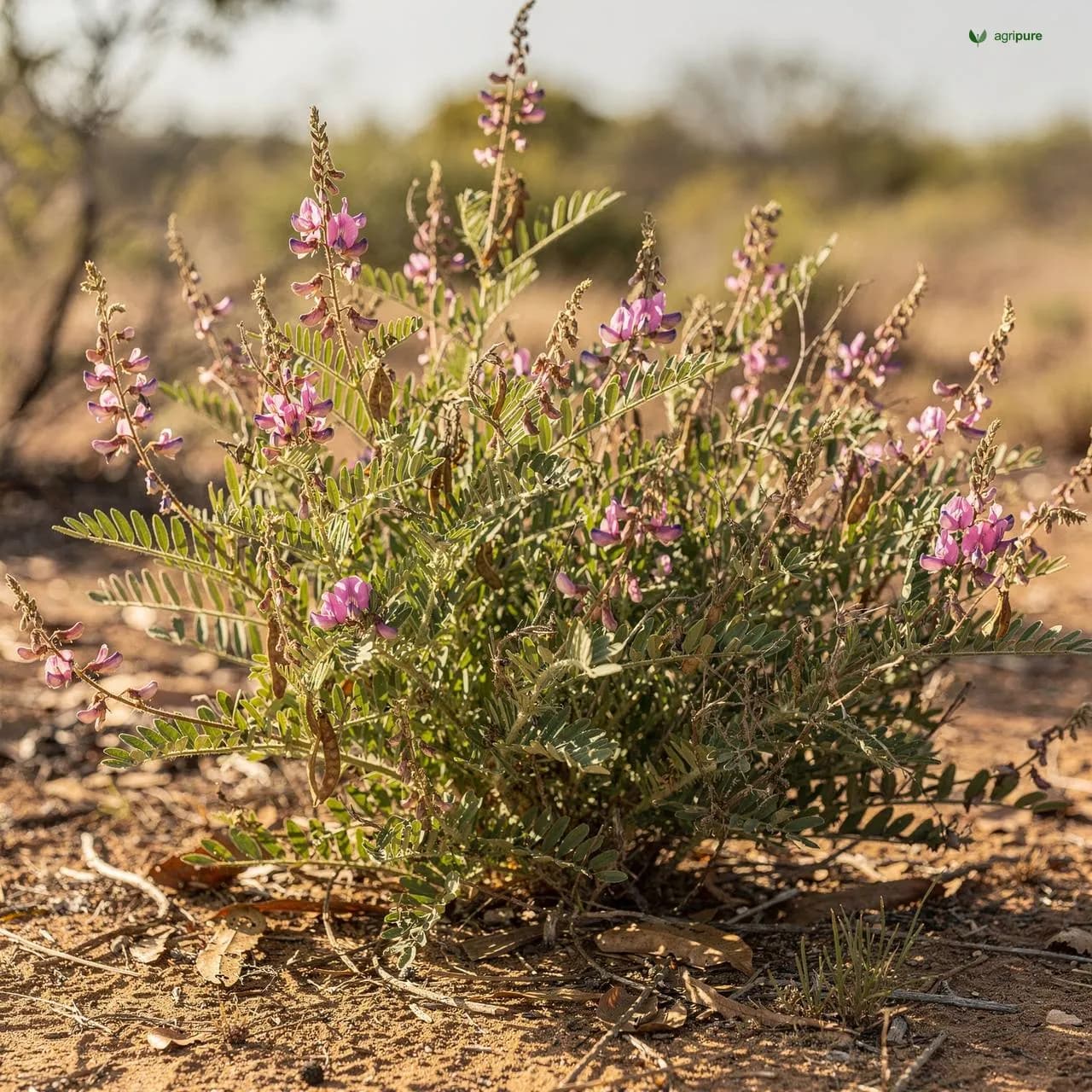
It is an erect, profusely branching shrub whose stems turn woody near the base and persist from year to year. Field descriptions put it at roughly 3 to 4 ft (about 1 to 1.2 m) tall and call it hardy and perennial. The foliage is grey-green and compound; sources disagree slightly on leaflet count, with iNaturalist’s taxon guide describing leaves with 1 to 4 leaflets and eFlora of India recording 3 to 6 alternate or sub-opposite leaflets on observed material, the leaves villous (softly hairy). A distinctive feature is the stipules densely clothed in white, two-branched (biramous) hairs.
Growing wild indigo
This is not a widely cultivated garden plant, and the sourced literature is light on formal horticultural protocols, so the picture below is built from its ecology rather than invented figures. It is a tropical-to-subtropical species of dry, semi-arid regions, described as an erect perennial of dry country and grown as a forage plant in semi-arid areas. In the wild it has been recorded up to about 500 m elevation in wooded grassland mosaic vegetation.
- Climate and hardiness: It is a warm-climate perennial. One field observation logged site conditions of roughly 26 to 27.5 °C with around 700 mm of rainfall annually. No source assigns a USDA hardiness zone; given its native footprint in tropical and warm subtropical climates with little frost, it is best treated as a warm-climate, frost-sensitive plant, with cold winters a likely limit. (That zone judgement is an inference, not a figure from the primary sources.)
- Soil: It grows on dry-region ground and has been observed thriving on deep black soils; as a semi-arid rangeland species it is adapted to lean, dry conditions rather than rich, wet beds.
- Sun and water: Consistent with its dry-region habit, it suits open, sunny, low-rainfall sites and tolerates the heat and aridity of semi-arid country.
Specific propagation method, sowing dates, plant spacing, and time to maturity are not documented in the sources gathered here, so they are deliberately left out rather than guessed. As a perennial shrubby legume of dry rangelands, treat it as a warm-season, drought-adapted plant: establish it in warm, free-draining ground and keep it on the lean, dry side rather than over-watering.
Harvest and uses
Wild indigo’s main documented value is as a forage, soil-improving, and dye plant, with a secondary, cautious place in traditional medicine. As a forage species it is grazed and browsed in semi-arid rangelands, and as a member of the pea family it belongs to the legume group long valued for building soil. The genus name Indigofera means “indigo-bearing,” pointing to its third use: like its relatives, this species has historically been used for blue dye.
No reliable yield figures appear in the sources, so none are stated here. As a perennial shrub rather than a once-over crop, its useful output is the standing browse and leaf material it produces season after season rather than a single harvested tonnage.
How to identify it
Wild indigo can be confused with other members of its large genus — it carries the synonym Indigofera paucifolia Delile — so identification rests on a combination of characters rather than any single trait. Look for:123
- Habit: A low, many-branched perennial shrub, roughly 1 to 1.2 m tall, woody at the base.
- Leaves: Compound, grey-green, and hairy (villous), with relatively few leaflets.
- Stipules: Densely covered in white, two-branched (biramous) hairs — a strong diagnostic cue.
- Flowers: Borne in many-flowered racemes usually under 11 cm long, with a calyx about 2 to 3 mm long whose triangular lobes are about as long as the tube; the flowers are pink, and the standard petal is silvery on the outside. Flowering has been reported year-round in parts of its range.
- Pods: Curved evenly along their length and somewhat constricted between the seeds, especially around aborted seeds. Fruiting is reported after the main flowering, with one Indian record noting flower and fruit in September.
Safety and cautions
This is the point to handle carefully. While Indigofera oblongifolia is used as forage, some sources describe it as toxic to livestock and as a “poisonous plant,” so its use as food or medicine requires caution. Its potential as a medicinal plant is noted in the same breath as that warning.
The practical reading is conservative: forage use and a toxicity caution sit side by side in the sources, so treat this as a browse and soil-improvement species rather than a food or medicine for people. Do not rely on it as a sole feed, and introduce any unfamiliar wild legume into livestock diets gradually as one part of a mixed ration. This profile makes no medical claims and gives no dosages; traditional medicinal use is mentioned only as reported in the literature, not as a recommendation.
Sources
- Indigofera oblongifolia taxon guide – iNaturalist
- Indigofera oblongifolia – eFlora of India
- Indigofera oblongifolia – JSTOR Global Plants
- Indigofera oblongifolia Forssk. – GBIF
- Indigofera oblongifolia herb sheet – India Flora Online, IISc
- Indigofera oblongifolia – Useful Tropical Plants
- Indigofera oblongifolia observation – India Biodiversity Portal
Sourcing notes
Easily raised from seed collected off riverbank or waste-ground stands. As a legume it benefits from the right rhizobia, usually already present where other Indigofera or wild legumes grow.