support
Himalayan Indigo
kainthi
Indigofera heterantha
Also known as Kainthi (Pakistan).
- kpk hills
- pothohar
International hardiness
- USDA 6-9
- RHS H4
- AU: Cool temperate, Warm temperate, Mediterranean
Where it grows — regional guide
| Zones / rating | Regional notes |
|---|---|
USDA 6-9 | Grown in full sun as a summer-blooming ornamental legume; flower edibility is not documented as confirmed safe food. |
| Zones / rating | Regional notes |
|---|---|
H4 (-10 to -5C) | Deciduous ornamental shrub grown in sunny borders for rose-pink summer blooms, though flower edibility is unconfirmed as food. |
| Zones / rating | Regional notes |
|---|---|
Cool temperate, Warm temperate, Mediterranean | No region-specific data yet |
| Zones / rating | Regional notes |
|---|---|
USDA 6-9 (USDA scale) Canada uses its own zone system; Canadian zones run roughly one lower than USDA. | No region-specific data yet |
| Zones / rating | Regional notes |
|---|---|
KPK hills, Pothohar | Pakistan:Native deciduous shrub of rocky hillsides and open slopes; bears rose-pink summer flowers, but flower edibility is unverified as food. India:Native across Himalayan slopes; grown for basketry twigs and purple-pink summer blooms, but flowers are unverified food. |
Grows alongside
Species that appear with Himalayan Indigo in 2 of our published guides — a starting list for a guild, not a planting plan.
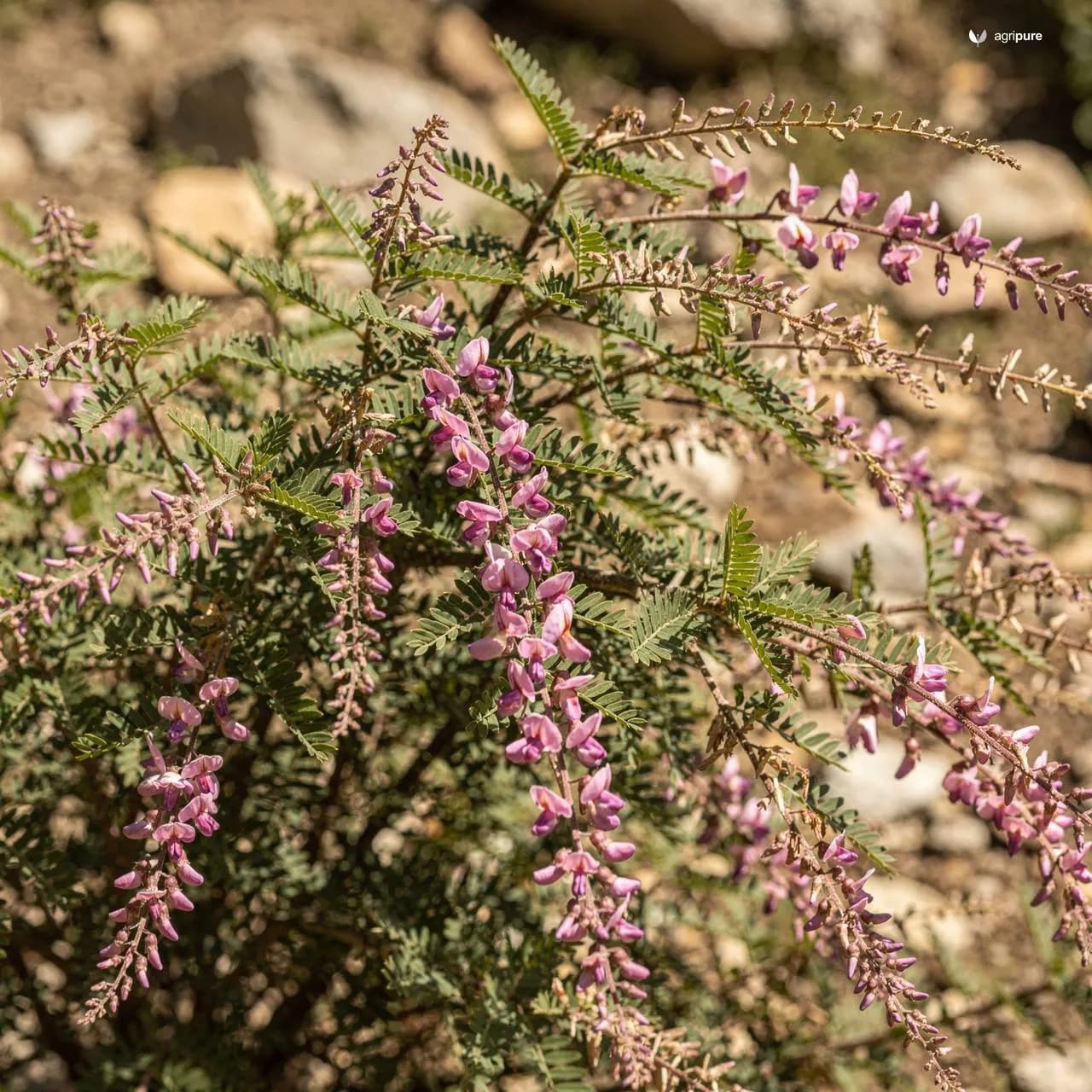
Himalayan indigo (Indigofera heterantha) is a deciduous shrub in the pea family (Fabaceae), grown above all for its long summer show of rose-pink to lilac, pea-like flowers and its fine, bluish-green foliage. It is native to the Himalaya, where floristic records place it across a broad altitude band of roughly 600 to 3,100 m, with its range also extending into Afghanistan, Tibet, the Khasia hills, and China. For a homesteader, its appeal is straightforward: it is a tough, sun-loving legume that flowers through mid-summer, suits a wide span of soils, and earns a place along a hot, open boundary or sunny slope.
It is a medium-sized shrub, typically about 2 to 3 m tall, with pinnate (feather-divided) leaves and an open, finely textured habit. The flowers are borne in upright clusters; one arboretum description dates the main bloom to mid-summer, with the purple to pink-lilac flowers followed by dark purple seed pods in fall. A regional flora describes the pods as cylindric and up to about 5 cm long. Mature spread is roughly 2.5 m, so a plant given room forms a wide, arching shrub rather than a tight column.
Growing Himalayan indigo
This is an undemanding shrub that rewards a warm, bright position. A few grounded points from the sources:
- Sun: Give it full to part sun; it is specifically described as useful in hot, sunny locations, which is where it flowers best.
- Soil and moisture: It tolerates a wide range of soil conditions but prefers slightly moist, well-drained ground. It is not a plant for waterlogged sites.
- Hardiness: Cold-tolerance figures vary between sources. One horticultural database rates it as hardy to about UK zone 7; a separate garden source claims a much wider USDA zone 5 to 11 range, but that figure is less authoritative and is best treated with caution.
- Spacing: No source gives an exact spacing figure. Given a mature size of roughly 3 m tall by 2.5 m wide, allow each shrub room for that full spread rather than crowding it.
It can be raised several ways. A horticultural database describes propagation by seed (soaked for about 12 hours in warm water first), by half-ripe cuttings taken in July or August, by root cuttings taken in December, and by lifting suckers during the dormant season. The warm-water soak helps hard-coated legume seeds take up moisture and germinate more evenly. No reliable source in this research gives a defined time-to-maturity, so none is stated here; treat it as an ornamental shrub that establishes over a season or two and then flowers each summer.
Harvest and uses
Himalayan indigo is grown chiefly as an ornamental, valued for its long summer flowering and fine foliage rather than for a measurable crop. The research provides no quantified yield for this species, so no harvest figure is given here. Its practical uses, as documented in the sources, are these:
- Material and craft: The flexible branches are reported as used in basket making, in building twig bridges, and as fuel.
- Edible flowers (traditional report): One database notes the flowers are eaten, being boiled and pickled. This is a single traditional-use entry with no safety detail, so read it as a minor traditional food rather than an established crop (see Safety below).
- Nitrogen fixation: As a member of Fabaceae, the genus Indigofera is described as nitrogen-fixing. Note that this is a general statement about the genus and the legume family, not a measurement made specifically for I. heterantha in the sources here.
- Dye: Despite the common name, this species is not established in the research as a primary indigo-dye source. The classic dye indigos are other species such as *Indigofera tinctoria and *I. arrecta; I. heterantha is mentioned only in a general dye context, not as a commercial dye plant.
How to identify it
Look for the combination of features below, which together separate it from many other garden shrubs:123
- Habit: Deciduous shrub about 2 to 3 m tall, open and finely textured.
- Leaves: Pinnate (divided into small leaflets), bluish-green and fine in texture.
- Flowers: Pea-like, purple to pink-lilac (rose-pink to lilac), carried in upright clusters in summer.
- Pods: Cylindric, up to about 5 cm long, ripening to dark purple seed pods in fall.
Safety and cautions
The research provides no reliable toxicity assessment for Indigofera heterantha specifically, and no source states which parts, if any, are poisonous. Because one database reports the flowers as edible but gives no safety information or contraindications, the conservative reading is that edibility here is limited and poorly documented: treat the flowers as an unverified traditional food, not a confirmed safe one. The sources likewise supply no medicinal-use safety information for this species, so no medicinal claims are made or should be inferred here.
Sources
- Indigofera heterantha (Himalayan Indigo) – Holden Forests & Gardens
- Indigofera heterantha – Wikipedia
- Indigofera heterantha – eFlora of India
- Indigofera heterantha – Plants For A Future (PFAF)
- Re-Imagining Indigofera – Pleasant Run Nursery
Sourcing notes
Common on KPK and Pothohar hillsides, so seed is easy to collect from wild stands; scarify and sow in full sun, avoiding shaded sites where it will not establish.