pioneer
White Lupin
turmus
Lupinus albus
Also known as Turmus (Pakistan, India).
- pothohar
- kpk hills
International hardiness
- USDA 7-10
- RHS H4
- AU: Mediterranean, Warm temperate, Cool temperate
Where it grows — regional guide
| Zones / rating | Regional notes |
|---|---|
USDA 7-10 | Spring-sown cool-season legume for acidic soils; bitter seeds carry toxic quinolizidine alkaloids and require debittering unless certified sweet seed is grown. |
| Zones / rating | Regional notes |
|---|---|
H4 (-10 to -5C) | RHS rating H4: hardy annual grown as green manure or pulse; bitter seed strains carry toxic alkaloids and must be debittered or replaced with sweet cultivars. |
| Zones / rating | Regional notes |
|---|---|
Mediterranean, Warm temperate, Cool temperate | Grown in mediterranean cropping belts on acidic, sandy soils; traditional bitter seeds contain toxic quinolizidine alkaloids and require thorough processing. |
| Zones / rating | Regional notes |
|---|---|
USDA 7-10 (USDA scale) Canada uses its own zone system; Canadian zones run roughly one lower than USDA. | No region-specific data yet |
| Zones / rating | Regional notes |
|---|---|
Pothohar, KPK hills | Pakistan:Cultivated in Pothohar and KPK hills for soil improvement and grain; bitter varieties contain toxic alkaloids and need traditional soaking and debittering. India:Grown in cooler northern tracts as a winter pulse and green manure; bitter forms contain toxic quinolizidine alkaloids requiring thorough debittering. |
Grows alongside
Species that appear with White Lupin in 3 of our published guides — a starting list for a guild, not a planting plan.
White lupin (Lupinus albus) is an annual legume grown for its high-protein seed, its value as a green manure, and its knack for thriving on poor, acidic ground where most pulses struggle. It originates in the Mediterranean, with a center of origin in Greece, western Turkey, and the southern Balkans where wild graecus forms persist, and was traditionally cultivated around the Mediterranean and along the Nile Valley. For a homesteader, the appeal is twofold: it builds soil while it grows — fixing nitrogen and prying loose otherwise-locked phosphorus — and the seed of “sweet” (low-alkaloid) cultivars is an edible, high-protein crop. One caveat sits over everything below: traditional “bitter” forms are toxic unless correctly debittered, so this is a plant to grow with knowledge rather than guesswork.
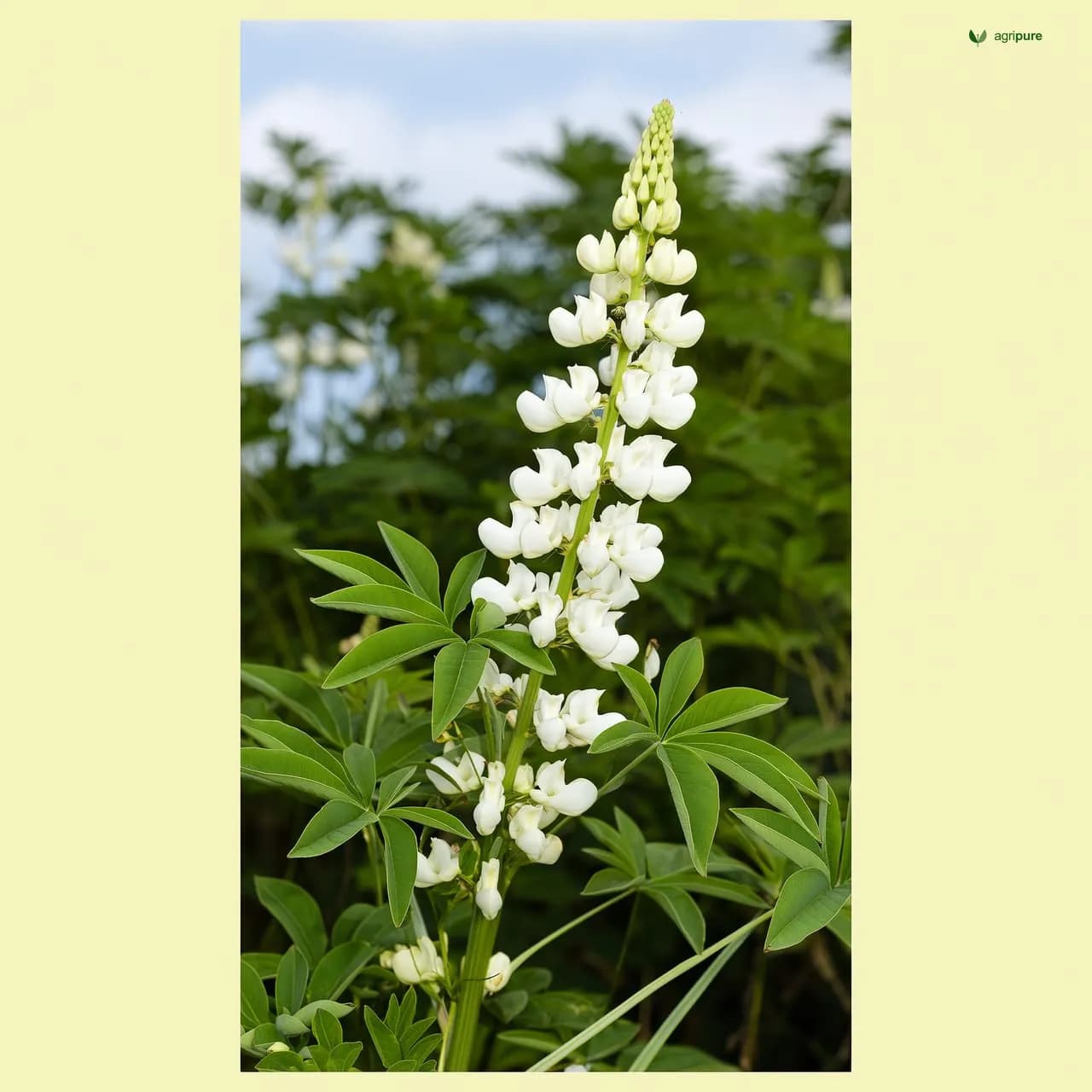
White lupin is an erect, branched annual reaching roughly 120 cm (about 47 in) tall, with a strong taproot that penetrates more than 60 cm into the soil. Alongside the taproot it forms distinctive cluster roots, dense bundles of short lateral rootlets that are the engine behind its ability to scavenge phosphorus from poor soils. Its leaves are alternate and palmately compound, with 5 to 9 leaflets that are nearly smooth on top and hairy beneath. The flowers are typical pea-flowers in terminal racemes, usually white, opening in May and June in temperate climates. Long, oblong pods follow in clusters of 3 to 7, each holding 3 to 7 large seeds. The seeds are large, flat, and roughly rectangular with rounded corners (about 7 to 16 mm long, 6 to 12 mm wide, and 2 to 5.5 mm thick), typically white to cream in cultivated forms and rich in protein, at roughly 30 to 40 percent of the whole seed.
Growing white lupin
White lupin is propagated by seed only; there is no standard vegetative method in agriculture. It performs best as a cool-season crop, growing where mean monthly temperatures during the season run 15 to 25 degrees Celsius (59 to 77 degrees Fahrenheit), with optimal growing-season rainfall of about 380 to 1,000 mm (15 to 39 in). It is cold tolerant overall, but temperatures of about minus 6 to minus 7 degrees Celsius (21 to 18 degrees Fahrenheit) at germination are harmful, and high temperatures or drought stress hinder flowering and pod set. Reliable seed production needs at least roughly five months without significant moisture stress. Primary and floristic sources do not assign USDA hardiness zones directly; horticultural references infer it is generally suited, as a spring-sown annual rather than a perennial, to climates corresponding roughly to USDA zones 4 to 8 — an inference from its climate range, not an explicit zonal listing.
Aim for a weed-free, firm seedbed. After sowing, firming the soil with a cultipacker or similar for good seed-to-soil contact is recommended, and a stale seedbed with early tine weeding — within about three days of sowing, taking care not to disturb the seed — helps keep weeds down during establishment. Drill the seed 2.5 to 5 cm (1 to 2 in) deep; seeding rates in agricultural practice range widely, from about 50 to 160 lb per acre depending on purpose and stand density. Inoculate the seed with the lupin-specific Bradyrhizobium the first time you grow it on a given plot to ensure strong nodulation and nitrogen fixation. Firm plant-spacing figures and exact sowing dates beyond “spring-sown in temperate regions” are not consistently given in the available sources, so they are left out rather than stated with false precision.
Harvest and uses
The harvest is the seed, taken when pods have filled and the crop has matured. Its headline trait is protein — roughly 30 to 40 percent of the whole seed, which is why white lupin is of interest as a plant-protein crop. Beyond food, the plant earns its place in a rotation below ground: as a legume it fixes atmospheric nitrogen, and its cluster roots markedly improve phosphorus uptake, which is why it succeeds on low-fertility, acidic ground where other pulses sulk. That makes it valuable as a green manure and soil-builder as well as a grain legume. Its range is wide: from a Mediterranean and Nile-valley base it is now cultivated from northern Europe and Russia to the arid Australian plains and the Andean highlands.
Safety and cautions
White lupin seed is edible only when you use low-alkaloid “sweet” cultivars, or after the seed has been properly debittered. All traditional “bitter” forms are toxic if not correctly processed, because of naturally occurring quinolizidine alkaloids. A few grounded points for any homesteader considering it:
- Do not assume market-bought or unlabeled lupin seed is safe to eat straight off the plant. Bitter landraces require correct, thorough processing before they are fit for food.
- When the goal is edible grain, source seed of a known sweet cultivar from a reputable supplier rather than relying on guesswork about alkaloid levels.
Used within those limits, white lupin is a genuinely useful homestead legume — a soil-improving, phosphorus-scavenging cool-season crop that doubles as a high-protein grain.
Sources
- White lupine (Lupinus albus) Plant Guide — USDA NRCS
- White lupin: alkaloids and processing — Livestock Research for Rural Development
- The white lupin genome and cluster-root phosphorus uptake — Nature Communications
- Cultivation of white lupin — Legume Hub
- Lupinus albus origin, adaptation and cultivation — ScienceDirect (Field Crops Research)
- White lupin (Lupinus albus) — Feedipedia (INRAE / CIRAD / AFZ / FAO)