secondary
Peppermint
filfili podina
Mentha × piperita
Also known as Filfili Podina (Pakistan).
- punjab plains
- pothohar
- kpk hills
International hardiness
- USDA 3-11
- RHS H7
- AU: Cool temperate, Warm temperate, Mediterranean, Subtropical
Where it grows — regional guide
| Zones / rating | Regional notes |
|---|---|
USDA 3-11 | Fully hardy perennial across USDA zones 3 to 9 that spreads via running rhizomes; large ingestions or concentrated oil can cause vomiting and diarrhea. |
| Zones / rating | Regional notes |
|---|---|
H7 (below -20C) | RHS rating H5: fully hardy culinary perennial best confined to pots to stop invasive spread; concentrated essential oils can trigger vomiting and diarrhea. |
| Zones / rating | Regional notes |
|---|---|
Cool temperate, Warm temperate, Mediterranean, Subtropical | Vigorous perennial for cool and warm temperate gardens needing moist ground and containment; concentrated essential oils can trigger vomiting and diarrhea. |
| Zones / rating | Regional notes |
|---|---|
USDA 3-11 (USDA scale) Canada uses its own zone system; Canadian zones run roughly one lower than USDA. | Extremely hardy perennial surviving harsh winters in damp garden corners; plant in sunken pots to curb rhizomes, and avoid large doses that cause diarrhea. |
| Zones / rating | Regional notes |
|---|---|
Punjab plains, Pothohar, KPK hills | Pakistan:Cultivated in Punjab, Pothohar and hill kitchen gardens in moist semi-shade; contain root runners to stop invasion, and avoid large oil doses that cause vomiting and diarrhea. |
Grows alongside
Species that appear with Peppermint in 29 of our published guides — a starting list for a guild, not a planting plan.
Peppermint (Mentha × piperita) is an aromatic perennial herb in the mint family, grown for its strongly scented, menthol-rich leaves. It is a natural hybrid of watermint and spearmint, indigenous to Europe and the Middle East and now widely cultivated and naturalized far beyond that range. For a homesteader, the appeal is that it is one of the easiest perennials to keep going: a single rooted division will colonize a moist, partly shaded corner and supply tea and flavoring leaves year after year — the catch being that it spreads aggressively by underground rhizomes and needs a plan to keep it in bounds.
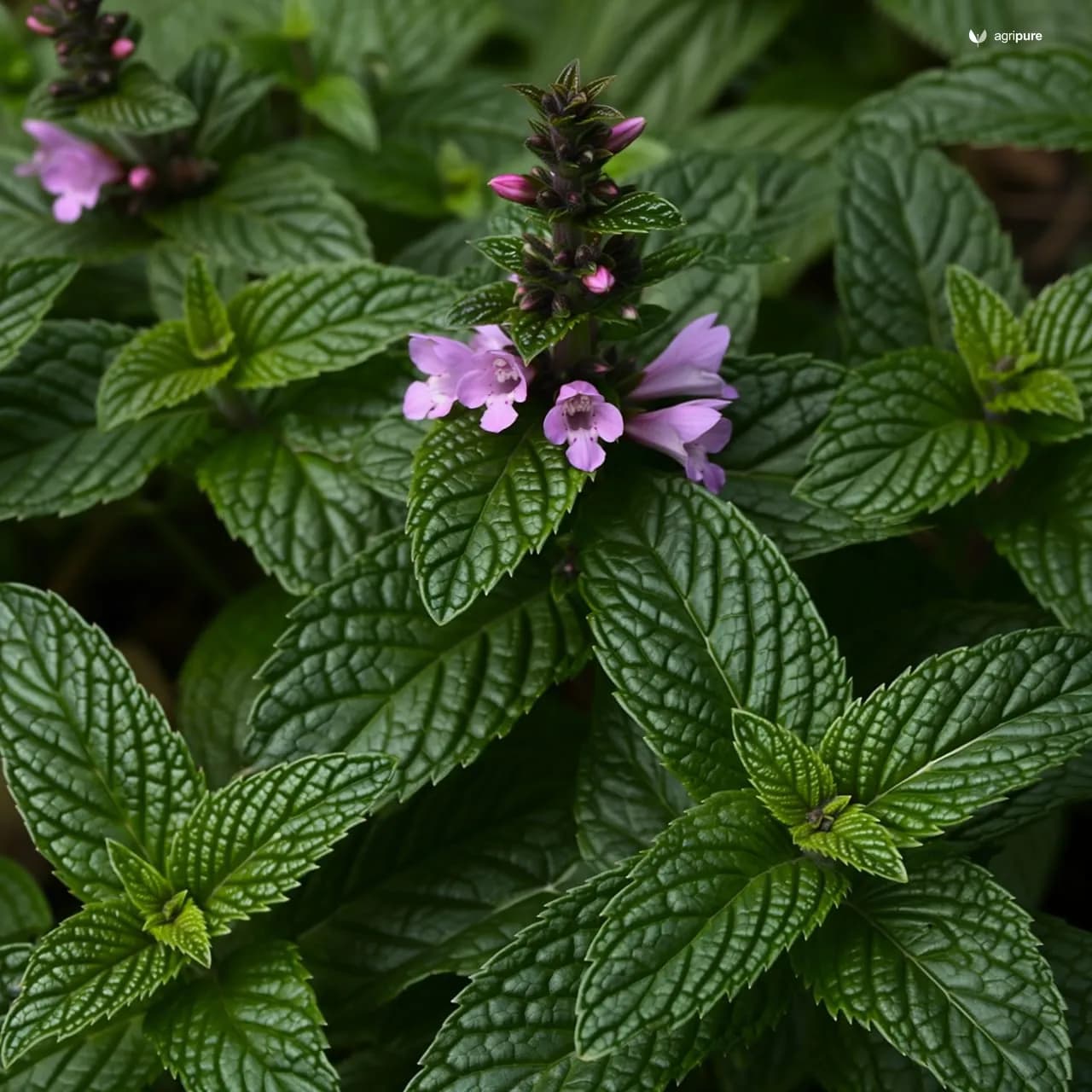
It is an upright, rhizomatous perennial with fragrant leaves carried in opposite pairs and small tubular flowers, described as pink to lavender, packed into dense terminal spikes. Because peppermint is a hybrid cross between watermint and spearmint, it is occasionally found growing wild alongside its two parent species, but it is overwhelmingly a cultivated plant. NC State Extension lists its origin as Europe and the Middle East and rates it for USDA hardiness zones 5a through 9b, so it overwinters reliably across a wide swath of temperate gardens.
Growing peppermint
Peppermint does not come reliably true from seed; the standard and most dependable methods are division of an established clump or rooted stem cuttings taken from a known plant. It prefers rich, moist soil in partial shade, with a near-neutral soil pH of roughly 6.0 to 7.0.1 It tolerates a range of soils; the main thing it will not accept is dry ground. It is unusually shade-tolerant for a culinary herb, performing well on as little as three hours of sun per day.
Spacing depends on your strategy. Set divisions about 18 inches apart if you are planting into open ground, or confine a single plant to a 12 to 16 inch pot to keep its running rhizomes from taking over the bed — a practical way to enjoy the herb without letting it escape. NC State does not give a firm days-to-harvest figure, so none is invented here; in practice the plant establishes quickly, and regularly pinching the branch tips encourages a bushier habit and increases the volume of leaf you can cut.
Harvest and uses
The usable parts are the leaves and flowers, harvested fresh or dried. In the kitchen, peppermint is a workhorse flavoring: teas and other beverages, jellies, syrups, candies, ice creams, and mint sauce all draw on it, and it doubles as a fragrance and potpourri plant. Beyond culinary use, it is valued industrially and in medicine, with its essential oil and polyphenols being the main constituents of interest. The reviewed literature reports that peppermint essential oils carry antimicrobial, antioxidant, antispasmodic, anthelmintic, and acetylcholinesterase-inhibitory activities. The provided sources do not give a reliable quantified leaf or oil yield figure, so none is stated rather than guessing.
Managing its spread and ecological role
The single most important thing to understand about peppermint is that it is an aggressive spreader, traveling outward by rhizomes to form a dense mat. This is exactly what makes it useful as a ground cover for filling difficult, consistently moist space — and exactly why it becomes a management headache if you turn your back on it. On a homestead the sensible approaches are to give it a contained bed, sink it in a buried pot, or site it where you actively want it to ramble, such as a damp edge it can carpet without crowding out fussier plants. Its dense terminal flower spikes are attractive to pollinators when the plant is allowed to bloom.
Safety and cautions
The leaves and flowers are a normal culinary ingredient, but the research flags genuine cautions worth respecting, all tied to the plant’s essential oils, which are identified as the toxic principle.
- NC State Extension classifies peppermint as having low-severity poison characteristics and notes that large ingestions can cause vomiting and diarrhea; the same source records no contact dermatitis from handling it.
- The toxic principle is the plant’s essential oils rather than any single poisonous organ — leaves, stems, and flowers are not flagged as uniquely dangerous at ordinary culinary doses, but concentrated essential-oil products are a different matter and call for caution.
- On the medicinal side, GBIF notes that peppermint’s medicinal uses have not been approved as effective or safe by the U.S. Food and Drug Administration, while the European Medicines Agency considers topical adult use of peppermint preparations safe within a pulegone limit of 1% (140 mg).
This profile describes traditional and reported uses and makes no claim that peppermint treats or cures any condition. The sources cited here do not list specific drug interactions or contraindicated groups for this species, so none are invented; as a general rule, treat concentrated peppermint oil cautiously and seek qualified advice before any medicinal use.
Sources
- Mentha x piperita (Peppermint) — NC State Extension Gardener Plant Toolbox
- Mentha × piperita L. — GBIF (Global Biodiversity Information Facility)
- Mentha piperita — ScienceDirect Topics