secondary
Khair (Catechu Acacia)
khair
Senegalia catechu
- punjab plains
- pothohar
- kpk hills
International hardiness
- USDA 10-12
- RHS H1c
- AU: Tropical, Subtropical, Arid / semi-arid
Where it grows — regional guide
| Zones / rating | Regional notes |
|---|---|
USDA 10-12 | No region-specific data yet |
| Zones / rating | Regional notes |
|---|---|
H1c (5 to 10C) | No region-specific data yet |
| Zones / rating | Regional notes |
|---|---|
Tropical, Subtropical, Arid / semi-arid | No region-specific data yet |
| Zones / rating | Regional notes |
|---|---|
USDA 10-12 (USDA scale) Canada uses its own zone system; Canadian zones run roughly one lower than USDA. | No region-specific data yet |
| Zones / rating | Regional notes |
|---|---|
Punjab plains, Pothohar, KPK hills | Pakistan:A thorny, drought-hardy deciduous tree of the dry plains, Pothohar and lower hills, raised from seed for hard timber, firewood and the heartwood extract katha; site it away from paths because of its spines. India:A resilient tree of dry deciduous forests and rocky soils, yielding traditional katha extract from its dense heartwood. |
Grows alongside
Species that appear with Khair (Catechu Acacia) in 1 of our published guides — a starting list for a guild, not a planting plan.
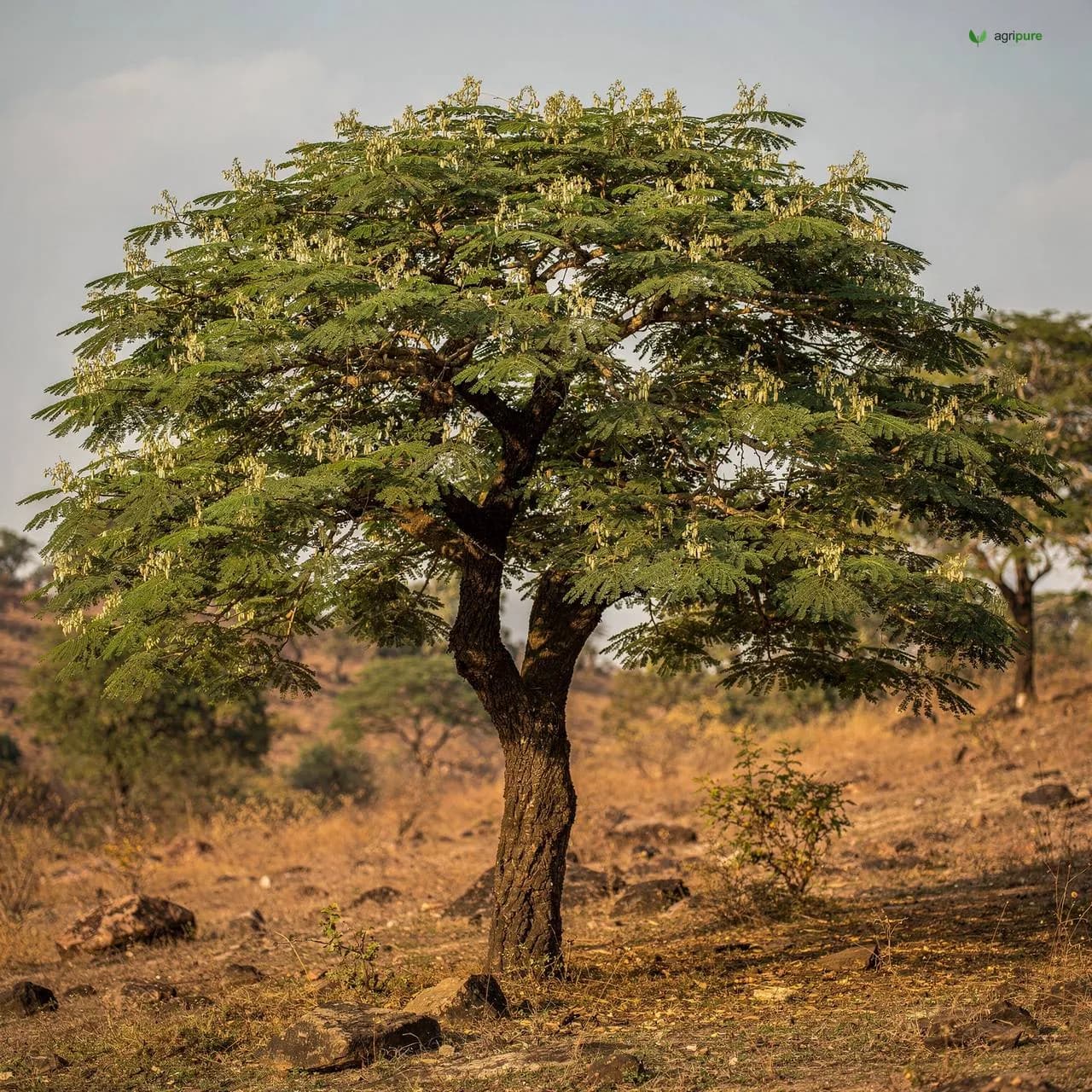
Khair, also called catechu acacia (Senegalia catechu, formerly Acacia catechu), is a deciduous, thorny tree native to the Indian subcontinent and ranging east to southern China (Yunnan) and western Indo-China. Flora records list it as native across south China, Bhutan, India, Nepal, Pakistan, and Myanmar. It belongs to the same broad legume group as the other acacias, and on a homestead it earns its keep as a tough, multipurpose tree: a hardwood source whose heartwood yields the famous tannin-rich extract known as katha or cutch, while the standing tree binds soil and feeds bees.
It is a medium-sized tree with grayish-brown bark and paired spiny stipules at the leaf bases that give it its characteristic armed, thorny look. The leaves are bipinnate (feathery and twice-divided, typical of the acacias), the flowers are borne in slender pale yellow to white spikes, and the fruit is a flat, shiny pod roughly 5 to 9 cm long. The combination of paired stipular spines, fern-like bipinnate foliage, and flat glossy pods is the most reliable way to tell it apart in the field.
Growing khair
Khair is fundamentally a tree of seasonally dry tropical climates, and it is described in the sources as a species of comparatively dry regions, though it can also push into heavy-rainfall country where it grows on alluvial sites. In the Himalayas its natural elevation range is reported at roughly 900 to 1,200 m. For a homesteader this makes it a candidate for warm, dry-leaning ground rather than cold or perpetually wet sites.
It is propagated by seed. One source describes soaking the seed in hot water first (a common way to break the hard seed coat of legume trees), then raising the seedlings in a nursery for about six months before they are planted out into the field. Beyond that, the reliable sources here do not give verified figures for exact sun exposure, soil type, watering, plant spacing, USDA hardiness zone, or time to harvest, so those are deliberately left out rather than guessed at. In practice, treat khair as a warm-climate, dry-tolerant tree: start it from scarified seed in a nursery and grow the seedlings on before transplanting.
Harvest and uses
Khair is grown above all for its wood and, in particular, the heartwood, which is processed into katha and cutch (catechu). This is an industrial-scale crop: one source reports that around 63,000 tonnes of khair wood were consumed annually in India to manufacture cutch and catechu. Reliable per-tree yield figures are not given in the sources, so none is stated here rather than invented.
The uses recorded in the sources span several categories:
- Culinary: the heartwood extract, katha or catechu, is used to flavor and color paan — the betel-leaf preparation made with areca nut and lime. Note that this is the processed extract, not a fresh edible plant part.
- Material and craft: the wood is used for furniture, tools, firewood, and charcoal, and the tree also supplies material for dyeing, leather tanning, preserving fishing nets, and even as a viscosity regulator in oil drilling.
- Ecological and agroforestry: the tree is valued for soil binding and landscape restoration, and its flowers provide nectar and pollen for bees.
- Medicinal (traditional): the heartwood extract, bark, and wood extract appear in traditional medicine, with reported use especially for cough and sore throat.
Pollination and wildlife value
For a homestead aiming to support pollinators, the flowering tree is a useful asset: its blossoms are noted as a source of both nectar and pollen for bees. Combined with its role in soil binding and restoration, this makes khair a tree that does ecological work, feeding insects and holding ground, alongside its harvestable products.
Safety and cautions
A few honest, source-grounded cautions are worth flagging:
- It is a thorny tree. The paired spiny stipules are a defining feature, so site it where the spines are useful (such as a boundary or living barrier) rather than across a path or work line.
- It is not a general food plant. The only culinary use documented in the sources is the processed heartwood extract (katha/catechu) used in paan — not the fresh leaves, bark, pods, or wood. Do not treat the raw plant parts as food.
- On medicinal use, be conservative. The medicinal references here are traditional-use and review material, not clinical safety guidance. The sources do not provide verified dosages, contraindications, interaction warnings, or guidance on who should avoid it, and they do not document specific toxicity of the species. The defensible statement is simply that medicinal use of khair is traditional and is not supported here by clinical safety data. This profile makes no medical claims and gives no dosages; anyone considering medicinal use should seek qualified advice.
Sources
- Acacia catechu (Senegalia catechu) — eFlora of India
- Khair Information (uses, cutch/catechu production, growing conditions)
- Senegalia catechu — Wikipedia
- Senegalia catechu — Plants of the World Online (Royal Botanic Gardens, Kew)
- Senegalia catechu (Khadira): traditional medicinal review — Journal of Ayurveda and Integrated Medical Sciences
- Senegalia catechu propagation (hot-water seed treatment, nursery period) — indiantreepix discussion
Sourcing notes
Raise from seed; khair seed is available through KPK and Punjab forest department nurseries and germinates readily after a short hot-water or scarification treatment. Collect from healthy local trees on dry, rocky sites for stock suited to Pothohar conditions.