secondary
Wild Olive
kahu
Olea ferruginea
Also known as Kahu (Pakistan).
- pothohar
- kpk hills
- balochistan highlands
International hardiness
- USDA 8-11
- RHS H3
- AU: Mediterranean, Warm temperate, Subtropical
Where it grows — regional guide
| Zones / rating | Regional notes |
|---|---|
USDA 8-11 | No region-specific data yet |
| Zones / rating | Regional notes |
|---|---|
H3 (-5 to 1C) | No region-specific data yet |
| Zones / rating | Regional notes |
|---|---|
Mediterranean, Warm temperate, Subtropical | No region-specific data yet |
| Zones / rating | Regional notes |
|---|---|
USDA 8-11 (USDA scale) Canada uses its own zone system; Canadian zones run roughly one lower than USDA. | No region-specific data yet |
| Zones / rating | Regional notes |
|---|---|
Pothohar, KPK hills, Balochistan highlands | Pakistan:An indigenous drought-tolerant tree of the Pothohar, KPK hills and Balochistan; widely established as a resilient rootstock for grafting commercial olives. India:Native to the dry Himalayan foothills and northwestern hill tracts; a durable dryland evergreen tree suited to rocky slopes and semi-arid terrain. |
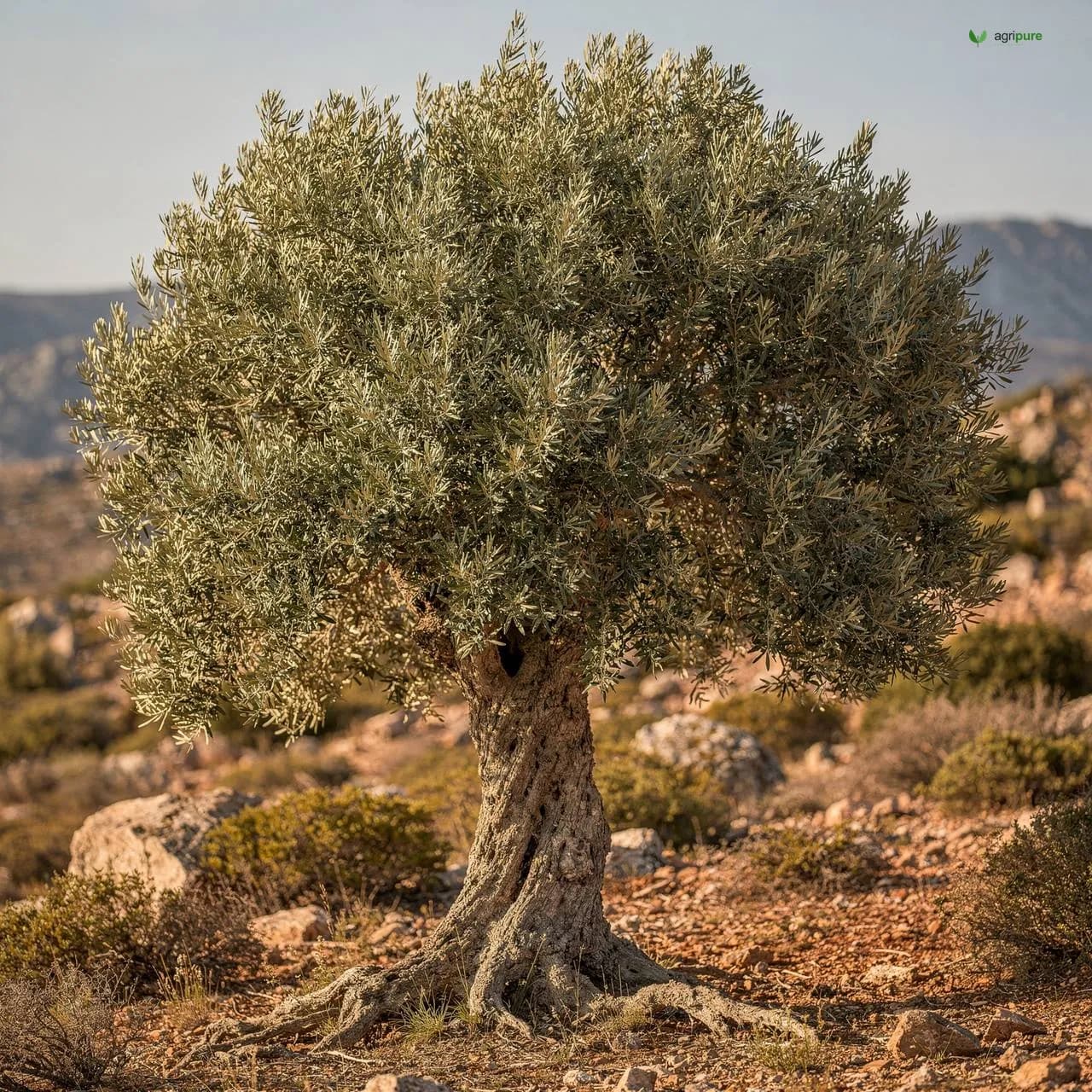
Wild olive (Olea ferruginea), often called the Indian olive, is a small, much-branched evergreen tree in the olive family (Oleaceae). It is one of the wild olives — closely allied to, and frequently treated as part of, Olea europaea subsp. cuspidata — and it grows naturally across a broad belt of dry country, from sub-Saharan and north-east Africa through Arabia and West Asia (Afghanistan, Iran), across the Indian subcontinent and into western and southern China. In the northwest Himalaya it is described as an underutilised native fruit tree. For a homesteader, the appeal is its toughness: this is a hot-climate, drought-adapted relative of the cultivated olive that holds dry, stony ground and produces edible drupes, durable wood, and a tree that lives for generations.
Description and identification
Wild olive is a dense, much-branched evergreen tree, typically 2 to 15 m tall within the wild olive complex, with a trunk that becomes gnarled with age much like the common olive. The leaves are the classic olive form — opposite, simple, and leathery — but smaller and narrower than those of the cultivated tree, often oblong-lanceolate, grey-green to dark green above and paler beneath. In spring it carries small white to creamy flowers in axillary panicles (branched clusters in the leaf joints). The fruit is a typical olive drupe, small at about 9 to 12 mm across, green when immature and turning brownish-black as it ripens, with a thin fleshy layer over a single hard stone. The wood is hard and durable, with a strong aromatic scent likened to bay rum, and it is prized for fine furniture and turnery.
One practical note on names: because many floras now fold O. ferruginea into O. europaea subsp. cuspidata, most detailed botanical and horticultural data appear under the cuspidata name rather than under “O. ferruginea” alone.
Growing wild olive
Wild olive is a tree of subtropical dry forest, including Himalayan subtropical broadleaf forest, and its native range sees hot, dry seasons with pronounced drought followed by cool to mild winters — generally some winter chill, but not the severe, wet cold that harder climates bring. That ecology is the key to siting it: think hot dry summers and mild winters, full exposure, and free-draining ground rather than rich, irrigated flats.
On climate hardiness, the honest answer is that there is no peer-reviewed USDA zone rating published specifically for O. ferruginea. As a guide, the closely allied common olive (O. europaea, the same species complex) is grown outdoors in roughly USDA zones 8 to 10, with some cultivars hardy to zones 7a–7b, and performs best where summers are hot and dry and winters mild and wet. Given the close relationship and shared ecology, wild olive is likely comparable in frost tolerance, but any precise zone figure for this species alone would be guesswork and is left out here.
Cultivation-specific literature for wild olive itself is limited, so the practical horticulture is generally drawn from Olea europaea and its wild subspecies, which are horticulturally very similar. The one method the sources here document clearly is propagation, and they note that detailed sowing dates, spacing, and time-to-harvest figures for O. ferruginea specifically are not consistently recorded — so rather than invent precise numbers, treat it as you would any dryland olive: a slow, long-lived tree for a sunny, well-drained, low-fertility site that you are planting for the decades, not the season.
Harvest and uses
The harvest is the small olive drupe, picked as it turns from green to brownish-black at ripeness. The fruit carries the same thin fleshy mesocarp over a single stone as any olive, and wild olives of this complex have a long history of use for their fruit and oil, though the drupes are markedly smaller than those of selected cultivars. Beyond the fruit, the tree earns its place several times over: its hard, durable, aromatic wood is highly valued for fine furniture and turnery, and as a dense evergreen it provides shade and holds dry slopes. In its native northwest Himalaya it is specifically flagged as an underutilised fruit tree crop — a productive native that has been overlooked rather than fully developed. For a homestead on hot, marginal ground, that combination of edible fruit, useful timber, and sheer resilience is the real return.
Sources
- Olea europaea subsp. cuspidata – eFlora of India
- Olea europaea subsp. cuspidata – Wikipedia
- Olea europaea subsp. cuspidata – PROTA (Plant Resources of Tropical Africa)
- Olea europaea – North Carolina Extension Gardener Plant Toolbox (NC State Extension)
- Olea ferruginea Royle, Indian olive: an underutilised fruit tree crop of northwest Himalaya – Fruits (Cambridge University Press)
Sourcing notes
Wild olive is widely available as seedling and rootstock through Pothohar nurseries and the Barani Agricultural Research Institute at Chakwal. The usual route is to establish kahu, then graft it over to a fruiting olive cultivar such as the BARI Zaitoon selections.