secondary
Leafless Milkweed Shrub
barara / bata
Periploca aphylla
Also known as Batta (Pakistan).
- pothohar
- balochistan highlands
- sindh coast
International hardiness
- USDA 9-11
- RHS H2
- AU: Arid / semi-arid, Subtropical
Where it grows — regional guide
| Zones / rating | Regional notes |
|---|---|
USDA 9-11 | No region-specific data yet |
| Zones / rating | Regional notes |
|---|---|
H2 (1 to 5C) | No region-specific data yet |
| Zones / rating | Regional notes |
|---|---|
Arid / semi-arid, Subtropical | No region-specific data yet |
| Zones / rating | Regional notes |
|---|---|
USDA 9-11 (USDA scale) Canada uses its own zone system; Canadian zones run roughly one lower than USDA. | No region-specific data yet |
| Zones / rating | Regional notes |
|---|---|
Pothohar, Balochistan highlands, Sindh coast | Pakistan:A native leafless desert shrub of arid Balochistan and Salt Range slopes; holds dry soils, but contains toxic milky latex unsafe for food use. |
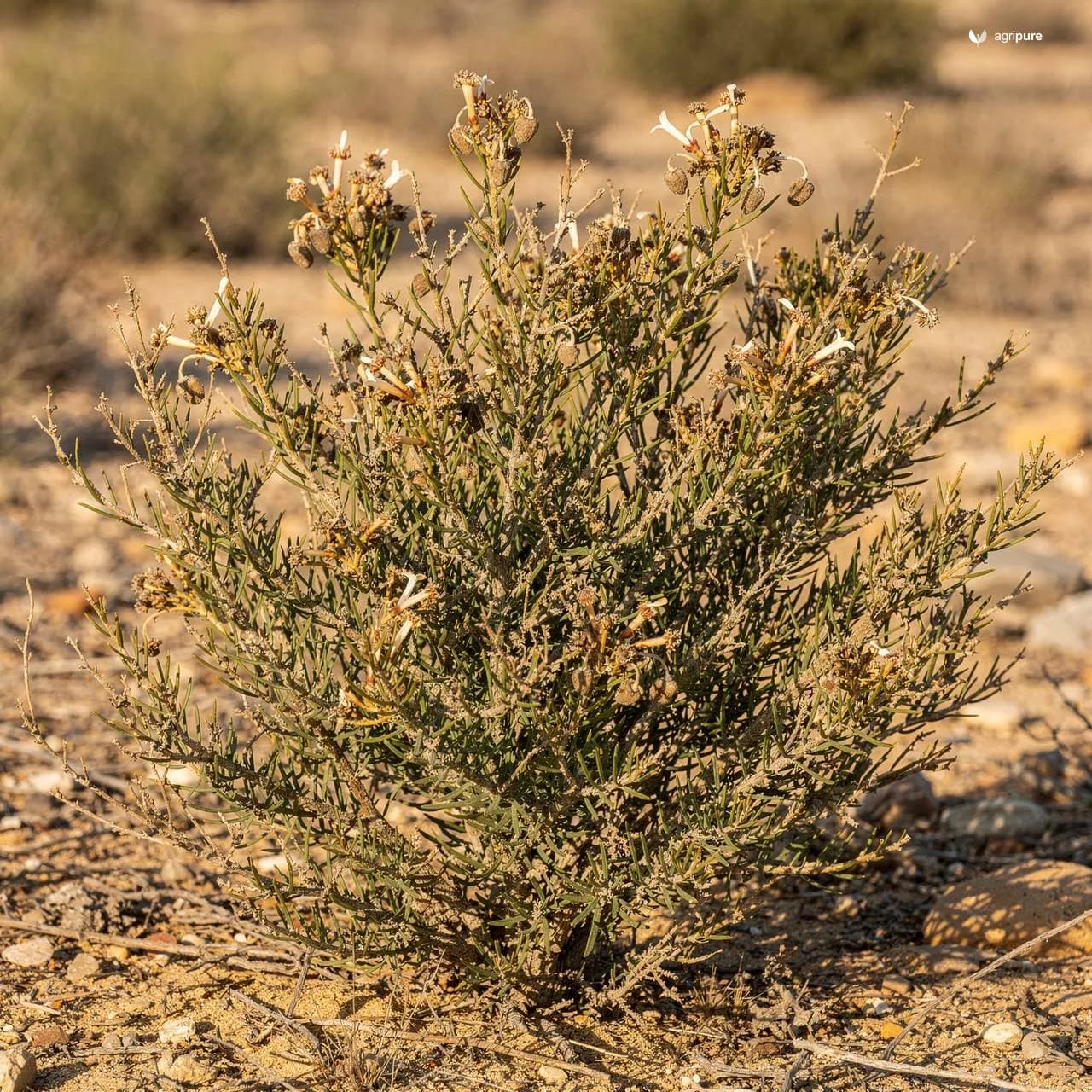
Leafless milkweed shrub (Periploca aphylla, barara or bata) is a near-leafless dryland shrub of the Pothohar scrub, the Balochistan slopes, and the arid Sindh fringe. It is an erect, milky-sapped bush that goes most of the year without leaves, and across its range it is one of the most-used folk medicines for swollen joints and gut complaints. On a syntropic site it works as a hardy secondary-stage shrub that holds dry ground while supplying medicine, browse, and fuel.
Where it thrives
Barara is an erect, branched shrub, roughly 1.8 to 3 m tall, generally leafless and full of milky juice, with only minute leaves when they appear at all. It grows on dry, rocky ground through Pakistan, Afghanistan, and Iran on to Egypt, thriving in scrubland and semi-arid country where its leaflessness cuts water loss. That tolerance of drought and thin, stony soil is what spreads it across the Pothohar, the Balochistan highlands, and the dry Sindh interior, on exactly the kind of degraded ground where softer plants fail.
Role in the system
In a dryland guild barara fills the secondary shrub layer, a tough, woody bush that establishes on marginal, eroding ground and helps stabilise it. Its main return is medicinal, so it earns its place as a multipurpose component, a standing home remedy, more than as a forage or fuel crop on its own. As hardy scrub it also gives browse to stock and woody stems for fuel, and its root system holds thin soil on dry slopes. The design logic is to use it where its drought-hardiness counts: a resilient shrub for the hard, dry edges of a system rather than for good ground.
Uses
Barara is a heavily used folk medicine. The milky juice is applied to tumours and swellings and used for swollen joints, cough, and flu, and the plant treats skin complaints, ulcers, and constipation, with the ash made into a poultice for swollen joints. Local healers use it as a stomachic and tonic and for inflammatory conditions, and laboratory work has found antioxidant and antimicrobial activity in the aerial parts, which supports the traditional use. Alongside the medicine, the shrub is browsed by livestock and its woody stems are cut for fuel, so a single hardy bush carries three returns off dry ground.
Cautions
The plant is rich in milky latex and bioactive compounds, so the same chemistry that makes it a remedy means it should be used with care rather than eaten freely, and dosing in folk use is deliberately small. Treat it as a medicinal and browse shrub for marginal ground, not as a food plant, and harvest stems for fuel and fodder without clearing the bushes out, since they are part of what holds these dry, erosion-prone slopes together.
Sources
- Marwat, S. K., et al. “Floristic Account of the Asclepiadaceous Species from the Flora of Dera Ismail Khan District, KPK, Pakistan.” American Journal of Plant Sciences.
- Iqbal, S., et al. (2012). “Antioxidant, Antimicrobial, and Free Radical Scavenging Potential of Aerial Parts of Periploca aphylla and Ricinus communis.” ISRN Pharmacology.
Sourcing notes
Barara is propagated from seed and grows readily on dry, rocky ground across the Pothohar and Balochistan. Collect seed from healthy wild shrubs, and harvest stems for medicine, fodder, and fuel without clearing stands, since they help hold erosion-prone dryland slopes.