climax
Chir pine
Pinus roxburghii
- kpk hills
International hardiness
- USDA 8-11
- RHS H3
- AU: Warm temperate, Subtropical
Where it grows — regional guide
| Zones / rating | Regional notes |
|---|---|
USDA 8-11 | No region-specific data yet |
| Zones / rating | Regional notes |
|---|---|
H3 (-5 to 1C) | No region-specific data yet |
| Zones / rating | Regional notes |
|---|---|
Warm temperate, Subtropical | No region-specific data yet |
| Zones / rating | Regional notes |
|---|---|
USDA 8-11 (USDA scale) Canada uses its own zone system; Canadian zones run roughly one lower than USDA. | No region-specific data yet |
| Zones / rating | Regional notes |
|---|---|
KPK hills | Pakistan:The native pine of lower sub-Himalayan KPK hills; anchors dry, sloping ground, but parts are not safe to eat. India:Native across the subtropical Himalayan monsoon belt; yields resin and timber on steep rocky slopes, though parts must not be eaten. |
Chir pine (Pinus roxburghii) is a large, three-needled conifer native to the Himalayan monsoon belt, where it ranges from Afghanistan through Pakistan, India, Nepal, and Bhutan into southern Tibet, typically growing between about 450 and 2,300 m elevation. For a homesteader working dry, sloping, hard-to-plant ground, its appeal is straightforward: this is a tough mountain pine that holds a hillside, throws shade, and over a long lifespan returns timber, fuel, and resin rather than a quick seasonal crop. It is grown for wood, cones, and oleoresin, not for food, so it belongs in the long-horizon, structural part of a property rather than the kitchen garden.
Description and identification
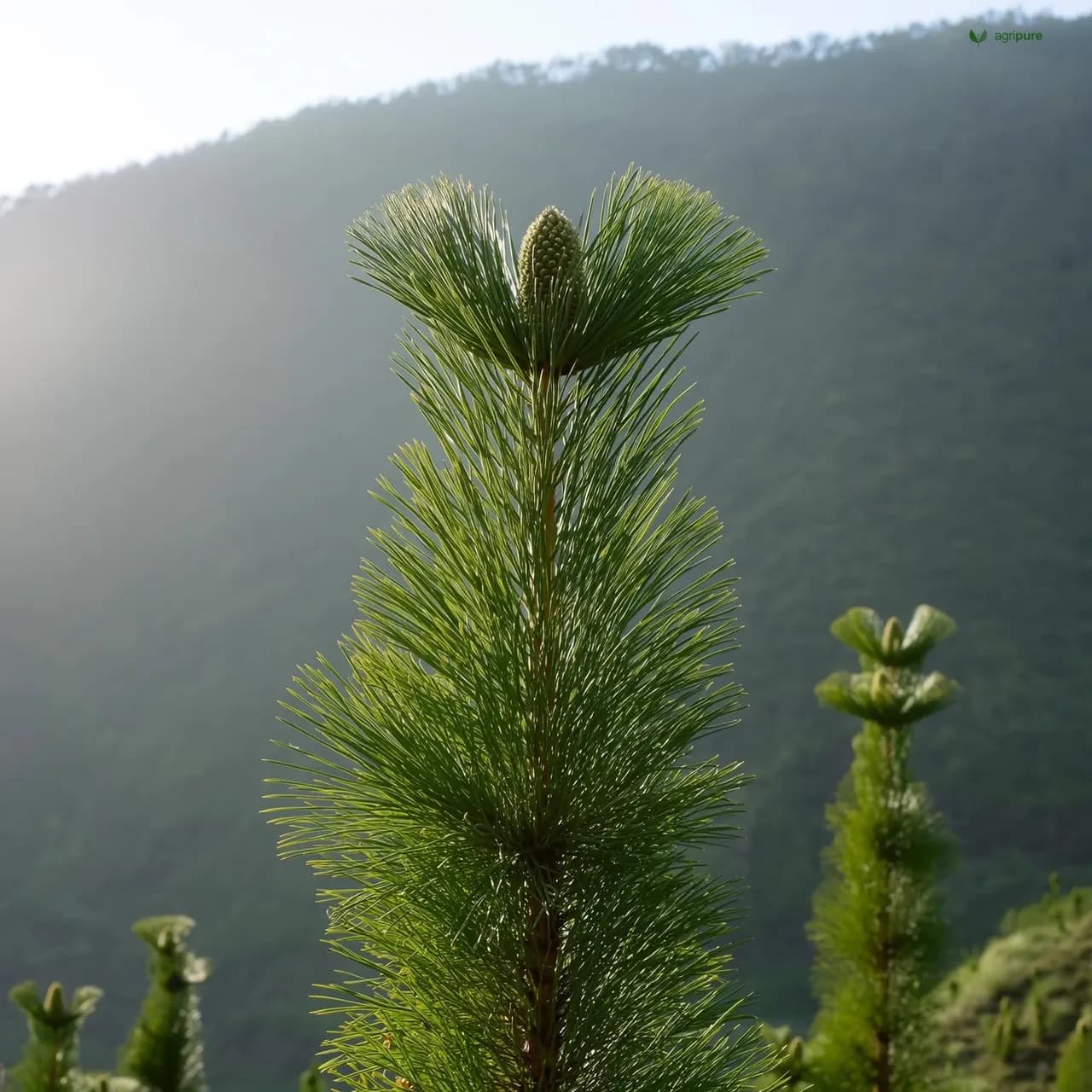
Chir pine is commonly described as a large tree; an authoritative description records it reaching up to about 55 m tall, while a horticultural listing gives a more typical mature size of roughly 30 m tall by 15 m wide in cultivation. Three features make it recognizable in the field:1
- Needles: borne three to a bundle (fascicle), slender, and long (about 20 to 30 cm) with a persistent sheath at the base.
- Bark: dark red-brown, thick, scaly, and deeply fissured along its length, a distinctive plated look on mature trunks.
- Cones: ovoid and substantial, roughly 10 to 20 cm long by 6 to 9 cm wide, with seeds maturing around October to November.
The combination of three long needles per bundle and heavy, deeply furrowed red-brown bark separates it from many other pines a grower might encounter.
Growing chir pine
This is a tree of the Himalayan monsoon belt, restricted in the wild to a band roughly between 72° and 95° E and 27° and 35° N, across a broad elevation range on mountain slopes. One conifer reference rates it for about Zone 9, with a cold-hardiness limit somewhere between roughly \-6.6 °C and -1.1 °C, which marks it as a warm-temperate to subtropical mountain species rather than a hard-frost tree. A reliable USDA-zone citation was not available in the research, so that single Zone 9 rating is the only hardiness figure given here.
Beyond range and hardiness, species-specific home-garden cultivation guidance in the sourced research was limited, so several details are deliberately omitted rather than invented. The research confirms the tree produces seed cones and mature seeds, but it did not provide a verified propagation protocol, exact soil texture or pH, irrigation needs, planting spacing, or a confirmed time to maturity — so those are intentionally left out rather than stated with false precision. In practice, treat it as the slow, structural conifer it is: a long-lived mountain tree for an open slope, planted with patience rather than managed like an annual crop.
Harvest and uses
Chir pine is harvested for wood, cones, and oleoresin rather than edible fruit. Its standing in the landscape is considerable: one reference notes it is the most widely planted conifer in Nepal, where it makes up about 17% of the country’s forested area — a measure of how dominant it is, though not a yield figure. The research did not provide quantitative yields for resin, seed, or timber per tree or per hectare, so no such numbers are claimed here.
The wood is used for construction and furniture, and the trunk is a source of resin; the species is also drawn on for paper pulp, turpentine, and rosin production. In medicinal tradition, the essential oil and resin have been used for cuts, wounds, boils, and blisters, with folk uses also recorded for bronchial disorders, asthma, skin diseases, toothache, earache, and ulcers. These are descriptions of traditional use, not endorsements: this profile makes no claim that the plant treats or cures any condition.
Safety and cautions
The sourced research did not contain any reliable statement that Pinus roxburghii is poisonous to people or livestock, so no species-specific toxicity is asserted here. Equally, it did not establish that the needles, resin, seeds, or any other part are safely edible as food — so edibility should not be assumed, and no part should be eaten on the basis of these sources.
For the medicinal uses above, the available sources describe traditional practice and essential-oil bioactivity but provide no patient-level safety guidance — no dosages, contraindications, pregnancy or lactation cautions, or drug-interaction data. Because of that gap, no dosage or internal-use advice is given here. Anyone considering medicinal use of the resin or oil should treat it conservatively and seek qualified guidance first.
Sources
- Pinus roxburghii — The Gymnosperm Database (Conifers.org)
- Pinus roxburghii — Speciality Trees
- Pinus roxburghii: extraction and uses — International Journal of Current Science (IJCSP)
- Ethnomedicinal and essential-oil uses of Pinus species — PMC (National Library of Medicine)
- Pinus roxburghii — Wikipedia