climax
Blue Pine
biar
Pinus wallichiana
Also known as Biar (Pakistan), Bhutan Pine (UK & Ireland, Australia), Himalayan White Pine (United States, Canada).
- kpk hills
- balochistan highlands
International hardiness
- USDA 5-9
- RHS H6
- AU: Cool temperate, Warm temperate
Where it grows — regional guide
| Zones / rating | Regional notes |
|---|---|
USDA 5-9 | Planted as an ornamental conifer across USDA zones 5 to 9 in full sun with shelter from drying winter winds; avoid internal resin doses, especially in pregnancy. |
| Zones / rating | Regional notes |
|---|---|
H6 (-20 to -15C) | Hardy at RHS H6 and widely planted as an ornamental conifer with graceful weeping needles; resin or tar extracts should never be taken internally in pregnancy. |
| Zones / rating | Regional notes |
|---|---|
Cool temperate, Warm temperate | Planted in cool-temperate and warm-temperate gardens as a specimen tree for its weeping needles; pine resin or tar should not be consumed internally during pregnancy. |
| Zones / rating | Regional notes |
|---|---|
USDA 5-9 (USDA scale) Canada uses its own zone system; Canadian zones run roughly one lower than USDA. | Hardy in milder coastal gardens but needs shelter from desiccating winter winds; internal doses of pine resin or tar must be avoided, particularly during pregnancy. |
| Zones / rating | Regional notes |
|---|---|
KPK hills, Balochistan highlands | Pakistan:Raised in upland nurseries and planted on open mountain slopes for timber and slope cover; internal use of pine resin or tar must be avoided during pregnancy. India:Native across Himalayan mountain tracts where it provides evergreen cover and timber; large internal doses of pine resin or tar should be avoided in pregnancy. |
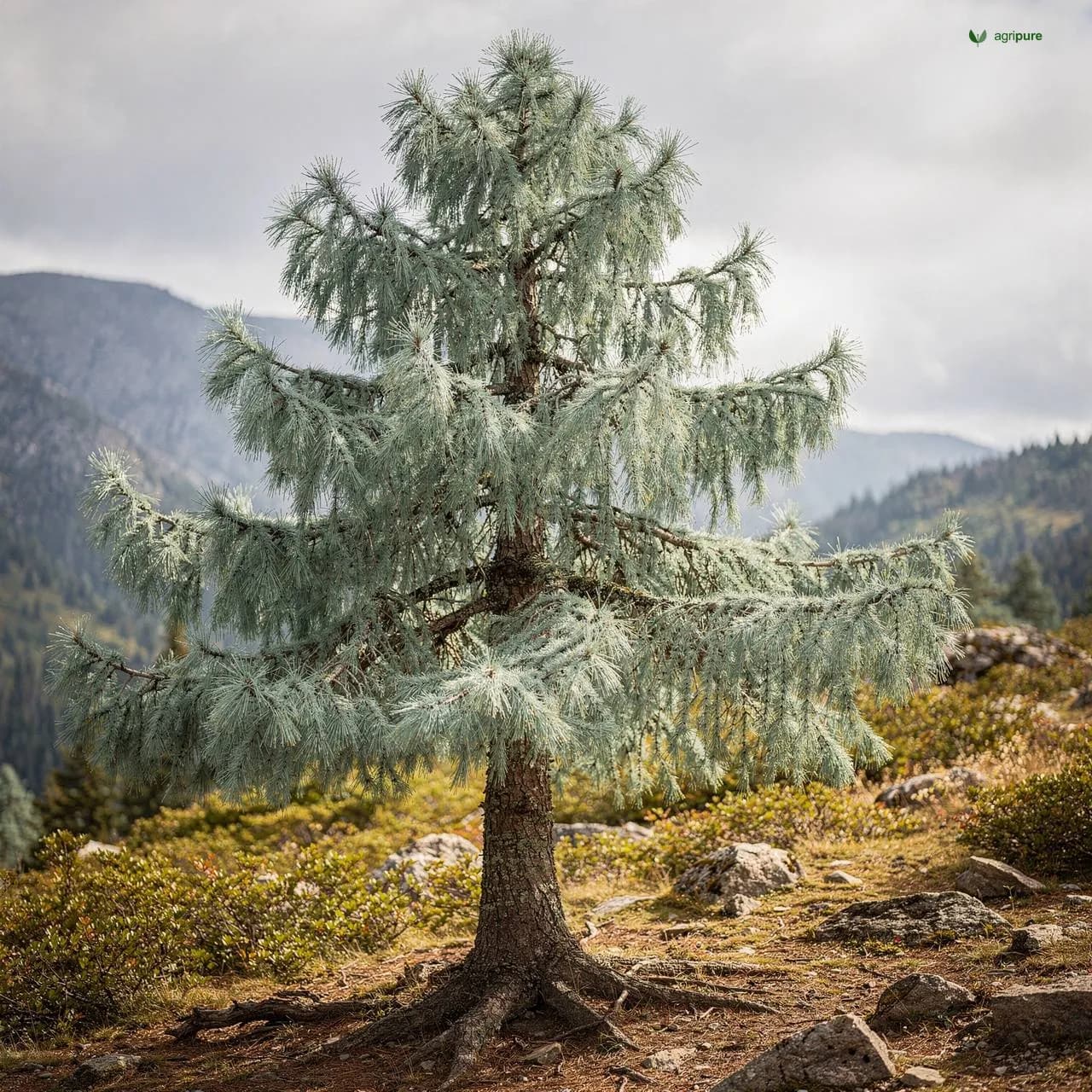
Blue pine (Pinus wallichiana), also called Bhutan pine or Himalayan white pine, is a tall, long-needled, five-needle white pine native to the mountains of central Asia. It grows naturally along the great arc of the Himalaya, Karakoram and Hindu Kush, and it is valued chiefly as a timber, resin and ornamental tree, with limited but real edible and folk-medicinal traditions. For a homesteader at altitude or in a cold-temperate climate, its appeal is that it is a graceful conifer that establishes on open and even rough ground, useful for putting evergreen cover, windbreak and eventual timber back onto bare slopes.
This is a large evergreen conifer, typically 30 to 50 m tall in the wild (occasionally more), with a trunk reaching roughly 1 to 1.5 m in diameter. The crown is broadly pyramidal when young and rounds off with age, carried on wide-spreading, pendulous branches that give the tree a loose, graceful, open look that is part of why it is so often planted as an ornamental. The bark is dark grayish-brown, becoming flaky and then furrowed on older trunks, and the young shoots are stout, blue-green and smooth, without down.
How to identify blue pine
The single most reliable field mark is the needles, which are borne in bundles of five — the signature of the white pines. On blue pine these needles are unusually long and soft, about 10 to 20 cm long, blue-green to glaucous in colour, and distinctly drooping or hanging. The seed cones are equally diagnostic: long, slender and pendent, roughly 15 to 30 cm long, ripening to a yellow-buff colour with thin scales. The seeds themselves are small, about 4 to 6 mm long, but carry a large wing 15 to 35 mm long to help them disperse on the wind. The combination of very long, soft, drooping five-needle bundles with a blue-green cast and large hanging cones up to a foot long makes this tree hard to confuse.
Growing blue pine
In the wild, blue pine grows at roughly 1,600 to 3,900 m elevation (sometimes higher), in mountain valleys, on screes and on glacier forelands, where it forms either pure stands or mixes with deodar cedar, spruce, fir, birch and oaks. It favours a temperate mountain climate with dry winters and wet summers. It is shade-intolerant and behaves as an early-seral (pioneer) species after disturbance, which is what makes it useful for colonising open ground.
On hardiness the sources genuinely disagree, so it is worth being honest about the range rather than quoting a single figure. One conifer cold-hardiness study reported it hardy only to USDA Zone 8; a European tree nursery lists it as low as Zone 7a (about -17.7 to -15 °C); and North American horticultural sources report it surviving in landscape use across roughly Zones 5a to 7b. Taken together, practical experience suggests Zones 5 to 7 are feasible on many sites, but extreme cold or desiccating winter winds can scorch and discolour the needles. Treat it as a cold-tolerant, cool-summer pine that is sensitive to drying winter wind.
- Sun: Plant it in full sun. It is shade-intolerant, so give it 6+ hours of direct light a day; NC State lists it for full sun to partial shade, but full sun is optimal.
- Propagation: As a typical pine it is grown from seed, and it is widely raised this way for forestry and plantation use across its native range.
- Transplanting: NC State advises transplanting it when small for best results, which implies it resents root disturbance once it has put on size — so move seedlings young or start them where they are to grow.
- Exposure: Because winter wind can discolour the needles, give it some shelter from drying, freezing winds where your winters are harsh.
Species-specific details such as stratification times, plant spacing and exact time-to-maturity are not clearly documented in these general sources, so they are left out here rather than stated with false precision.
Harvest and uses
Blue pine is grown mainly for timber, resin and as an ornamental, and it carries limited but genuine edible and folk-medicinal traditions as well. Across its native Himalayan range it is an important forestry and plantation tree. For the homesteader, the most practical returns are structural and ecological: a graceful evergreen for shelter and windbreak, a pioneer that will take an open or disturbed slope and form a high canopy, and, in time, a source of softwood timber and resin. Its loose, pendulous form also makes it one of the more ornamental of the large pines.
Safety and cautions
No acute toxicity unique to blue pine is reported in the major references. As with pines generally, though, the usual conifer cautions apply to any edible or medicinal use: the sources advise avoiding use in pregnancy, avoiding large internal doses of resin or tar, and not relying on long-term medicinal use without professional supervision. Its traditional edible and folk-medicinal uses are real but limited, and this profile makes no medical claims and gives no dosages — treat any internal use of pine resin, tar or extracts conservatively and seek qualified advice first.
Sources
- Pinus wallichiana — The Gymnosperm Database (conifers.org)
- Pinus wallichiana — Van den Berk Nurseries
- Pinus wallichiana — Trees and Shrubs Online
- Pinus wallichiana — NC State Extension Plant Toolbox
- Pinus wallichiana — Conifers Garden Encyclopedia
- Pinus wallichiana — Wikipedia
Sourcing notes
Blue pine is one of the easier high conifers to raise from seed and is stocked by KPK and northern forest nurseries. It establishes on open and rocky sites, so it is a practical choice for restoring cover on bare slopes.