Key takeaways
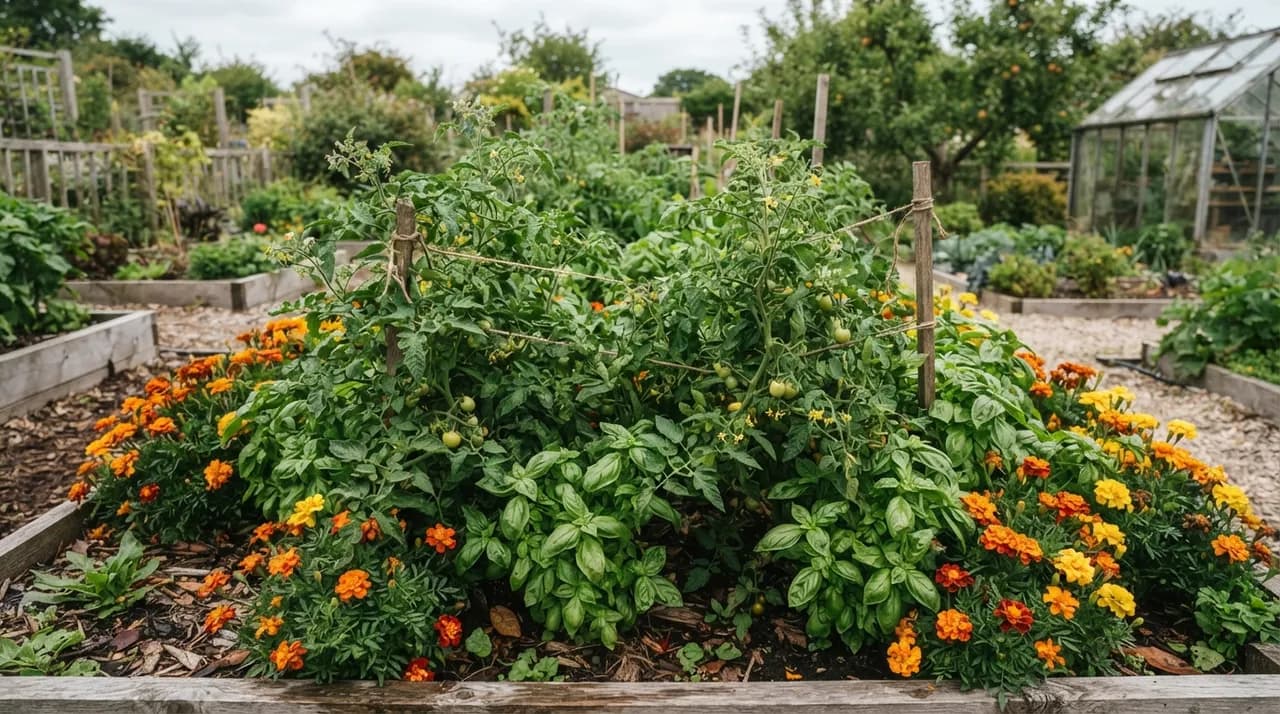
Marigolds and tomato plants growing companionably side-by-side in a raised garden bed.
Companion planting marigolds with tomatoes to naturally repel pests and attract beneficial insects.
- Companion planting grows crops near each other for a benefit — pest control, pollination, support, shade, or nitrogen — and a handful of those mechanisms hold up in trials.
- The strongest evidence sits behind trap crops, pest-masking diversity, beneficial-insect habitat, living mulch, and legume nitrogen, not most one-to-one “this plant loves that plant” charts.
- The three sisters works because corn gives beans a trellis, beans fix nitrogen, and squash shades the soil as living mulch — documented in North America since about 1070 AD.
- Honest good-neighbor picks: basil and marigolds near tomatoes, nasturtium near squash and cucumbers, onions among carrots, beans climbing corn.
- Keep tomatoes, peppers, eggplant, and potatoes 50 to 60 feet from black walnut, whose juglone is toxic to them, and treat fennel as a loner until research says otherwise.
Walk any Iowa or Pacific Northwest kitchen garden in July and you will see it: tomatoes ringed with basil, marigolds tucked at the bed corners, beans winding up cornstalks, squash sprawling underneath. That is companion planting — pairing crops so they help each other instead of just sharing dirt. The idea is old, the charts are everywhere, and the science is more mixed than most of those charts admit. Of the 5 mechanisms people lump under the term, some are backed by field and greenhouse trials and some are passed-down folklore that nobody has tested. This guide separates the two across 7 crop groups, so you can plant the combinations that earn their space and skip the ones that only sound good. It is the kitchen-garden cousin of permaculture guilds, scaled down to a single bed.
What companion planting actually does
Companion planting is not one technique — it is a bundle of 5 mechanisms, and they do not all carry the same weight of evidence. Knowing which is which is the difference between a garden plan and a horoscope. University of Minnesota Extension puts the caution plainly: the long pest-repellent lists you find online are not always accurate or backed by research. So start with the mechanisms that are.
The five ways neighbors help
- Trap cropping. A sacrificial plant lures pests off your main crop. Documented pairs include tomatoes with cowpeas and bell peppers with hot cherry peppers. The trap goes in 1 to 2 weeks first, then you destroy or treat it once the pests gather.
- Masking and confusion. Dense, diverse plantings with little bare ground make it harder for a pest to find its host. Aromatic herbs near tomatoes work partly this way, and a few studies show basil and marigolds reducing thrips on tomatoes in both field and greenhouse conditions.
- Beneficial-insect habitat. Flowers feed the predators and parasitoids that eat your pests. Interplanting sweet corn with buckwheat, cowpea, and sunn hemp has been shown to raise populations of the natural enemies of corn earworm.
- Living mulch. A sprawling crop shades the soil, holds moisture, and crowds out weeds — the job squash does in the three sisters. It is the green version of the wood-chip mulch you would otherwise spread.
- Nitrogen fixation. Legumes partner with soil bacteria to pull nitrogen from the air, feeding themselves and, eventually, their neighbors as the roots break down into living soil.
How much of this is proven
Here is the honest part. As Illinois Extension notes, there has not been a lot of research done on companion planting at a garden scale, and many recommendations rest on anecdotal evidence. The 5 mechanisms above are real and studied. The leap from “diversity helps” to “marigolds specifically repel your potato beetles” is where most charts break — and that 1 claim, it turns out, has been tested and failed in multiple studies. Treat the mechanism as the law and the pairing as the hypothesis.
Mechanism | What it does | Evidence |
|---|---|---|
Trap cropping | Lures pests off the main crop | Trial-supported |
Masking / confusion | Hides the host crop in diversity | Trial-supported |
Beneficial habitat | Feeds predators and parasitoids | Trial-supported |
Living mulch | Shades soil, holds moisture, blocks weeds | Trial-supported |
Nitrogen fixation | Legumes add nitrogen to the soil | Well established |
One-to-one “loves/hates” | Specific plant-pair magic | Mostly untested |
The three sisters, and what the evidence says
The clearest worked example of companion planting is also the oldest on this continent. Corn, beans, and squash grown together — the three sisters — is documented in North America from roughly 1070 AD, adapted by Indigenous growers over the 500 years before European contact. It still teaches the principle better than any chart.
A three sisters planting mound with corn standing tall, pole beans winding up the stalks, and broad squash leaves covering the soil below
Each sister’s job
Across the 3 plants, the roles divide cleanly, and each one maps to a mechanism:
- Corn is the trellis. It gives the beans a living pole to climb, saving you the cost of 6-foot stakes.
- Beans are the fertilizer. As the USDA National Agricultural Library describes it, beans absorb nitrogen from the air and convert it to nitrates, fertilizing the soil for the corn and squash, while they are supported by winding around the corn stalks.
- Squash is the living mulch. Its broad leaves provide ground cover between the corn and beans, preventing weeds from taking over the field, and they hold soil moisture through a dry August.
The honest caveat on nitrogen
Beans do fix nitrogen, but do not overstate it. Legume fixation runs roughly 25 to 75 lb of nitrogen per acre per year in a natural system, and common beans are among the weakest fixers — under 50 lb per acre, often less than they use themselves. Most of that nitrogen also stays locked in the plant until the roots decompose over 1 or more seasons, so the corn standing beside the beans this year sees little of it. The three sisters is a durable, elegant system. It is not a substitute for feeding heavy crops like corn.
Plant it right: sow corn first and let it reach 4 to 6 inches before adding beans, so the stalks can bear the climbing vines. Add squash around the edges a week or two later. Get the timing backwards and the beans smother young corn, or the squash shades out seedlings — the system only works in sequence.
A good-neighbor, bad-neighbor guide by crop
This is what most gardeners came for: a companion planting chart for the crops they actually grow. Below are the pairings with the best support across 7 crop groups, plus the ones to skip. Where a pairing is folklore rather than tested, the section says so — and a hand trowel makes tucking these companions between main-crop plants quick work.
A raised vegetable bed with tomato plants ringed by basil and orange marigolds, with lettuce and onions filling the spaces between
Tomato companion plants
Tomatoes are the most-searched crop in the garden, and the best companion plants for tomatoes lean on masking and beneficial habitat. Tomatoes pair classically with basil — a few studies show basil and marigolds cutting thrips — and basil doubles as a kitchen crop. Marigolds and nasturtium add pest confusion and trap-crop value. Keep tomatoes at least 2 feet from brassicas like cabbage and broccoli, which compete heavily, and well clear of any black walnut. Carrots, onions, and lettuce fill the bed without crowding.
Pepper companion plants
Peppers want the same neighbors as their solanum cousins, and the 2 strongest picks are aromatic herbs and a trap crop. Good companion plants for peppers include basil and other aromatic herbs for masking, plus hot cherry peppers as a documented trap crop for the bell-pepper patch. Cowpeas nearby pull in beneficial insects. Avoid planting peppers where fennel or black walnut roots reach, since both can stunt them.
Cucumber and squash companion plants
Cucumbers, squash, courgette, watermelon, and other cucurbits share the same pests — squash bugs and cucumber beetles — so they share the same allies. An Iowa study found nasturtium and marigolds both reduced damage from squash bugs and cucumber beetles. Beans and corn make natural cucumber companion plants, echoing the three sisters. A few radishes sown among the vines act as a quick trap crop. Keep cucurbits out of fennel’s shadow.
Strawberry companion plants
For strawberry companion plants, the goal is ground-level diversity that brings in beneficials without crowding the crowns set 12 inches apart. Borage is the traditional pick and a strong nectar source for pollinators and predators; spinach and lettuce make good low neighbors. Onions and garlic at the bed edge add aromatic cover. Keep strawberries away from brassicas, which compete for the same shallow root zone.
Basil, dill, and other herb companions
Herbs are the workhorses of companion planting, and at least 3 of them earn a spot in any bed. Basil companion plants well with tomatoes and peppers; dill, cilantro, and fennel are umbellifers whose flowers feed parasitic wasps and hoverflies — though fennel itself is a poor garden neighbor. Rosemary, lavender, and other aromatic perennials add pest-masking cover at the bed margins. Let a few herbs flower; the open umbels and spikes are beneficial-insect fuel.
Bean, carrot, and brassica companions
Beans feed the bed with nitrogen and climb corn happily; keep them at least 1 row away from onions and garlic, whose exudates can suppress legume growth. For carrot companion plants, the standout is the onion family: in carrot-onion mixed cropping, carrot fly attacks fell compared with carrot grown alone, an effect tied to onion root exudates and bioactive sulfur compounds. Brassicas like broccoli, cabbage, and kale pair well with aromatic herbs and alliums that mask their scent from cabbage moths and aphids, but they are greedy — keep them clear of tomatoes and strawberries.
Crop | Good neighbors | Keep apart from |
|---|---|---|
Tomatoes | Basil, marigold, nasturtium, carrots, lettuce | Brassicas, black walnut |
Peppers | Basil, hot cherry pepper, cowpea | Fennel, black walnut |
Cucumbers / squash | Nasturtium, marigold, beans, corn, radish | Fennel |
Strawberries | Borage, spinach, lettuce, onion edge | Brassicas |
Carrots | Onions, leeks, lettuce | Dense fennel |
Beans | Corn, squash, cucumber | Onions, garlic |
Brassicas | Aromatic herbs, onions, dill | Tomatoes, strawberries |
What not to plant together
Bad neighbors matter as much as good ones, and there are 3 honest reasons to keep two plants apart: allelopathy, shared pests, and competition. Tight spacing in raised beds only raises the stakes, so the spacing rules below earn their keep.
Allelopathy — chemical interference
Allelopathy is, in Penn State Extension’s words, the ability of a plant to release toxins that suppress the growth of plants in its vicinity. The textbook case is black walnut, which produces the compound juglone. Solanum-family vegetables — tomatoes, peppers, potatoes, and eggplant — are some of the least tolerant of juglone, so keep them 50 to 60 feet from a mature black walnut’s root zone. Squash, beans, and onions tolerate juglone better, so they are the safer picks within that 60-foot zone. Sunflowers are mildly allelopathic too, which is worth remembering at the edge of a bed.
The fennel question
Fennel appears on nearly every “do not plant” list, accused of stunting beans, tomatoes, and more. The honest answer is thinner than the lists suggest: as a Michigan State Extension reply put it, there does not appear to be enough research on fennel to say if it is truly allelopathic. Poor growth near fennel is often plain competition for light and water, not chemistry. Give fennel its own corner at least 3 feet off and you sidestep the debate either way.
Shared pests and competition
The other 2 reasons are simpler. Plants in the same family share pests and diseases, so massing all your brassicas, or all your solanums, in 1 block hands those pests a feast — spacing and mixing dilute the risk. Competition is just arithmetic: two heavy feeders, or a tall crop shading a sun-lover, will both lose. Keep brassicas away from tomatoes and strawberries, and do not let corn shade your peppers.
A mature black walnut tree at the edge of a vegetable garden with wilting tomato plants growing too close within its root zone
How to read a companion planting chart, honestly
A companion planting chart is a useful starting point and a poor scripture. The grids you screenshot are mostly distilled folklore, and some of their headline claims fail when tested — the popular idea that marigolds repel Colorado potato beetles, for instance, has been contradicted by multiple studies. That does not make the whole chart worthless. It means you read it as a menu of hypotheses, not a set of rules, and run each one through 3 quick questions.
A practical filter
Run any pairing through three questions before you trust it:
- Which mechanism is this? If you cannot name one of the 5 — trap, mask, habitat, mulch, nitrogen — the pairing is probably folklore.
- Has it been tested, or just repeated? Trap crops, aromatic masking, and beneficial habitat have trial support. One-to-one “loves/hates” claims usually do not.
- What is the downside if it is wrong? Interplanting basil with tomatoes costs you nothing if the pest effect is small — you still get basil. Banking your whole pest plan on it is the mistake.
Plant the high-evidence combinations with confidence, treat the rest as low-cost experiments, and keep your own notes across 1 or 2 seasons. Your bed in your zone is the only trial that fully counts.
The takeaway
Good companion planting earns its place when you anchor it to mechanism. Lean on the 5 that hold up — trap crops, masking diversity, beneficial habitat, living mulch, and legume nitrogen — and the rest of the chart becomes optional seasoning rather than a rulebook. Ring your tomatoes with basil and marigolds, send beans up the corn, let squash mulch the ground, edge the carrots with onions, and keep the solanums 50 feet from black walnut. Do that and you are not following a horoscope. You are gardening the way the three sisters always asked you to — by planting communities, not just crops.
Frequently asked questions
What is companion planting?
Companion planting is growing 2 or more crops near each other so at least one benefits — through pest control, pollination, physical support, shade, or nitrogen. It bundles 5 mechanisms, and the ones with research behind them are trap cropping, pest-masking diversity, beneficial-insect habitat, living mulch, and legume nitrogen fixation.
What are the best companion plants for tomatoes?
Basil, marigolds, and nasturtium are the most useful tomato companions: a few studies show basil and marigolds reducing thrips on tomatoes. Carrots, onions, and lettuce share the bed without competing. Keep tomatoes away from brassicas, which compete heavily, and from black walnut, whose juglone is toxic to them.
What should you not plant near each other?
Keep tomatoes, peppers, eggplant, and potatoes 50 to 60 feet from a mature black walnut, since its juglone is toxic to them. Avoid massing crops of the same family, which share pests, and separate heavy feeders that compete. Fennel is widely listed as a bad neighbor, though the evidence for true chemical interference is thin.
Does the three sisters method really work?
Yes, and it is documented in North America from about 1070 AD. Corn gives beans a trellis, beans fix nitrogen, and squash shades the soil as living mulch. The one caveat: common beans are weak nitrogen fixers and release most of it only as their roots decompose, so do not rely on them to fully feed the corn.
Are companion planting charts accurate?
Partly. The 5 mechanisms behind companion planting are real, but many one-to-one chart claims are anecdotal and untested, and some — like marigolds repelling Colorado potato beetles — have failed in trials. Use a chart as a list of hypotheses, plant the well-supported pairings confidently, and treat the rest as low-cost experiments.
References
- USDA National Agricultural Library. “The Three Sisters of Indigenous American Agriculture.” nal.usda.gov
- University of Minnesota Extension. “Companion planting in home gardens.” extension.umn.edu
- University of Florida IFAS Extension. “Marigolds (Tagetes spp.) for Nematode Management” (ENY-056/NG045). edis.ifas.ufl.edu
- University of Illinois Extension. “Companion planting: Combining plants for a healthy, well-balanced garden.” extension.illinois.edu
- Penn State Extension. “Allelopathy in the Home Garden.” extension.psu.edu
- New Mexico State University Extension. “Nitrogen Fixation by Legumes” (Guide A-129). pubs.nmsu.edu
- Frontiers in Plant Science. “Understanding the defense mechanism of Allium plants through the onion isoallicin-omics study.” ncbi.nlm.nih.gov
- UC ANR Master Gardeners. “Better Together: The New Science of Companion Planting.” ucanr.edu
- Wszelaki, A. “Trap Crops, Intercropping and Companion Planting” (University of Tennessee Extension W235). doi.org
- Ratnadass, A., et al. “Plant species diversity for sustainable management of crop pests and diseases in agroecosystems: a review.” Agronomy for Sustainable Development. doi.org