secondary
Long Pepper
pipli
Piper longum
Also known as Pippali (India), Pipli (Pakistan).
- sindh coast
- punjab plains
International hardiness
- USDA 10-12
- RHS H1b
- AU: Tropical, Subtropical
Where it grows — regional guide
| Zones / rating | Regional notes |
|---|---|
USDA 10-12 | Suited to frost-free humid shade in USDA zones 10 to 12; culinary use is safe, but avoid medicinal doses in pregnancy, diabetes, or surgery. |
| Zones / rating | Regional notes |
|---|---|
H1b (10 to 15C) | Grown in heated glasshouses at RHS H1b; season dishes safely, but avoid medicinal extracts in pregnancy, diabetes, or before surgery. |
| Zones / rating | Regional notes |
|---|---|
Tropical, Subtropical | Grown in humid tropical and subtropical gardens; use as spice, but avoid medicinal doses in pregnancy, diabetes, or surgery. |
| Zones / rating | Regional notes |
|---|---|
USDA 10-12 (USDA scale) Canada uses its own zone system; Canadian zones run roughly one lower than USDA. | No region-specific data yet |
| Zones / rating | Regional notes |
|---|---|
Sindh coast, Punjab plains | Pakistan:Cultivated in warm, frost-free gardens; use as a warming spice, but avoid medicinal doses in pregnancy, diabetes, or before surgery. India:A native vine of warm, humid forests; spice use is safe, but avoid high medicinal doses in pregnancy, diabetes, or before surgery. |
Grows alongside
Species that appear with Long Pepper in 2 of our published guides — a starting list for a guild, not a planting plan.
Long pepper (Piper longum), also called Indian long pepper or pippali, is a perennial, dioecious climbing vine in the pepper family (Piperaceae) — the same family as the black pepper of the spice rack. It is grown not for a round peppercorn but for its slender, spike-shaped fruiting heads, which are dried whole and used both as a warming kitchen spice and as a staple of Ayurvedic herbal practice. Its native range runs through the warm, humid forests of South and Southeast Asia. For a homesteader in a frost-free, humid climate, it is a niche perennial that earns a shaded, well-watered corner: a vining spice and medicinal plant rather than a staple food crop.
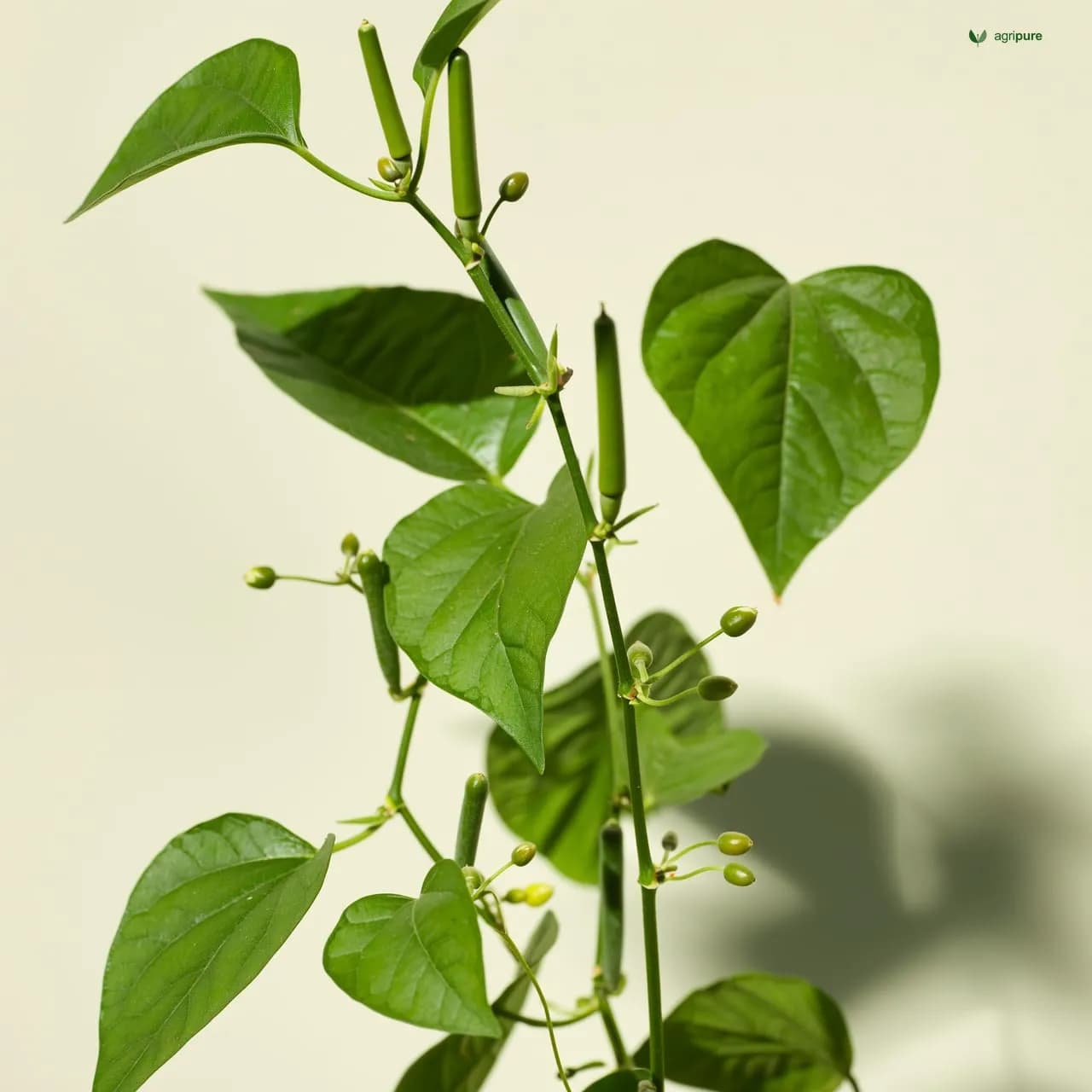
The plant is a slender, aromatic climber with creeping, jointed stems and perennial woody roots, often spreading along the ground or up a support. Its leaves are ovate and cordate (heart-shaped) with broad, rounded basal lobes, roughly 5 to 9 cm long and 3 to 5 cm wide. Lower leaves sit on long stalks and can be almost kidney-shaped, while the upper leaves are nearly stalkless and clasp the stem. The tiny flowers are carried on leaf-opposed spikes, and the plant is dioecious — male and female flowers occur on separate plants. Male spikes are slender, about 4 to 5 cm long, with two stamens per flower; female spikes are short and cylindrical, typically 1.3 to 2.5 cm long and around 4.5 mm thick, turning red when ripe and studded with minute, yellowish-orange ovoid drupes sunk into the fleshy spike. Those dried female fruiting spikes are the “long pepper” of commerce.
One identification caution worth carrying: another plant sold as “long pepper,” Piper retrofractum (native to Java and Indonesia), is a separate species whose fruits are sometimes confused with chili peppers. Seed or plant material is worth checking to confirm it is genuinely Piper longum and not P. retrofractum or common black pepper, P. nigrum.
Growing long pepper
Long pepper is a plant of tropical to subtropical, humid, frost-free country. Its natural and cultivated range covers heavy-rainfall regions with consistently high relative humidity, and the Spices Board of India notes that it is grown on limestone soils in such high-rainfall, high-humidity areas. WebMD describes it simply as a plant found in southern Asia. No primary horticultural source in the available research assigns it a formal USDA hardiness zone; based purely on its frost-free, humid native range, it is best treated as a tropical perennial for warm, frost-free gardens, but that is an inference from climate rather than a published rating.
Honest limits on the cultivation detail: the reputable sources gathered here describe long pepper’s habit and habitat but do not lay out a verified, species-specific protocol for propagation method, plant spacing, or exact time to maturity. Rather than invent those numbers, this profile leaves them out. What the sources do support is the growing environment — a warm, humid, frost-free site with steady rainfall or irrigation, on free-draining ground, with a support for the vine to creep over. Because the plant is dioecious, growers who want a fruiting (female) crop should be aware that male and female flowers occur on separate plants, so a fruiting stand needs female vines.
Harvest and uses
The harvest is the female fruiting spike. It is gathered and dried whole, and the dried spike, not the leaf or stem, is the marketable spice and herbal commodity. A practical visual cue from the botany is ripeness: the cylindrical female spike turns red as it ripens, with the tiny drupes embedded in the fleshy head. Dried, these spikes look like small, hardened catkins.
In the kitchen, long pepper is an aromatic spice with a hotter, more complex character than ordinary black pepper. Beyond cooking, the dried fruit (pippali) has a long record in Ayurvedic medicine as one of the classic traditional remedies. The research provides no verified yield figures for a homestead-scale planting, so none are stated here; treat it as a specialty crop whose value lies in the quality and dryness of the cured spike rather than in bulk tonnage.
Safety and cautions
Long pepper is edible and safe as a culinary spice, used in the small amounts typical of seasoning food. The cautions attach to medicinal use, that is, taking it in larger-than-culinary quantities as a remedy. In that context the sourced safety information describes its safety as uncertain, with specific cautions noted for pregnancy, bleeding disorders, scheduled surgery, and diabetes. This profile describes the plant’s traditional and culinary use only and makes no medical claims, recommends no dosage, and does not suggest it treats or cures any condition. Anyone considering long pepper medicinally, and especially anyone who is pregnant or breastfeeding, has a bleeding disorder or diabetes, is taking prescription medication, or has surgery planned, should seek qualified medical advice first.
Sources
- Piper longum — eFlora of India
- Pepper (Long) / Piper longum — Spices Board of India
- Long pepper — Wikipedia
- Indian Long Pepper — WebMD
- Piper longum L. — GBIF