secondary
Black Pepper
kali mirch
Piper nigrum
Also known as Kali Mirch (India, Pakistan).
- sindh coast
International hardiness
- USDA 10-12
- RHS H1b
- AU: Tropical
Where it grows — regional guide
| Zones / rating | Regional notes |
|---|---|
USDA 10-12 | Grown outdoors in frost-free regions across USDA zones 10 to 12, or in warm greenhouse containers; requires high humidity and shade. |
| Zones / rating | Regional notes |
|---|---|
H1b (10 to 15C) | Grown in warm, humid glasshouses at RHS H1b; train the climbing vine onto a moss pole in bright indirect light to set fruit. |
| Zones / rating | Regional notes |
|---|---|
Tropical | Suited to humid tropical lowlands; climbs host trees in shaded conditions to bear spikes of peppercorns. |
| Zones / rating | Regional notes |
|---|---|
USDA 10-12 (USDA scale) Canada uses its own zone system; Canadian zones run roughly one lower than USDA. | No region-specific data yet |
| Zones / rating | Regional notes |
|---|---|
Sindh coast | Pakistan:Grown as a protected container vine in frost-free coastal Sindh; needs dappled shade, high humidity, and regular watering to fruit. India:Native to the tropical region on the western coast of Kerala; climbs support trees to yield black and white peppercorns. |
Grows alongside
Species that appear with Black Pepper in 3 of our published guides — a starting list for a guild, not a planting plan.
Black pepper (Piper nigrum) is a perennial, evergreen climbing vine grown for its small spicy fruits, the peppercorns, which are among the most widely traded spices in the world. It is native to Malabar, the tropical region on the western coast of southern India in the state of Kerala, and is often summarized more broadly as a native of South or Southeast Asia. For a homesteader, the appeal is that a single vine, given warmth, humidity, and something to climb, will keep producing fragrant peppercorns for years from a modest footprint, whether trained up a support tree in the tropics or kept in a pot on a sunny windowsill in a cooler climate.
Identifying black pepper
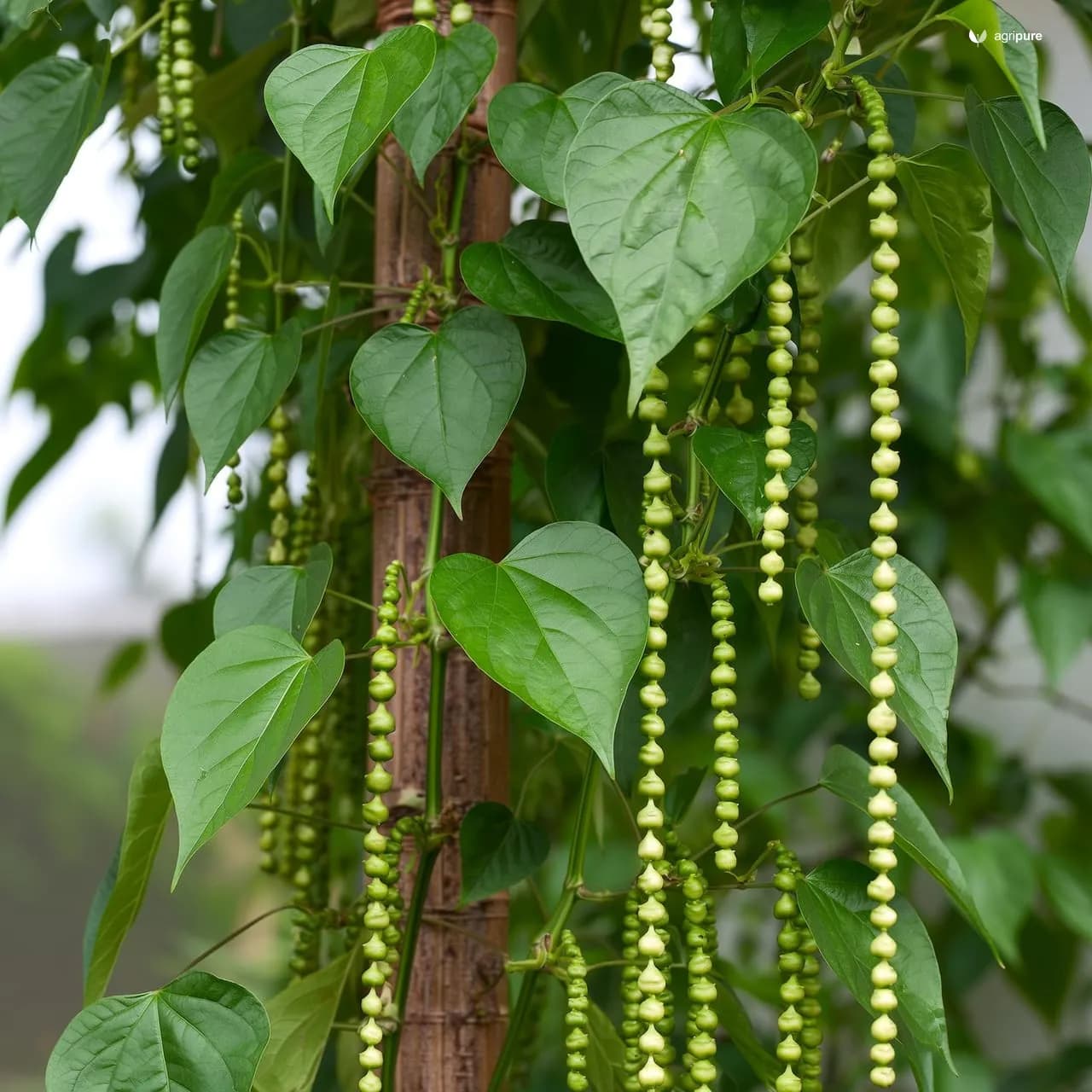
Black pepper is a member of the pepper family, Piperaceae, in the genus Piper. It is a climbing, evergreen vine that roots at its nodes and clings to trees or other supports using adventitious roots, behaving like an “ivy-like climber” that adheres to a support tree or man-made structure. The main vining stem develops many side branches once the plant is established. Its flowers are small and borne on hanging, catkin-like spikes, and the fruit that follows is a drupe (a stone fruit) about 5 mm across when fresh and fully mature, packed densely along those spikes. When fully ripe and fresh, each fruit turns dark red and holds a single seed; the dried drupe is what we call a peppercorn.
One plant yields several familiar products depending on when the fruit is picked and how it is processed. Black pepper is made from unripe green berries that are briefly fermented and then sun-dried until they shrivel into the brownish-black corns we recognize. Green pepper comes from the same unripe fruits, dried more quickly or otherwise preserved. White pepper is the inner seed of fully ripe fruits with the outer skin (pericarp) removed.
Growing black pepper
This is a tropical, frost-free plant that wants real warmth and high humidity, and it is grown as a perennial vine in the tropics. Horticultural guidance for gardeners treats it as hardy only in **USDA zones 10 to 11, with the coldest temperature it will tolerate sitting around **35 degrees F (about 1.5 degrees C). Outside those zones it is commonly grown in containers indoors or in a greenhouse, where the warmth and humidity it needs can be controlled. Today it is cultivated at scale in Vietnam, Indonesia, Brazil, India, Burkina Faso, and Malaysia, which are among the largest producing countries.
To grow it well:
- Light: It thrives in full to part sun. For an indoor plant, a bright, sunny windowsill is recommended.
- Support: As a climbing vine it needs something to grow up — a trellis, stake, or support tree — which it adheres to with its roots.
- Spacing: When planting several vines outdoors, space them 8 to 12 feet apart to give the roots and canopy room to spread.
- Propagation: The horticultural guidance here assumes you start from purchased live plants and prune above the nodes to encourage new growth, consistent with the way this vine roots and branches at its nodes. It can also be grown from seed taken from fully ripe fruits.
Detailed figures for sowing temperatures, exact time to maturity, and per-plant yield are not given in the sources used here, so they are deliberately left out rather than stated with false precision. In practice, treat black pepper as a warm, humid-loving perennial: keep it above its cold threshold, give it steady warmth and moisture, and provide a sturdy support for it to climb.
Harvest and uses
The harvest is the cluster of small drupes borne along each hanging spike, and the stage at which you pick them decides the product. For classic black pepper, the unripe green berries are gathered, briefly fermented, and then sun-dried until they shrivel and darken to brownish-black. Leaving the fruit to ripen to dark red and then removing the outer pericarp from the seed gives white pepper, while unripe fruits dried quickly or preserved give green pepper — all three from the very same vine.
The primary use is culinary: the dried peppercorn is one of the world’s most widely traded and used spices, valued for its pungency and aroma. For a home grower, even a single well-kept vine offers the satisfaction of harvesting and drying your own peppercorns and choosing whether to finish them as black, green, or white pepper.
Sources
- Black pepper — Wikipedia
- Black Pepper — McCormick Science Institute
- Care Info: Black Pepper (Piper nigrum) — Wellspring Gardens
- Piper nigrum (PINI3) — USDA PLANTS Database