Key takeaways
- Formative pruning during the first three years establishes a strong framework for long-term health and fruit production.
- The open-center system is ideal for stone fruits like peaches and nectarines, promoting light penetration and easy harvesting.
- The central-leader system suits pome fruits such as apples and pears, building a robust central trunk for height and yield.
- Proper cuts, sanitation, and sharp tools are essential to prevent disease and ensure vigorous growth in young trees.
- Dormant pruning focuses on structural development, while light summer pruning can manage vigor and encourage fruit bud formation.
- Selecting the right pruning system based on species and desired tree form significantly impacts future orchard productivity and management.
Quick answer: Formative pruning during the first three years establishes a strong framework for young fruit trees, important for long-term health and fruit production. It involves choosing between open-center (for stone fruits) and central-leader (for pome fruits) systems to optimize light, air, and structural integrity.
Establishing a productive home orchard in places like the Mid-Atlantic or Pacific Northwest, where fruit trees thrive, begins with careful attention in the first three years. Many growers in USDA zones 5-8 understand that the initial pruning decisions profoundly influence a tree’s health, longevity, and fruit yield for decades to come. Neglecting formative pruning often leads to weak branches, disease susceptibility, and reduced harvests, potentially costing hundreds of pounds of fruit over a tree’s lifespan.
This early training, known as formative pruning, is about shaping the tree’s permanent structure. We’ll explore two primary systems – the open-center and the central-leader – detailing their application, benefits, and the specific fruit species they best serve. Understanding these methods is foundational for any home grower aiming for a resilient and bountiful orchard, capable of producing hundreds of pounds of fruit annually from a mature tree.
Why formative pruning matters in the first three years
Formative pruning, specifically in the first one to three years after planting, is arguably the most critical period for a fruit tree’s structural development. Without this early intervention, trees often grow into dense, unproductive forms, making future management difficult and reducing potential yields by 30% or more. The goal is to establish a strong scaffold system that can support heavy fruit loads — sometimes over 100 pounds per tree — and allow adequate sunlight penetration to all parts of the canopy. This initial shaping also helps prevent future structural weaknesses, such as narrow crotch angles that are prone to splitting under stress from wind or fruit weight, especially in regions with high winds like the Great Plains [1].
establishing a strong scaffold
A well-pruned young tree directs its energy into developing robust branches rather than excessive, unproductive growth. For instance, an apple tree in USDA zone 6, if left unpruned, might grow 6-8 feet tall in its first year but with many weak, competing shoots. By removing these competing shoots and selecting strong scaffold branches, we encourage wider crotch angles—ideally between 45 and 60 degrees—which are significantly stronger than narrow, acute angles. This structural integrity is vital for trees expected to produce fruit for 20 years or more. Proper pruning also improves air circulation within the canopy, reducing humidity and the incidence of fungal diseases that thrive in moist environments, potentially cutting disease pressure by 25% to 40% [2]. For more detailed guidance on pruning techniques, consider visiting How to prune fruit trees: by season, by species, and by tree age.
- Structural integrity: Develops strong, wide-angled branches to support future fruit loads.
- Sunlight penetration: Ensures light reaches all leaves for efficient photosynthesis.
- Air circulation: Reduces disease pressure by preventing stagnant, humid conditions.
- Balanced growth: Directs energy into productive wood, not excessive vegetative growth.
- Long-term productivity: Sets the stage for decades of consistent, high-quality fruit production.
The open-center system: ideal for stone fruits
These why formative pruning points carry into this section, too.
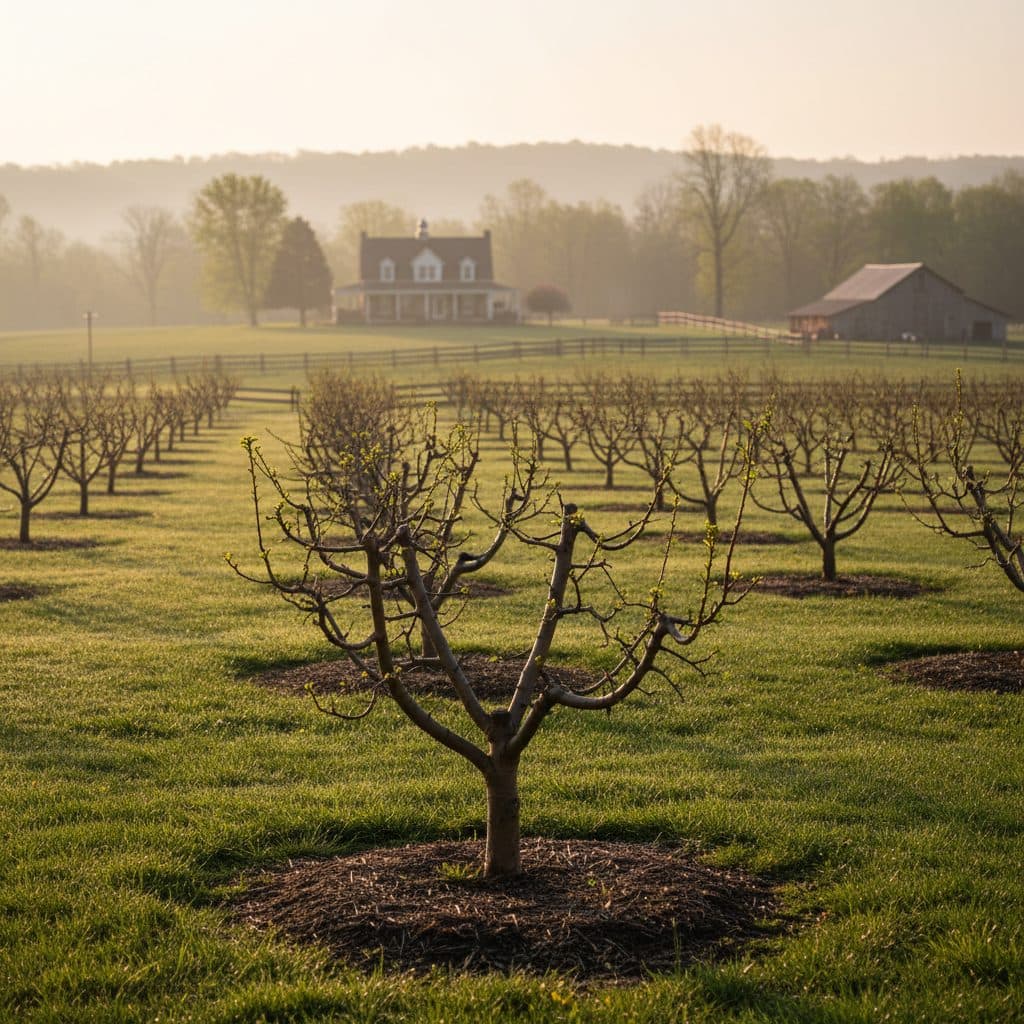
The open-center, or vase, system is a popular choice for stone fruits like peaches, nectarines, plums (especially Japanese plums), and some apricots, particularly in warmer climates like USDA zones 7-9 where rapid growth is common. This system aims to create a bowl-shaped canopy with an open center, allowing maximum sunlight penetration to the interior of the tree and improving air circulation. This design matters for peaches, which produce fruit on one-year-old wood and require ample light for fruit bud development and ripening, often yielding 40-60 pounds of fruit per mature tree. The open-center structure also makes harvesting and pest management significantly easier, as the tree typically remains at a manageable height of 8-12 feet [3].
implementing open-center pruning
To establish an open-center tree, the primary step in the first year is to head back the central leader to a height of 24-30 inches at planting. Immediately after this, select three to five well-spaced scaffold branches that are evenly distributed around the trunk and have wide crotch angles (45-60 degrees). These scaffolds should ideally be 6-8 inches apart vertically. All other branches, including the remaining central leader, are then removed. In the second and third years, focus on maintaining the open center by removing any vigorous upright shoots growing into the middle of the tree. Continue to select secondary branches from the primary scaffolds, ensuring good spacing and light exposure. This system can increase fruit size by 10-15% due to better light exposure compared to dense, unpruned trees [4].
- Initial cut: Head back central leader to 24-30 inches at planting.
- Scaffold selection: Choose three to five well-spaced branches with wide crotch angles.
- Center removal: Eliminate all growth in the tree’s center to promote an open canopy.
- Ongoing maintenance: Remove vigorous upright shoots and maintain good light penetration.
- Suitable species: Peaches, nectarines, Japanese plums, and some apricots.
The central-leader system: building strength for pome fruits
That work on open-center system sets up what follows here.
The central-leader system is the preferred method for pome fruits such as apples, pears, and most sweet cherries, particularly on semi-dwarfing or standard rootstocks in regions like the Northeast and Pacific Northwest. This system maintains a dominant central trunk, or leader, from which tiers of horizontal scaffold branches emerge. The goal is to create a Christmas tree shape, wider at the base and tapering towards the top, which allows sunlight to penetrate the lower branches and ensures good air circulation. This structure provides excellent strength for supporting heavy fruit loads, sometimes exceeding 150 pounds per mature tree, and is well-suited for high-density plantings where trees are spaced 10-15 feet apart [5].
developing a strong central leader
In the first year, the central leader is maintained, and any competing upright shoots are removed. Select three to five well-spaced scaffold branches with wide crotch angles (45-60 degrees) in the first tier, ensuring they are 18-24 inches from the ground. These branches should be spread using wooden spreaders or clothespins to achieve a horizontal angle, which encourages fruit bud formation over vegetative growth. In the second and third years, continue to select additional tiers of scaffold branches, ensuring each tier is 24-36 inches above the one below it. The central leader itself should be headed back by about one-third each year to encourage branching and maintain vigor. This systematic approach can increase fruit yield per acre by 20-30% compared to less structured systems, especially in commercial apple orchards [6]. For information on suitable varieties, see Best Cold-Hardy Fruit and Nut Trees for USDA Zones 4-6.
- Maintain central leader: Ensure one dominant vertical shoot remains.
- Tiered scaffolds: Select 3-5 horizontal branches per tier, spaced 24-36 inches apart.
- Branch spreading: Use spreaders to achieve 45-60 degree angles for scaffolds.
- Leader heading: Cut back the central leader by one-third annually to encourage branching.
- Suitable species: Apples, pears, and sweet cherries.
Essential tools and techniques for young tree pruning
This builds directly on central-leader system.
Regardless of the chosen system, using the correct tools and techniques matters for the health of your young fruit trees. Sharp, clean pruning shears (hand pruners) are essential for making precise cuts on branches up to 0.75 inches in diameter. For larger branches, loppers are necessary, and a pruning saw may be needed for anything over 1.5 inches. Dull tools tear bark and wood, creating jagged wounds that are slow to heal and invite disease, potentially increasing disease incidence by 15-20%. Always sanitize your tools with a 10% bleach solution or rubbing alcohol between trees, especially if you suspect disease, to prevent pathogen spread across your orchard [2].
making proper cuts
When making a cut, locate the branch collar – the slightly swollen area at the base of the branch where it joins the trunk or a larger limb. Cuts should be made just outside the branch collar, at a slight angle, to allow for proper wound closure. Avoid flush cuts, which remove the branch collar and hinder the tree’s natural healing process, potentially extending healing time by several months. Similarly, avoid leaving stubs, which are dead wood and can become entry points for pests and diseases. For heading cuts, which shorten a branch to an outward-facing bud, make the cut about 0.25 inches above the bud, angled slightly away from it. This encourages new growth in the desired direction, which shapes the tree efficiently and improves light exposure by 10-20% within the canopy. Regular monitoring of soil moisture, perhaps with a soil moisture meter, can also inform tree vigor and pruning needs.
- Sharp tools: Use clean hand pruners, loppers, and saws for precise cuts.
- Sanitation: Disinfect tools between trees with a 10% bleach solution to prevent disease spread.
- Branch collar: Cut just outside the branch collar to promote proper wound healing.
- No stubs or flush cuts: Avoid leaving dead wood or damaging the healing tissue.
- Outward-facing buds: Head cuts should be made above an outward-facing bud to direct new growth.
Comparison of Open-Center vs. Central-Leader Pruning Systems
Feature | Open-Center System | Central-Leader System |
|---|---|---|
Primary Goal | Maximize light penetration to inner canopy, facilitate harvest | Develop strong central trunk, maximize vertical space and yield |
Tree Shape | Vase or bowl-shaped, open center, 8-12 ft tall | Christmas tree shape, dominant central leader, 10-20 ft tall |
Suitable Fruit Types | Peaches, Nectarines, Japanese Plums, Apricots | Apples, Pears, Sweet Cherries |
Scaffold Branches | 3-5 primary scaffolds originating from a low point | Multiple tiers of scaffolds, evenly spaced along the leader |
Light Distribution | Excellent to inner canopy, promotes fruit ripening | Good, especially to lower branches if properly spread |
Ease of Harvest | Generally easier due to lower, spreading form | May require ladders for upper canopy on mature trees |
Critical Cropping Angle: Scaffold branches with crotch angles between 45 and 60 degrees are up to 5 times stronger than narrow-angled branches, significantly reducing the risk of breakage under a 50-pound fruit load.
Early Yield Boost: Proper formative pruning can bring a young fruit tree into commercial production 1-2 years earlier, potentially adding hundreds of dollars in early revenue for a small orchard of 10-20 trees.
Frequently asked questions
When is the best time to perform formative pruning on young fruit trees?
The best time for formative pruning is during the dormant season, typically in late winter or early spring before bud break, when the tree is not actively growing. This allows the tree to direct its energy into healing cuts and vigorous spring growth, and you can clearly see the tree’s structure without leaves, making it easier to make precise cuts for structural development, impacting up to 80% of future growth.
Can I switch pruning systems after the first year?
While it’s best to decide on a system at planting, you can sometimes transition between systems in the first two years, especially if the tree is still small. For example, a tree initially headed for a central leader could be converted to an open-center by removing the central leader and selecting three to five new scaffolds. This might set back development by one year, but it’s generally feasible for trees under 6 feet tall.
How often should I prune a young fruit tree?
Young fruit trees typically require pruning once a year during the dormant season for structural development. Additionally, light summer pruning can be beneficial to remove vigorous upright shoots (water sprouts) or suckers, manage tree size, and encourage fruit bud formation. This summer pruning should remove no more than 10-15% of the canopy to avoid stressing the tree.
What is the difference between a heading cut and a thinning cut?
A heading cut shortens a branch, removing the terminal portion and stimulating growth from buds just below the cut, often used to encourage branching or control height. A thinning cut removes an entire branch back to its point of origin (trunk or larger limb), opening up the canopy and reducing density. Thinning cuts are often preferred for young trees to establish strong, well-spaced scaffold branches, often removing 20-30% of growth.
Do all fruit trees benefit from formative pruning?
Yes, nearly all deciduous fruit trees benefit significantly from formative pruning in their early years. While the specific system (open-center or central-leader) varies by species and desired outcome, establishing a strong, well-structured framework is universal for long-term health, productivity, and ease of management, potentially extending a tree’s productive life by 5-10 years.
References
- Pruning young deciduous fruit trees / (1919). Pruning young deciduous fruit trees /.
- Pruning Dwarf Fruit and Nut Trees (2018). Pruning Dwarf Fruit and Nut Trees.
- Pruning and training fruit trees / (1973). Pruning and training fruit trees /.
- Pruning bearing deciduous fruit trees / (1925). Pruning bearing deciduous fruit trees /.
- Fruit Trees: Pruning Overgrown Deciduous Trees (2002). Fruit Trees: Pruning Overgrown Deciduous Trees.
- Competition in apple, as influenced by Alar sprays, fruiting, pruning and tree spacing (1972). Competition in apple, as influenced by Alar sprays, fruiting, pruning and tree spacing.