pioneer
Khejri
Prosopis cineraria
- sindh coast
- balochistan highlands
International hardiness
- USDA 9-11
- RHS H2
- AU: Arid / semi-arid, Subtropical
Where it grows — regional guide
| Zones / rating | Regional notes |
|---|---|
USDA 9-11 | No region-specific data yet |
| Zones / rating | Regional notes |
|---|---|
H2 (1 to 5C) | No region-specific data yet |
| Zones / rating | Regional notes |
|---|---|
Arid / semi-arid, Subtropical | No region-specific data yet |
| Zones / rating | Regional notes |
|---|---|
USDA 9-11 (USDA scale) Canada uses its own zone system; Canadian zones run roughly one lower than USDA. | No region-specific data yet |
| Zones / rating | Regional notes |
|---|---|
Sindh coast, Balochistan highlands | Pakistan:A deep-taprooted native legume of the Sindh coast and Balochistan highlands; it tolerates heat and drought while providing light shade, edible pods, and livestock fodder. India:A drought-hardy tree of the north-west arid zone, including Rajasthan; it fixes nitrogen and provides light shade, edible pods, and livestock fodder. |
Grows alongside
Species that appear with Khejri in 1 of our published guides — a starting list for a guild, not a planting plan.
Khejri (Prosopis cineraria) is a small, drought-hardy, almost evergreen leguminous tree in the pea family (Fabaceae), native to the arid parts of Western Asia and the Indian subcontinent. Its range spans Afghanistan, Iran, India, Pakistan, Oman, Bahrain, Saudi Arabia, the UAE, and Yemen, and within India it is especially characteristic of the north-west arid zone, including Rajasthan and the Thar Desert. For a homesteader on hot, dry, marginal ground, the appeal is simple: a nitrogen-fixing legume that survives on very little rainfall, casts light shade, and supplies fodder, pods, fuel, and soil improvement from the same tree.
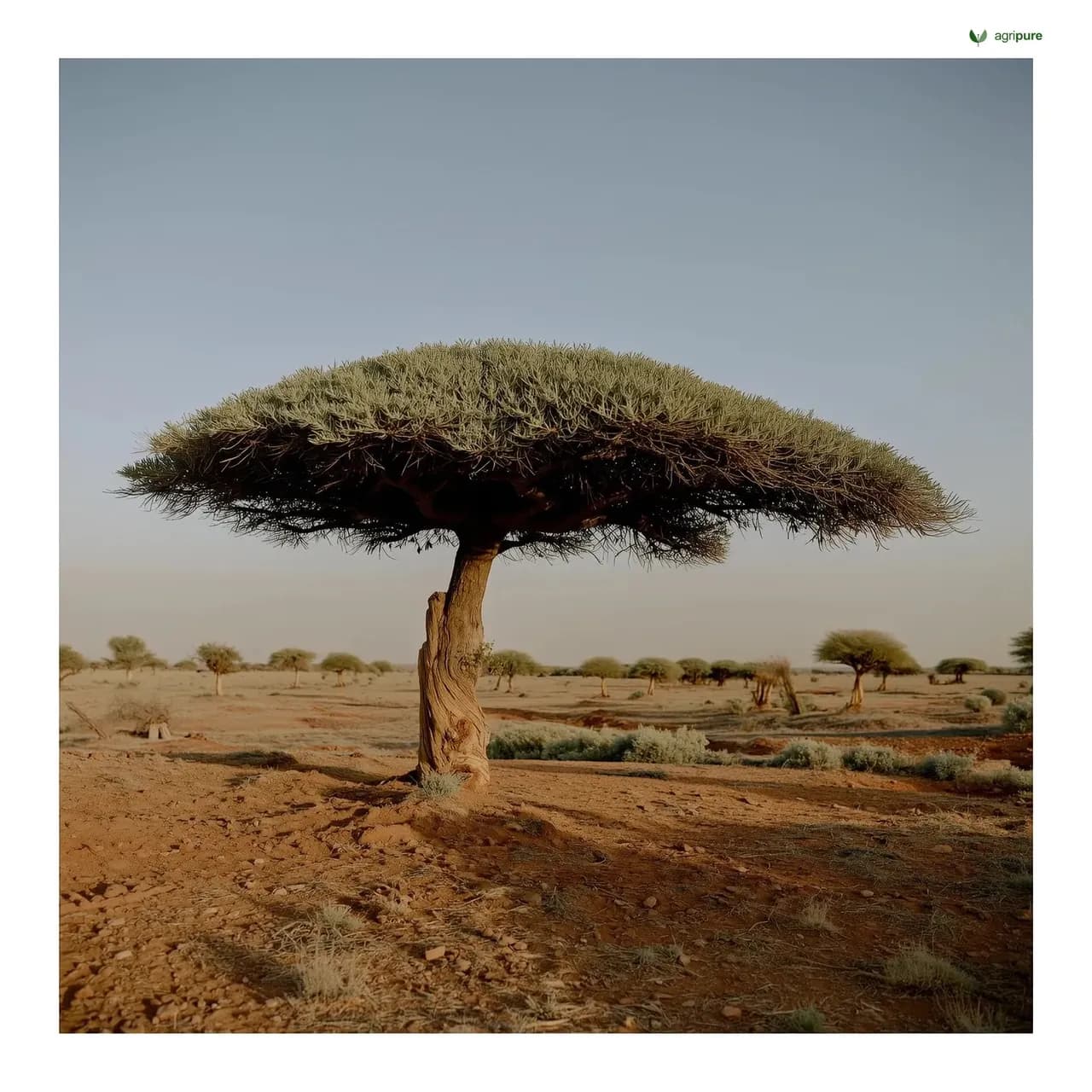
It is a small to moderate-sized thorny tree, typically 3 to 6.5 m tall (roughly 10 to 21 ft) with an open to rounded crown. The branches are slender and armed with conical or curved spines on the internodes. The foliage is bipinnate, with one to three pairs of pinnae each carrying seven to fourteen pairs of small oblong leaflets about 3 to 5 mm long; the leaves are bluish-green to dark green and nearly evergreen. Small creamy-white to yellow flowers are borne in slender stalked spikes 5 to 12 cm long, reported in north-west India from March to May after the leaf flush. These give way to long, slender, drooping cylindrical pods about 14 to 25 cm long, usually carrying ten to fifteen seeds, which reach full size roughly two months after flowering. Below ground it is a deep-taprooted legume, and that long tap root lets it reach moisture and fix atmospheric nitrogen long after surface soil has baked dry.
Growing Khejri
Seed is the preferred way to raise Khejri: the University of Arizona’s arboretum notes it is difficult to propagate from cuttings. The seed has physical (hard-coat) dormancy, so for reliable germination the seeds should be scarified and soaked in warm water before sowing. For vegetative propagation, expect low success from cuttings even with rooting hormone; air layering and planting root suckers are described as more successful.
This is a tree built for hot, dry, open ground. It is described as one of the most drought-tolerant trees there is, thriving in dry tropical, arid, and semi-arid climates with very low annual rainfall, which is exactly why it anchors desert agroforestry systems. It prefers well-drained soil and tolerates slightly alkaline ground. Mature trees are reported to take heat up to about 50 °C and to withstand light frost down to roughly −6 °C, placing it in warm, largely frost-free climates. Primary references do not assign it a direct USDA hardiness zone; based on that reported −6 °C minimum it is reasonably treated as a tree for climates equivalent to about USDA zones 9 to 11, though this is an inference from temperature data, not a cited USDA rating. Spacing and time-to-maturity figures are not given consistently in these general sources, so they are left out rather than stated with false precision; in practice, treat it as a slow, long-lived dryland tree — give it room, sun, and free-draining ground, and let the tap root do the work once it is established.
Harvest and uses
Khejri is a genuine multipurpose tree of desert farming systems, valued for fodder, human food, fuel, and agroforestry. Its pods are eaten, the bark has been used as a famine food in hard years, and the foliage is widely cut as livestock fodder. The pods reach full size about two months after flowering, giving a clear harvest window once they stop enlarging. The wood is used for fuel. Beyond direct yield, its standout homestead role is ecological: as a nitrogen-fixing legume with a deep tap root, it improves the ground it grows on while competing little at the surface, and its light, open canopy lets understorey crops and grasses persist beneath it.
How to identify it
Khejri is recognizable from a combination of features rather than any single one:246
- Habit: Small to moderate, almost-evergreen thorny tree, about 3 to 6.5 m tall, with an open to rounded crown.
- Branches: Slender, armed with conical or curved spines on the internodes.
- Leaves: Bipinnate, with one to three pairs of pinnae, each bearing seven to fourteen pairs of small (3 to 5 mm) oblong leaflets; bluish-green to dark green.
- Flowers: Small, creamy-white to yellow, in slender stalked spikes 5 to 12 cm long.
- Pods: Long, slender, drooping, cylindrical, about 14 to 25 cm long, usually with ten to fifteen seeds.
Older names you may see on labels include Mimosa cineraria, Prosopis spicata, and Prosopis spicigera; the accepted name is Prosopis cineraria (L.) Druce.
Safety and cautions
The references consulted describe Khejri as a benign, non-toxic tree that is extensively used as both fodder for livestock and food for people in traditional desert farming systems, with no specific parts reported as poisonous in the horticultural and agronomic literature reviewed. The pods are eaten and the bark has been used as a famine food. As with any traditional food plant, sensible homestead practice still applies: confirm the identification, prepare foods in the customary way, and introduce new forage to livestock gradually. This profile makes no medicinal claims for the plant.
Sources
- Prosopis cineraria overview – ScienceDirect
- Prosopis cineraria – Wikipedia
- Prosopis cineraria – University of Arizona Campus Arboretum
- Prosopis cineraria – eFlora of India
- The Tree of Life: Prosopis cineraria – Botanical Research Institute of Texas Library (Google Arts & Culture)
- Khejri Tree – Flowers of India