secondary
Red Mangrove
kamo / timar
Rhizophora mucronata
Also known as Timar (Pakistan).
- sindh coast
International hardiness
- USDA 11-12
- RHS H1b
- AU: Tropical
Where it grows — regional guide
| Zones / rating | Regional notes |
|---|---|
USDA 11-12 | No region-specific data yet |
| Zones / rating | Regional notes |
|---|---|
H1b (10 to 15C) | No region-specific data yet |
| Zones / rating | Regional notes |
|---|---|
Tropical | Native to tropical estuaries and tidal mudflats of northern Australia; prop roots trap sediment to buffer coasts, but tissues carry hazardous uterotonic compounds. |
| Zones / rating | Regional notes |
|---|---|
USDA 11-12 (USDA scale) Canada uses its own zone system; Canadian zones run roughly one lower than USDA. | No region-specific data yet |
| Zones / rating | Regional notes |
|---|---|
Sindh coast | Pakistan:A vital native stilt mangrove of the Indus delta and Sindh tidal creeks; stabilizes saline mud and buffers shorelines, but carries uterotonic effects in pregnancy. India:A keystone intertidal mangrove along sheltered tropical coasts and estuarine mudflats; traps silt and shields shorelines, but has unsafe uterotonic effects in pregnancy. |
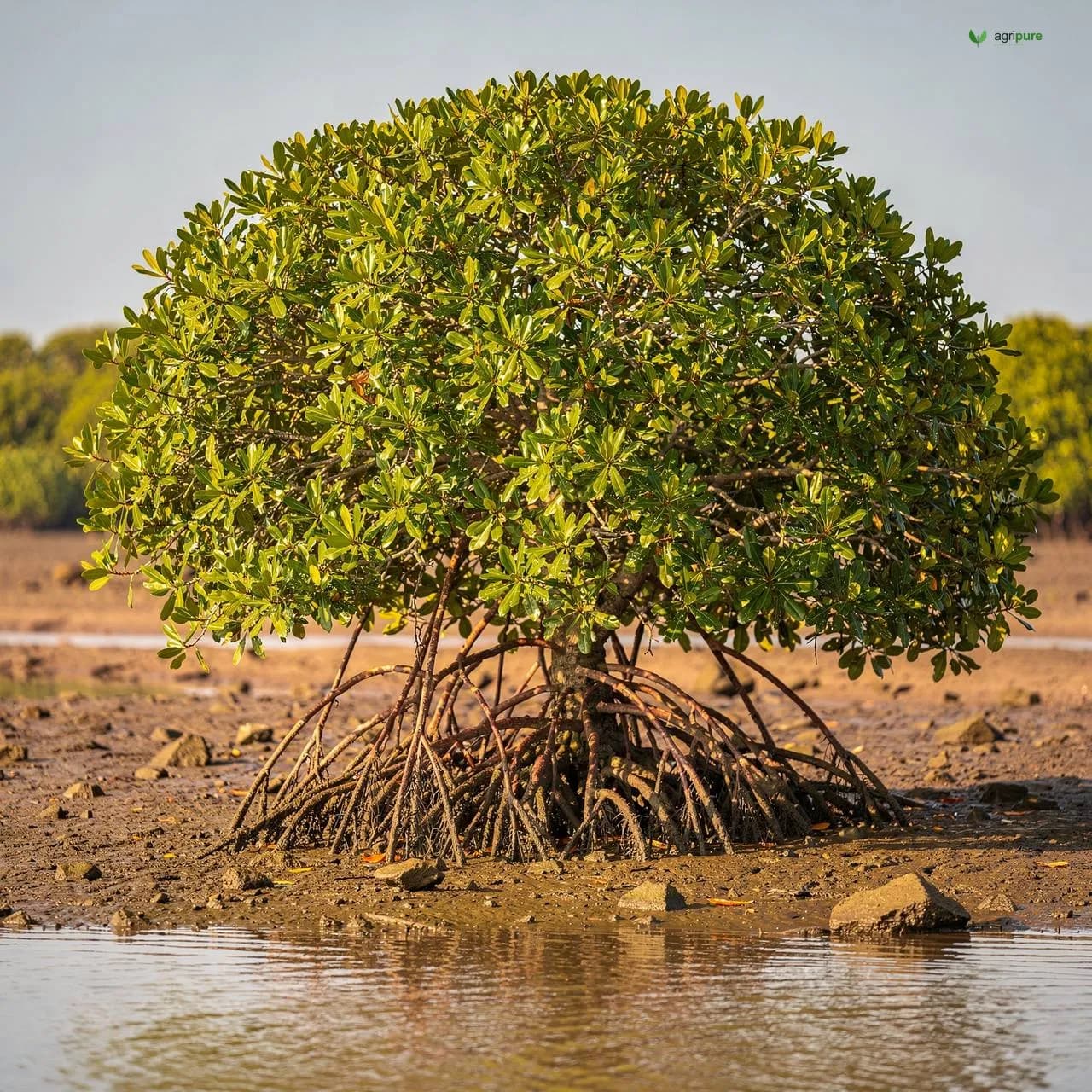
Red mangrove (Rhizophora mucronata) is a tropical-to-subtropical, intertidal tree of the mangrove family, native across the Indo-Pacific from East Africa through southern and Southeast Asia to northern Australia and the western Pacific. It is a true mangrove that lives rooted in brackish, tidally flooded mud along sheltered coasts and estuaries, not a garden or field crop. For a homesteader, the honest framing is this: it is a coastal-restoration and shoreline-protection species, not a backyard plant. If you steward a tidal estuary, a brackish creek, or a salt-flooded shoreline in the warm tropics, it can stabilise mud, build forest, and supply fuelwood, timber, tannin, and modest local food. Inland, on ordinary soil, it will not grow.
Red mangrove is an evergreen tree, typically 15 to 25 m tall, though height varies with exposure: along river banks it can reach 20 to 25 m, while on exposed sea fringes it usually stands only 10 to 15 m. Its most recognisable feature is the tangle of arching stilt (prop) roots that lift the trunk above the mud and anchor it in soft, waterlogged sediment; a fine network of feeding roots also spreads through the mud, but the strong prop roots are the primary field cue. The leaves are opposite, simple, leathery and elliptic to oblong, and carry a distinctive short, spiked (mucronate) point at the tip, the trait that gives the species its name and helps separate the Indo-West Pacific stilt mangroves. The stipules are yellowish with tiny black spots on the underside of the leaves.
Growing red mangrove
Red mangrove occupies a very narrow habitat. It grows in intertidal wetlands, roughly 0 to 6 m elevation between mean sea level and the highest tides, and does best in the fine mud sediments of downstream river estuaries. Its natural ground is estuaries, tidal creeks and flat coastal areas subject to daily tidal flooding. Among Indo-West Pacific Rhizophora, this species tends to favour places with regular freshwater flow, especially in the eastern part of its range, and it appears more tolerant of prolonged tidal inundation than some other mangroves, often forming an evergreen fringe at the seaward edge.
Propagation follows the mangrove’s own biology. Like other Rhizophora, red mangrove is viviparous: the embryos germinate while still attached to the parent tree, then the pencil-like seedlings (propagules) drop and float until they lodge in mud and root. In restoration practice this means planting is done by setting these living propagules directly into tidal mud rather than sowing dry seed. The site, not the gardener, sets the conditions: it must be saline-to-brackish tidal sediment, in full coastal sun, with daily tidal water movement. Precise nursery timing, spacing, and time-to-maturity figures are not given in the sources used here, so they are deliberately left out rather than stated with false precision.
Climate and hardiness
This is a strictly frost-free, warm-climate tree. Its native distribution is confined to tropical and warm-subtropical coasts, from equatorial Africa to low-latitude Asia and Australia, and it is absent from temperate climates. No primary horticultural source assigns it a precise USDA hardiness zone. As a comparison, the related American red mangrove (R. mangle) in Florida is killed or severely damaged by freezing and is limited to the state’s southern coastal counties. From its frost-free native range it is reasonable to treat R. mucronata as comparable to roughly USDA zones 11 to 12 in minimum-temperature tolerance, but this is an inference from climate, not a directly cited numeric rating.
Harvest and uses
Across its range, red mangrove is valued chiefly for shoreline protection, fuelwood and timber, tannin and dye, and local food and folk medicine. The dense prop-root systems trap sediment and buffer the coast, which is the main reason the species is planted in mangrove restoration. Its fruits and propagules are produced in sufficient quantity to be used locally as food, confirming they are a genuine subsistence harvest in some communities, though on a restoration site the standing forest and the protection it provides matter far more than any single crop. The bark and other tissues are rich in strong tannins, the basis of its use for tannin and dye.
Safety and cautions
Although parts of the plant are eaten locally, the sources are explicit that any medicinal use should be considered experimental and potentially risky, because of the tree’s strong bioactive tannins and reported uterotonic (labour-inducing) effects. This profile makes no medical claims and gives no dosages. Treat red mangrove as a restoration and material tree first; do not self-administer it as a remedy, and anyone who is pregnant should be especially cautious given the reported uterotonic activity. Practically, the other “caution” is ecological: plant it only on the saline tidal mud it actually needs, and harvest fuel, timber and bark conservatively so the protective forest is not stripped faster than it regrows.
Sources
- Rhizophora (Indo-West Pacific mangroves) – botanical overview (PDF)
- Rhizophora mucronata – Wikipedia
- Mangroves and cold tolerance – University of Florida IFAS Extension
- Rhizophora mucronata – ScienceDirect Topics
- Mangrove (Rhizophora mucronata) – U.S. Fish & Wildlife Service
- Rhizophora mucronata plant profile – USDA PLANTS Database
Sourcing notes
Red mangrove is raised from propagules in tidal nurseries along the Sindh coast and is widely used in Indus-delta restoration. Collect propagules from healthy local stands, plant only on tidal saline mud, and protect young seedlings from crab damage during establishment.