pioneer
Sand Dropseed (Feather Dropseed)
khabbal-ghas
Sporobolus ioclados
Also known as Khabbal Ghas (Pakistan).
- punjab plains
- sindh coast
- balochistan highlands
International hardiness
- USDA 9-11
- RHS H2
- AU: Arid / semi-arid, Subtropical
Where it grows — regional guide
| Zones / rating | Regional notes |
|---|---|
USDA 9-11 | No region-specific data yet |
| Zones / rating | Regional notes |
|---|---|
H2 (1 to 5C) | No region-specific data yet |
| Zones / rating | Regional notes |
|---|---|
Arid / semi-arid, Subtropical | No region-specific data yet |
| Zones / rating | Regional notes |
|---|---|
USDA 9-11 (USDA scale) Canada uses its own zone system; Canadian zones run roughly one lower than USDA. | No region-specific data yet |
| Zones / rating | Regional notes |
|---|---|
Punjab plains, Sindh coast, Balochistan highlands | Pakistan:A salt-excreting perennial tussock grass native to saline rangelands in Cholistan and the Sindh coast; keep use strictly to forage, as it is unverified as human food. India:A halophytic rangeland perennial native to arid salt flats and saline soils; useful for stabilizing salt-degraded ground, but has no documented role as human food. |
Grows alongside
Species that appear with Sand Dropseed (Feather Dropseed) in 1 of our published guides — a starting list for a guild, not a planting plan.
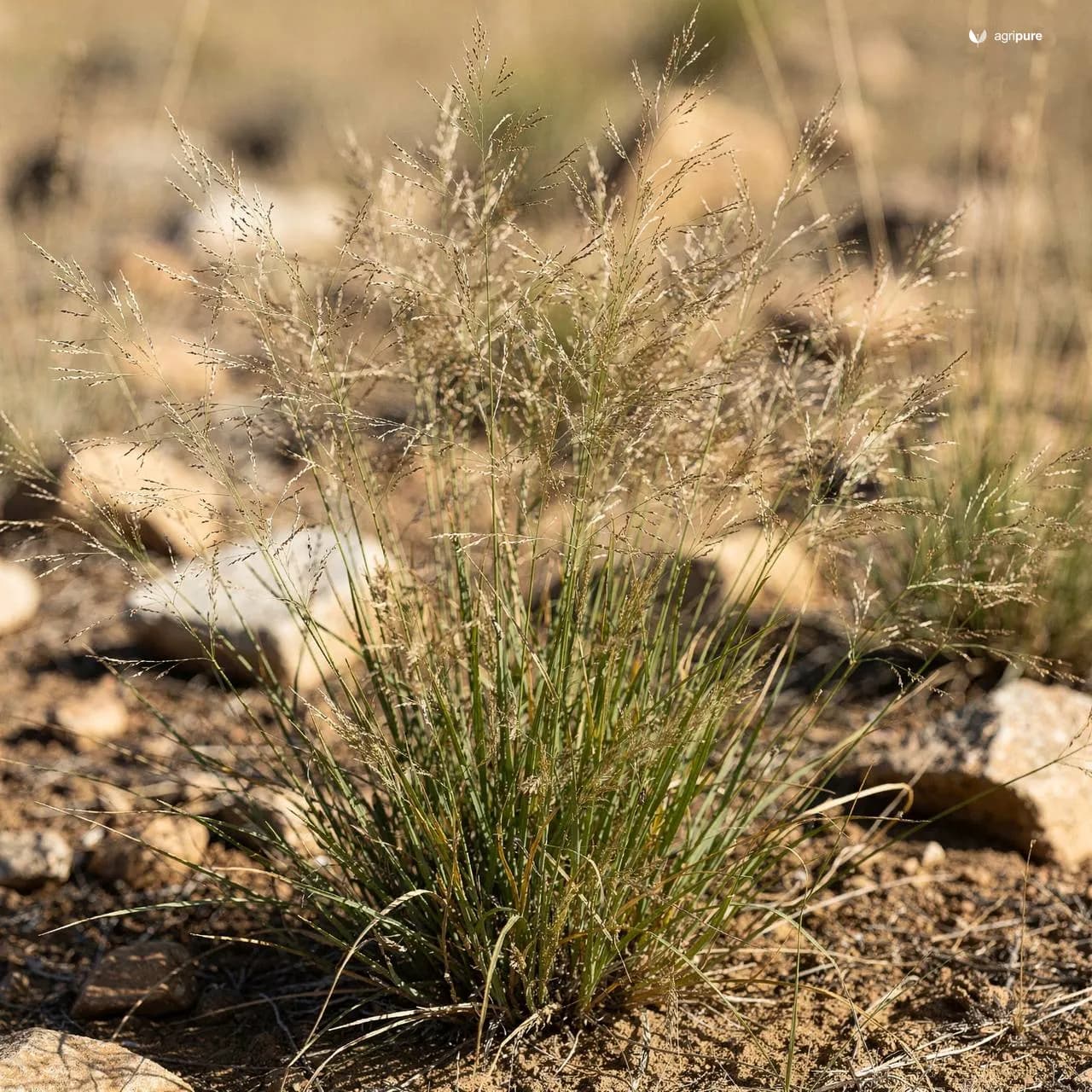
Pan dropseed (Sporobolus ioclados) is a salt-tolerant perennial grass in the grass family (Poaceae), known locally under vernacular names such as Sawri, Drabhri, and Dhrbholi. Kew’s Plants of the World Online gives its native range as Africa to the Indian Subcontinent, and ecophysiological work describes it as one of the few grasses able to dominate saline to hypersaline habitats. For a homesteader, its appeal is narrow but real: this is a forage and ground-cover grass for hot, dry, salt-burdened land where most other plants fail, not a food or kitchen crop, and it is best understood as a tool for stabilising and revegetating marginal ground.
Description and identification
Pan dropseed is a tussocky perennial grass that often forms creeping stolons and reaches up to about 80 cm tall. It is a C4 grass, a photosynthetic trait that helps explain its strong tolerance of both heat and salinity. Its leaves are flat or rolled, ranging from harsh to soft in texture and often pungent. Anatomical studies of saline-desert populations report small, thick leaves with thickened epidermis, well-developed bulliform cells, and enlarged mesophyll area, all read as adaptations to salt stress. A distinctive field feature is that it is a salt-excreting grass: specialised structures push excess salt onto the leaf surface, visible as deposits. Like other dropseeds it carries a panicle-type seed head, and the Flora of Mozambique describes its grain (caryopsis) as 0.8 to 1.2 mm long, elliptic, and somewhat laterally compressed.
Note on names: “sand dropseed” and “feather dropseed” are used loosely for several Sporobolus species, but the USDA PLANTS database specifically labels this species pan dropseed, so that is the most reliable common name to use. Recognised botanical synonyms include Sporobolus marginatus, Sporobolus verdcourtii, and Sporobolus laetevirens.
Growing pan dropseed
The scientific literature on this grass concentrates on its physiology and ecology, salt tolerance, drought tolerance, and soil reclamation, rather than on homestead-scale cultivation, so the honest cultivation picture is partial. Where sowing dates, exact watering schedules, and plant spacing are not documented in these sources, they are left out here rather than invented.
- Climate and site: Kew notes that it grows primarily in the seasonally dry tropical biome, and floras record it from low-altitude regions of East and Southern Africa. Field and experimental studies place it in highly saline soils, saline desert, and even hypersaline ground. That makes it a plant for warm, frost-limited, dry, salty sites rather than cool or temperate gardens.
- Salinity and drought: It is a typical halophyte (a salt-adapted plant) that is also adapted to drought, which is exactly why it persists where ordinary forage grasses cannot.
- Propagation: The sources here do not lay out a seed-biology or step-by-step propagation protocol for this species. However, as a tussocky perennial that produces creeping stolons, it is botanically capable of spreading vegetatively as those runners root down, in addition to setting seed in its panicles.
No primary source in this research assigns USDA hardiness zones to S. ioclados; the USDA record lists the taxon only as a classification entry, without distribution or hardiness detail. Because it is native to seasonally dry tropical regions and saline deserts rather than cold climates, it is best suited to warm, frost-limited conditions, but specific zone numbers cannot be stated reliably from these sources.
Harvest and uses
The research is clear and worth stating plainly: there is no reliable evidence that pan dropseed is used as a human food or as a medicinal herb, and its documented value is as forage and as an ecological or soil-reclamation species. For a working homestead, that translates into two practical roles. First, as forage: as a perennial halophyte grass it provides grazing on saline, drought-prone rangeland where better pasture has failed. Second, as a land-repair plant: its combination of salt excretion, drought tolerance, and stolon-forming tussock habit makes it a candidate for stabilising and revegetating degraded, salt-affected soils, the kind of phytoremediation use the recent literature emphasises. The sources here do not give homestead-scale yield figures for hay, seed, or grazing, so none are stated.
Safety and cautions
No specific toxicity of S. ioclados to humans is reported in this research. That absence of reported harm is not the same as proof of safety: because there is also no reliable evidence of its use as a human food or medicine, the responsible position from the sources is to keep its use to forage and ecological purposes pending better data, and not to treat it as an edible or medicinal plant. As with any wild grass grazed by stock, match its use to the documented role and do not extrapolate edibility or remedies it has not been shown to have.
Sources
- Exploring the adaptive mechanisms of Sporobolus ioclados under arid conditions – PMC (National Library of Medicine)
- Sporobolus ioclados – Plants of the World Online, Royal Botanic Gardens, Kew
- Adaptive responses of Sporobolus ioclados to salinity – Scientific Reports (Nature)
- Sporobolus ioclados (pan dropseed) classification – USDA PLANTS Database
- Sporobolus ioclados – JSTOR Global Plants
- Adaptations for salinity tolerance in Sporobolus ioclados from saline desert – Flora (ScienceDirect)
- Native range and biome for Sporobolus ioclados – Plants of the World Online, Kew
- Sporobolus ioclados – Flora of Mozambique
- Sporobolus ioclados taxonomy and synonyms – Plazi Treatment Bank
Sourcing notes
A native Cholistan and coastal rangeland grass rather than a nursery line; collect seed from local stands or contact arid-zone research stations working on saline revegetation.