Key takeaways
Glass jars filled with active fermenting kimchi and sauerkraut displaying bubbles on the counter.
Lacto-fermenting cabbage and radish mixtures using a simple salt brine method.
- 2 different crafts hide under the word “pickle”: lacto-fermentation, where wild bacteria make lactic acid in a salt brine, and vinegar pickling, where you add acetic acid directly. They taste, keep, and behave differently.
- Lacto-fermentation is safe for the same reason canning pickles is: lactic acid bacteria drop the pH below 4.6, and acid below that line blocks the bacterium that causes botulism. Salt and the absence of oxygen do the steering.
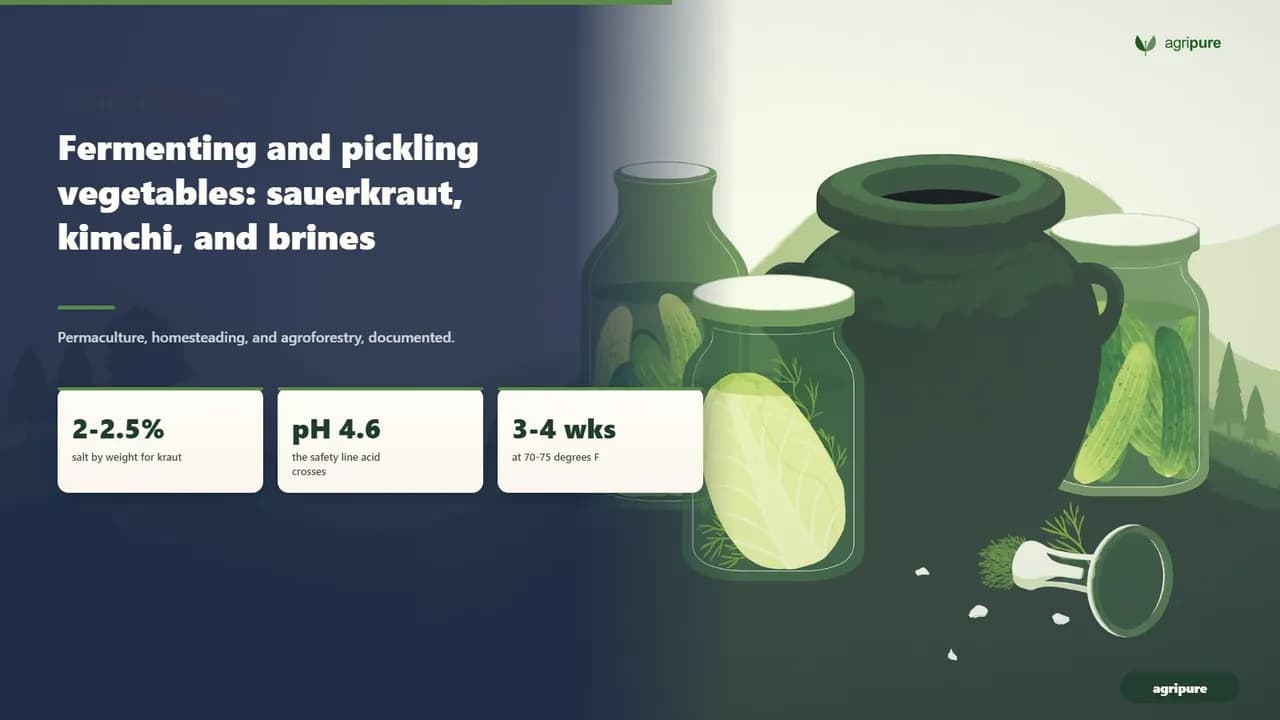
- For sauerkraut, salt is measured by weight at roughly 2% to 2.5% of the cabbage, which works out to about 3 tablespoons of canning salt per 5 pounds. Too little salt softens and spoils; too much stalls the bacteria.
- The 2 rules that decide success are simple: keep everything under the brine by 1 to 2 inches, and hold the temperature near 68 to 75 degrees F. Ferments run 3 to 4 weeks at room temperature.
- A flat white film is usually harmless kahm yeast, which you skim. Fuzzy growth in green, blue, or black is mold, and a moldy or putrid ferment gets thrown out, not rescued.
A crock of cabbage and salt on a kitchen counter is one of the oldest preserving tricks people have, older than canning by thousands of years and needing no heat, no jars, and no special skill. Shred 5 pounds of cabbage, work in 3 tablespoons of salt, pack it under its own juice, and 3 weeks later you have sauerkraut. The bacteria that do the work are already on the leaves. That same process — wild lactic acid bacteria turning sugar into acid in a salt brine — preserves kimchi, fermented dill pickles, and most of the sour vegetables on a homesteading kitchen shelf. This guide separates that craft from vinegar pickling, explains why the result is safe, and walks through the salt, the brine, and the troubleshooting that turn raw vegetables into something that keeps.
Two crafts, two acids
The word “pickle” covers 2 completely different methods, and confusing them is where most beginner mistakes start. Both make food sour and both make it keep longer, but they get there by different chemistry, and the chemistry decides everything downstream — flavor, shelf life, and whether the jar holds live bacteria or none at all.
Fermentation makes its own acid
In lacto-fermentation, you do not add the acid; the vegetables make it over 3 to 4 weeks. You submerge them in a salt brine, and the lactic acid bacteria already living on their surfaces go to work. As the University of Minnesota Extension describes the mechanism, bacteria such as Lactobacillus convert sugars into lactic acid and release carbon dioxide, and the acid produced lowers the pH of the food. That souring is the preservation: over 3 to 4 weeks the brine turns from salt water into a sharp, sour liquid that holds the food for months. Sauerkraut, kimchi, and traditional brined dill pickles are all lacto-ferments, and all of them are alive with bacteria when they are done.
Vinegar pickling adds the acid
Vinegar pickling, also called fresh-pack or quick pickling, skips the biology. You pour a hot or cold brine of vinegar, water, and salt over the vegetables, and the vinegar — which is acetic acid — does the souring directly. There is no fermentation and no waiting for microbes; the acid is in the jar from minute 1. This is the method behind most canning pickles recipes and nearly every shelf of grocery-store dills. A quick refrigerator pickle is the fastest version of all: cucumbers in a vinegar brine, into the fridge, ready in a day, with a crisp, sharp tang.
Which of the 2 to use, and when
Neither method is better; the 2 suit different goals. Choose by what you want from the jar:
- Reach for fermentation when you want depth of flavor and live cultures — sauerkraut for the year, a crock of fermented pickles, a batch of kimchi. It takes 3 to 4 weeks but almost no active work.
- Reach for vinegar pickling when you want speed, a predictable sharp bite, and a shelf-stable jar — bread and butter pickles, pickled beets, a fast batch of refrigerator dills before company arrives.
- Note the storage difference. Fermented vegetables stay alive and belong in cold storage; vinegar pickles, especially when water-bath canned, are sterile and shelf-stable. The 2 crafts end in different places.
Factor | Lacto-fermentation | Vinegar pickling |
|---|---|---|
Source of acid | Lactic acid made by bacteria | Acetic acid (vinegar) added |
Brine | Salt and water (~2% to 2.5% salt) | Vinegar, water, and salt |
Time | 3 to 4 weeks at room temperature | Minutes to a day or 2 |
Live cultures | Yes — alive when done | No — essentially sterile |
Storage | Cold storage; keeps maturing | Shelf-stable if canned |
Examples | Sauerkraut, kimchi, brined dills | Bread and butter pickles, fridge dills |
Why lacto-fermentation is safe: the 3 forces
Handing raw vegetables to wild bacteria sounds risky, and the first question any careful cook asks is the right one: why does this not make people sick? The answer is the same number that governs all of home canning — a pH of 4.6 — reached here by biology instead of a bottle of vinegar. 3 forces conspire to make a ferment safe, and understanding them turns the rules into common sense.
Acid below pH 4.6
The lactic acid bacteria do more than sour the food; they acidify it past the threshold where dangerous bacteria can grow. As the USDA’s canning guidance explains, acid foods have a pH of 4.6 or lower and include pickles and sauerkraut, while low-acid foods sit above 4.6 and are not acidic enough to prevent the growth of Clostridium botulinum. A finished sauerkraut is strongly acidic — the scientific literature puts a properly fermented kraut at a total acidity, as lactic acid, of 1.7% to 2.3%, with a pH well under 4.0. That is comfortably past the safety line, which is exactly why a sour, finished ferment is a stable food and a half-fermented one is not.
Salt selects for the right microbes
Salt is the bouncer at the door. At the start, a fresh vegetable carries a mix of microbes, and salt tilts the competition toward the ones you want. According to the National Research Council’s review of lactic acid fermentations, the salt extracts liquid from the vegetable to serve as the substrate for lactic acid bacteria, and raising the salt concentration to 3.5% gives 90% inhibition of growth for the early fermenters. At the roughly 2% used for sauerkraut, salt suppresses spoilage organisms while still letting the acid-makers thrive — enough to steer the ferment without stopping it.
Oxygen is the enemy
The third of the 3 forces is the absence of air. Lactic acid bacteria work without oxygen, and keeping air out blocks the molds and films that need it. The UC Davis food-science team is direct about the rule: all produce should be submerged in the brine, weights can be used to keep it down, and the fermentation should be kept away from air with a firmly applied lid, with the carbon dioxide released periodically by opening the container or using an airlock. The succession of microbes follows naturally — Leuconostoc mesenteroides initiates the fermentation, then Lactobacillus brevis and Lb. plantarum finish it, driving the acid down — but only under the anaerobic conditions that the literature says must be maintained to prevent spoilage.
Making sauerkraut by weight
Those anaerobic conditions in place, sauerkraut is the ferment to learn first, because it needs 2 ingredients and teaches the whole method. The one number that matters is the salt, and the professionals measure it by weight, not by the tablespoon — though the standard ratio happens to line up cleanly either way.
Salt at 2% to 2.5% of the cabbage
The reliable target is roughly 2% to 2.5% salt by the weight of the shredded cabbage. The National Center for Home Food Preservation’s tested method works with about 5 pounds of cabbage at a time and adds 3 tablespoons of canning or pickling salt — three-quarters of a cup for a full 25-pound crock. Weighing is more precise than measuring: 5 pounds is about 2,270 grams, so a 2.25% salt level is roughly 51 grams, and a kitchen scale removes the guesswork that a tablespoon leaves behind. Use canning or pickling salt, never iodized table salt — the University of Minnesota Extension notes that salt should be iodine-free, as iodine can interfere with fermentation, and anti-caking agents can cloud the brine. The cabbage itself can come straight from the cabbage you grow in the garden.
Massage, pack, and submerge
Once the salt is on, the technique is physical. The 4 steps are short:
- Salt and wait. Toss the shredded cabbage with the weighed salt and let it sit 15 to 20 minutes. The salt pulls water out of the leaves and starts the brine.
- Massage and pack. Squeeze and knead the cabbage by hand until it goes limp and releases its juice, then pack it firmly into the crock or jar, pressing out air as you go.
- Submerge it. The cabbage must stay under its own brine. The NCHFP says to keep the container deep enough that its rim sits 4 or 5 inches above the cabbage, and if the juice does not cover the cabbage, to add boiled and cooled brine.
- Weight it down. Set a fermentation weight, a brine-filled bag, or a clean plate on top so nothing floats up into the air.
Time and temperature
Then you wait, and the temperature sets the clock. The NCHFP gives the ranges precisely: at 70 to 75 degrees F the kraut is fully fermented in about 3 to 4 weeks; at a cooler 60 to 65 degrees F it may take 5 to 6 weeks; below 60 degrees F it may not ferment at all; and above 75 degrees F the kraut may turn soft. Taste it along the way and stop when the sourness is where you like it. Fully fermented kraut, the center notes, may be kept tightly covered in the refrigerator for several months.
A stoneware crock of shredded cabbage being pressed under its own brine with a glass fermentation weight holding the kraut below the surface
Kimchi and the wider world of fermented vegetables
Sauerkraut is 1 cabbage and salt; the rest of the fermented-vegetable world is the same method dressed in different flavors. Once the salt-brine-submerge logic clicks, the list of what you can ferment is long, and the cultural classics are just regional answers to the same problem of keeping a harvest.
How kimchi differs in 2 ways
Kimchi is Korea’s national ferment, and at heart it is the same lacto-fermentation as kraut with 2 twists. First, the vegetables — usually napa cabbage and Korean radish — are salted in a wet brine or by layering, then rinsed before the seasoning goes on. Second, that seasoning is a paste of garlic, ginger, scallion, and gochugaru (Korean red pepper), often with a little fish sauce, which both flavors the vegetables and feeds the bacteria. Kimchi ferments fast — a few days at room temperature is often enough before it moves to the cold — and it keeps developing sourness in the fridge over weeks. The microbiology is the same lactic-acid pathway; the spice and the speed are the difference.
A short list of what ferments well
Among the best fermented vegetables for a first year, beyond cabbage, are these 4 groups, the dense and the crisp:
- Roots and bulbs — carrots, beets, turnips, and radishes, sliced into sticks or coins.
- Crisp summer vegetables — cucumbers, green beans, and cauliflower, which hold their crunch in a brine.
- Alliums and aromatics — garlic cloves, whole or sliced, and ginger, often added to flavor a larger batch.
- Hot and sweet peppers — fermented into sauces and relishes once you have the basic method down.
Japanese tsukemono, Korean kimchi, and German kraut are 3 names for the same underlying craft. Many of these ferments are valued as much for live cultures as for flavor — fermented vegetables are among the foods researchers define as produced by lactic acid bacteria — though the surest reason to make them is that they turn a glut into something that lasts.
Glass jars of napa cabbage kimchi and sliced radish coated in red gochugaru paste fermenting on a kitchen counter
Fermented pickles versus quick pickles
Cucumbers deserve their own section, because “pickle” splits most sharply here. The 2 versions — a fermented dill and a quick refrigerator dill — look alike in the jar and could not be more different in how they are made, and choosing between them comes down to time and the result you want.
The fermented dill pickle
A true fermented pickle is a lacto-ferment: cucumbers in a salt brine, soured by bacteria over weeks. The NCHFP’s tested fermented pickle uses a brine built around 1/2 cup of canning salt, 1/4 cup of vinegar at 5%, and 8 cups of water per gallon of capacity, with the cucumbers held at 70 to 75 degrees F for about 3 to 4 weeks (or 5 to 6 weeks at a cooler 55 to 65 degrees F). The small splash of vinegar steadies the early brine, but the sourness still comes from fermentation. The result is the deep, complex, full-sour dill of a deli barrel — alive, and best kept cold once it is done.
The quick refrigerator pickle
A quick pickle skips all of that. You make a brine of vinegar, water, and salt, pour it over sliced cucumbers, and refrigerate; the acetic acid sours them directly in a day or 2. There is no fermentation, no live culture, and no 3-week wait — just a crisp, sharp, predictable pickle. The trade-off is the flavor: quick pickles are bright and one-note where a ferment is layered and sour. For a single jar to eat this week, the quick method wins on speed; for a crock to last the season, fermentation wins on depth.
A glass jar of whole pickling cucumbers fermenting in a salt brine with dill heads and garlic cloves and a few bubbles rising to the surface
The gear, the salt, and the conditions
None of this needs an expensive kitchen, which is part of the appeal — fermenting is the cheapest preserving method there is. But 3 things genuinely matter: the vessel, the salt, and holding the right conditions. Get those 3 right and almost any vegetable will ferment.
Equipment, from a jar to a crock
You can ferment in a wide-mouth quart jar or a 5-gallon stoneware crock; the principles scale. What every setup needs is a way to keep the vegetables submerged and a way to let carbon dioxide escape. The options:
- A vessel — a glass jar for small batches, a food-grade stoneware crock for big ones. Avoid bare metal, which the acid corrodes.
- A weight — a glass fermentation weight, a brine-filled bag, or a clean plate that holds the vegetables below the brine.
- An airlock or a daily check — a water-seal lid or airlock lets gas out while keeping air from getting in; without one, you simply open the jar daily to release pressure and skim.
The right salt
Salt type is a small detail that causes outsized trouble. Use canning or pickling salt, which is pure sodium chloride with no additives. Iodized table salt can interfere with fermentation, and the anti-caking agents in it cloud the brine; coarse kosher salt works but must be re-weighed because its flakes pack differently. Measuring by weight — about 2% to 2.5% for a dry-salted kraut, or a wet brine of 1 to 3 tablespoons of salt per quart of water for most vegetables, up to 5 tablespoons per quart for cucumbers, onions, and radishes — beats measuring by volume every time.
Holding the conditions
The last variable is the room. A temperature between 68 and 72 degrees F is ideal for most vegetable ferments, with 3 to 4 weeks a typical run; a cooler spot slows things down, and a warm one above 75 degrees F risks soft, off results. Keep the vessel out of direct sun, check it every few days, and keep the vegetables under the brine the whole time. A research-based, tested recipe from an extension service or the NCHFP is the safe starting point — fermentation is forgiving, but the numbers still matter.
The submersion rule: nearly every ferment that fails was exposed to air. Whatever your vessel, the vegetables must sit under the brine by 1 to 2 inches for the whole 3 to 4 weeks. A weight is not optional — it is the single cheapest insurance against mold in the crock.
Reading a ferment: kahm yeast, mold, and softness
That forgiving process still goes wrong sometimes, and a ferment talks to you while it works. Learning to read it is the difference between confidence and tossing good food in a panic. Most surprises on the surface of a crock are normal; a few are not. 3 problems account for nearly every question a beginner has.
Kahm yeast is harmless; mold is not
The 1 most common scare is a white film on the surface, and the good news is that it is usually nothing. The UC Davis food-science team explains that white, grey, or pink films forming on the surface are typically yeast — what home fermenters call kahm yeast — and for a ferment like sauerkraut the yeast should simply be removed periodically during fermentation. Mold is the different beast: molds require oxygen, grow at the air interface, and are a sign of a failed fermentation, and they are typically green, blue, brown, or black. The rule is clean and worth memorizing:
- Flat, white-to-cream film, no fuzz — kahm yeast. Skim it off and carry on; excessive growth can dull the flavor and reduce acidity, but it is not dangerous.
- Fuzzy, raised, or colored growth (green, blue, black) — mold. If you confirm mold on any part of a ferment, the UC Davis guidance is to discard it immediately.
- A putrid smell — a failed ferment. A good ferment smells pleasantly sour; a noticeably spoiled one should be thrown out, especially alongside any mold.
Soft, slimy, or off
The other failures trace back to the same few causes. Soft or slimy vegetables usually mean too little salt, a temperature that ran too warm, or produce that bobbed above the brine and met the air — which is why the NCHFP says plainly that if pickles become soft, slimy, or develop a disagreeable odor, discard them. Prevention is the cure: weigh the salt, keep the crock under 75 degrees F, and keep everything submerged. A ferment that stays cool, salty, and underwater rarely goes wrong.
When in doubt, check the pH
Your senses catch most problems, but a number settles the hard cases. Because acidity is the safety mechanism, the pH is the final referee — the UC Davis team notes that the pH can be checked periodically to ensure it does not rise above 4.6, and that carbon dioxide and a swelling vessel are a good sign only if the pH stays below that line. Inexpensive pH strips or a meter let you confirm a ferment crossed into the safe zone. If a batch never sours, never drops below 4.6, and smells wrong, do not eat it — that is the rare ferment that failed, and it is not worth the gamble.
Storing the harvest you soured
A finished ferment is not a sealed canning jar, and treating it like one is the last of the mistakes to avoid. The bacteria are still alive after 3 to 4 weeks, just slowed, and storage works with that fact rather than against it. The handoff from counter to cold is the final step in turning a garden glut into a year of sour, living food.
When a ferment tastes right, move it to cold storage below about 40 degrees F — a refrigerator, a root cellar, or a cold pantry. The cold does not stop fermentation; it slows it to a crawl, so a kraut or a jar of pickles keeps maturing, growing slowly more sour over months. Keep the vegetables submerged in their brine even in the fridge, since the brine is what protects them, and most ferments hold their quality for 6 months or more — the NCHFP keeps fully fermented kraut tightly covered in the refrigerator for several months, and many home ferments last the better part of a year. The vegetables came out of a kitchen garden in a single short season; soured and stored this way, they feed you long after the beds are bare. Start with one jar of cabbage and salt, learn to read the surface, and let the crock fill the rest of the year.
Frequently asked questions
What is the difference between fermenting and pickling vegetables?
Fermenting submerges vegetables in a salt brine and lets the lactic acid bacteria already on them produce lactic acid over 3 to 4 weeks, which sours and preserves the food and leaves it full of live cultures. Vinegar pickling instead pours a brine of vinegar (acetic acid), water, and salt over the vegetables, souring them directly with no fermentation. Sauerkraut and traditional dill pickles are fermented; most quick and canned pickles are vinegar-pickled.
How much salt do I use to ferment vegetables?
For dry-salted sauerkraut, use roughly 2% to 2.5% salt by the weight of the cabbage — about 3 tablespoons of canning or pickling salt per 5 pounds. For a wet brine, mix 1 to 3 tablespoons of salt per quart of water for most vegetables, and up to 5 tablespoons per quart for cucumbers, onions, and radishes. Always use iodine-free canning or pickling salt, because iodine can interfere with fermentation.
Is the white film on my ferment mold or kahm yeast?
A flat, white-to-cream film with no fuzz is almost always kahm yeast, which is harmless — skim it off and keep going, though heavy growth can dull the flavor. Mold is fuzzy and raised, usually green, blue, brown, or black, and it signals a failed ferment that should be discarded immediately. A putrid (rather than pleasantly sour) smell is the other sign to throw a batch out.
Why is fermented food safe to eat?
Lactic acid bacteria lower the pH of the brine below 4.6, and at that acidity the bacterium that causes botulism cannot grow, which is the same safety threshold the USDA uses for canned pickles and sauerkraut. Salt steers the process toward the right bacteria, and keeping the vegetables submerged keeps out the oxygen that molds need. A properly soured ferment typically reaches a pH under 4.0, well inside the safe zone.
How long do fermented vegetables last?
Once a ferment tastes right, move it to the refrigerator or a cold cellar below about 40 degrees F, keeping the vegetables submerged in their brine. The cold slows fermentation to a crawl rather than stopping it, so the food keeps slowly souring; most ferments hold good quality for 6 months or more, and many last close to a year. Sauerkraut keeps tightly covered in the fridge for several months at least.
References
- University of Minnesota Extension. “Preserving food at home: Fermentation.” extension.umn.edu
- National Center for Home Food Preservation. “Sauerkraut.” nchfp.uga.edu
- National Center for Home Food Preservation. “Fermented (Dill) Pickles.” nchfp.uga.edu
- National Research Council (US) Panel on the Applications of Biotechnology to Traditional Fermented Foods. “Lactic Acid Fermentations.” In: Applications of Biotechnology to Fermented Foods. National Academies Press; 1992. ncbi.nlm.nih.gov
- DiCaprio, E., Marco, M., Finnegan, P., Hanlon, M. “Common issues with fermented fruits and vegetables.” UC Davis Department of Food Science & Technology / UC ANR (2022). ucfoodsafety.ucdavis.edu
- USDA / National Center for Home Food Preservation. “Ensuring Safe Canned Foods” (Complete Guide to Home Canning, Guide 1). nchfp.uga.edu
- Penn State Extension. “Let’s Preserve: Fermentation (Sauerkraut and Pickles).” extension.psu.edu
- Dimidi, E., Cox, S. R., Rossi, M., Whelan, K. “Fermented Foods: Definitions and Characteristics, Impact on the Gut Microbiota and Effects on Gastrointestinal Health and Disease.” Nutrients, 11(8), 1806 (2019). doi.org
- Marco, M. L., et al. “The International Scientific Association for Probiotics and Prebiotics (ISAPP) consensus statement on fermented foods.” Nature Reviews Gastroenterology & Hepatology, 18, 196-208 (2021). doi.org