support
Shrubby Sea-Blite
lani / kharo lana
Suaeda fruticosa
Also known as Lani (Pakistan).
- sindh coast
- punjab plains
International hardiness
- USDA 6-10
- RHS H5
- AU: Arid / semi-arid, Mediterranean, Cool temperate
Where it grows — regional guide
| Zones / rating | Regional notes |
|---|---|
USDA 6-10 | No region-specific data yet |
| Zones / rating | Regional notes |
|---|---|
H5 (-15 to -10C) | No region-specific data yet |
| Zones / rating | Regional notes |
|---|---|
Arid / semi-arid, Mediterranean, Cool temperate | No region-specific data yet |
| Zones / rating | Regional notes |
|---|---|
USDA 6-10 (USDA scale) Canada uses its own zone system; Canadian zones run roughly one lower than USDA. | No region-specific data yet |
| Zones / rating | Regional notes |
|---|---|
Sindh coast, Punjab plains | Pakistan:A succulent native halophyte shrub of coastal salt flats and inland saline tracts; useful for reclaiming salty soils, but high-sodium foliage must not be a sole feed. |
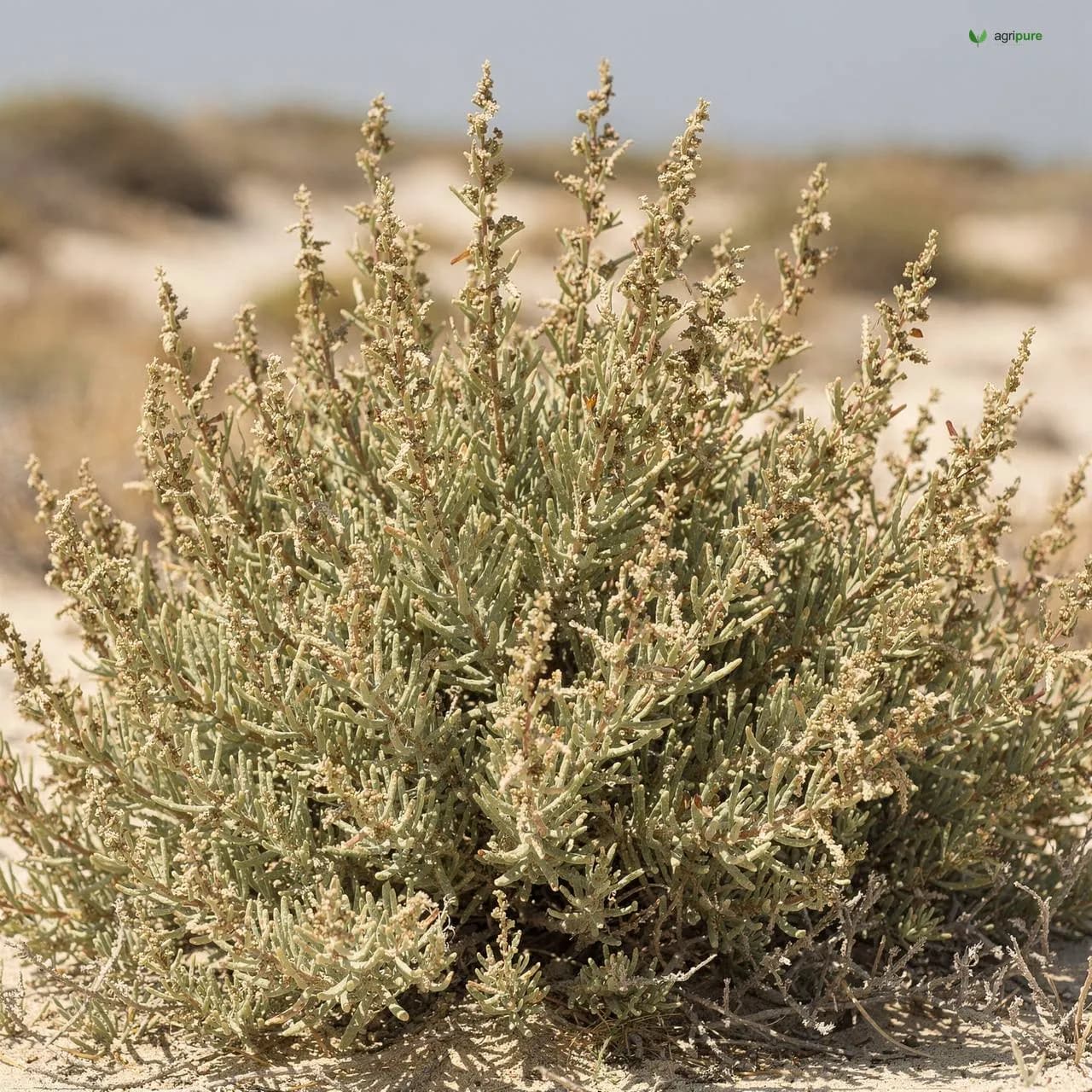
Shrubby sea-blite (Suaeda fruticosa, lani or kharo lana) is a succulent halophyte that dominates the salt flats around Karachi and the inland saline tracts of the Punjab. It is a fleshy-stemmed shrub built to live in salt, and on the most degraded saline ground it is often the main standing vegetation, grazed by camels and yielding an oil-rich seed. On a syntropic site it works as a support species: a salt-pulling pioneer of saline land that begins to reclaim ground too salty for almost anything else.
Where it thrives
Lani is an obligate halophyte of the Amaranthaceae, found across coastal and inland saline regions of Pakistan and the wider region. It is a leaf-succulent perennial, usually a rounded, densely branched bush 1 to 2 m tall, pale green when young and turning grey and fissured with age. It grows best at salt concentrations of roughly 200 to 400 mM and can survive up to about 1,000 mM, levels that would kill ordinary plants outright. It is a salt hyperaccumulator, drawing salt up into its tissues, which is why it dominates the Karachi salt flats and inland saline patches where soil salinity defeats most species. This is a plant of saline ground specifically, coastal and inland alike, not of ordinary cropland.
Role in the system
On saline ground lani is a support and reclamation species. As a hyperaccumulator it can be used to phytoremediate salt-affected and even metal-contaminated soils, drawing salinity out of the ground and beginning the slow work of making it usable. Field measurements put the scale of that at roughly 2,646 kg of sodium chloride stripped from the soil per hectare each year, a real dent in the salt load of a degraded site. In a guild on the saltiest land it is the species you start with to stabilise the surface, hold the soil, and lower salinity at the margins, opening the way for slightly less salt-tolerant plants to follow. Alongside that service it carries a real yield as forage and seed, so it is a working support plant rather than a bare placeholder. The design point is to use it where salinity is the limiting factor and let it lead the reclamation.
Uses
Lani is grazed as forage by camels, making it a genuine fodder source on saline rangeland where little else grows. Its seeds hold about 25% oil, an edible oil high in unsaturated fatty acids, so it doubles as an oilseed off ground that grows no conventional crop, and the same seed oil has been looked at for biodiesel. Burnt, the leaves yield the ash known as sajji, long used to make domestic soap, and the wood is also used as fuel. For saline land that combination, camel fodder, edible oilseed, and fuel from a plant that also pulls salt out of the soil, is the whole case for keeping it in the system.
Cautions
Because lani draws salt into its own tissues, the foliage is high in sodium, so it works as part of a camel’s mixed diet on saline range rather than as a sole feed, and that is how grazing herds actually use it. Site it where salinity is genuinely the limiting factor, not on workable cropland, and treat it as the opening move in reclaiming salt-affected ground rather than a permanent crop in its own right.
Sources
- Diray-Arce, J., et al. (2015). “Transcriptome assembly, profiling and differential gene expression analysis of the halophyte Suaeda fruticosa provides insights into salt tolerance.” BMC Genomics.
- Wikipedia contributors. “Suaeda fruticosa — morphology, salt removal, and uses.”
Sourcing notes
Lani establishes readily from seed on saline and salt-affected ground and is already abundant on coastal and inland salt flats. Collect seed from healthy local stands, and use it specifically to begin reclaiming saline land rather than on ground that grows ordinary crops.