pioneer
Dandelion
hand
Taraxacum officinale
Also known as Hand (Pakistan).
- kpk hills
- pothohar
International hardiness
- USDA 3-9
- RHS H7
- AU: Cool temperate, Warm temperate, Mediterranean
Where it grows — regional guide
| Zones / rating | Regional notes |
|---|---|
USDA 3-9 | A hardy perennial herb across USDA zones 3 to 9; harvest from unsprayed ground, note the latex allergy risk, and avoid medicinal use if on prescription drugs. |
| Zones / rating | Regional notes |
|---|---|
H7 (below -20C) | Rated RHS H7, grown or foraged in gardens; gather from unsprayed soil, beware latex allergies, and avoid medicinal use if taking prescription medications. |
| Zones / rating | Regional notes |
|---|---|
Cool temperate, Warm temperate, Mediterranean | Naturalized perennial gathered as greens; forage strictly from unpolluted ground, note latex allergy risks, and avoid medicinal use if on prescription drugs. |
| Zones / rating | Regional notes |
|---|---|
USDA 3-9 (USDA scale) Canada uses its own zone system; Canadian zones run roughly one lower than USDA. | Extremely hardy perennial herb for cool climates; gather from pesticide-free ground, note latex allergy risks, and avoid concentrated use with medications. |
| Zones / rating | Regional notes |
|---|---|
KPK hills, Pothohar | Pakistan:A wild perennial herb of the hills and meadows; harvest from clean sites, beware latex allergies, and avoid medicinal use if taking prescription drugs. |
Grows alongside
Species that appear with Dandelion in 29 of our published guides — a starting list for a guild, not a planting plan.
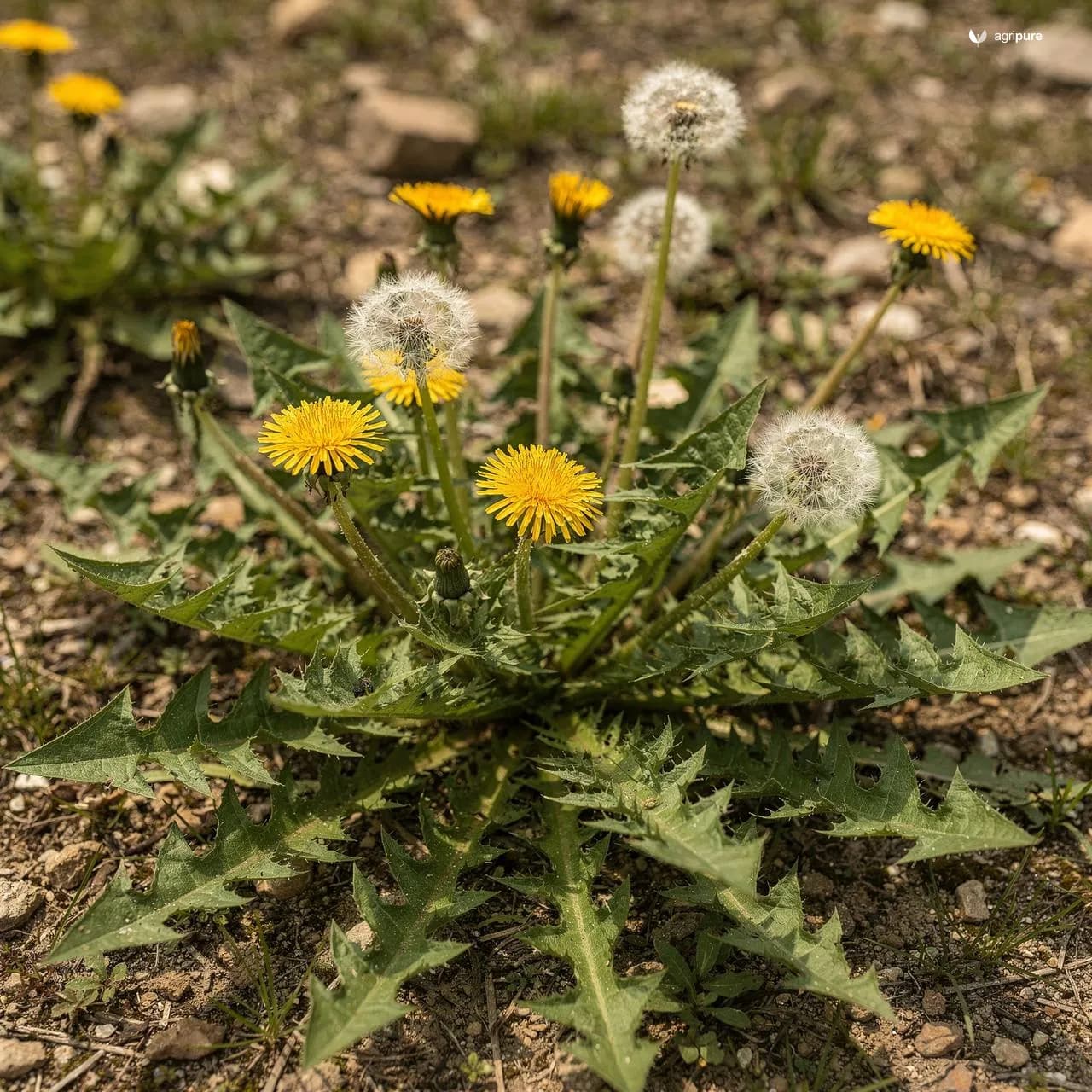
Dandelion (Taraxacum officinale) is the familiar yellow-flowered rosette of lawns, meadows, and disturbed ground, a taprooted perennial herb in the daisy family (Asteraceae). Native to Eurasia, it has naturalized across the entire Northern Hemisphere and is one of the most widely recognized of all wild plants. Most growers meet it as a weed, but the same plant is a genuine triple-purpose crop: its young leaves, its taproot, and its bright flower heads are all edible, and it has a long history of traditional medicinal use. For a homestead that wants food from ground other plants ignore, dandelion is hard to beat.
Growing Dandelion
Dandelion is exceptionally hardy and cosmopolitan. It is reported through at least USDA Zone 3, which covers most temperate homestead climates, and in California alone it grows in nearly every region except true desert, from sea level up to roughly 11,000 feet (3,300 m). You will find it in grassland, lawns, cultivated beds, mountain meadows, perennial-crop fields, and disturbed sites of all kinds. In practice this means any non-desert site of Zone 3 or warmer suits it without special protection.
If you want to grow it deliberately rather than just tolerate the volunteers, dandelion will grow almost anywhere regardless of soil, but richer soils produce better growth and more tender, less bitter leaves. Its habitat across sunny lawns, meadows, and pastures points to a plant that handles full sun through partial shade and ordinary garden moisture; it is not a bog plant and prefers ground that is not waterlogged. Propagation is easy. Sow seed on the soil surface or only lightly covered, any time from early spring (about four to six weeks before the last frost) through late summer; at around 55 °F (13 °C) the seed germinates in roughly ten days. For transplants, start seed in a cold frame or indoors in early spring, prick the seedlings out into deep individual pots that give the developing taproot room, and plant out in early summer at about 6–9 inches apart in rows roughly 12 inches apart.
Whether you forage or cultivate comes down to control. Foraging costs nothing and the plant is everywhere, but quality varies and you must be sure of clean ground, away from roadsides, sprayed lawns, and contaminated sites. Cultivating in good soil gives you tender leaves on demand and a clean, traceable harvest, at the cost of managing a plant that self-sows freely on the wind once it goes to seed.
Harvest and uses
Dandelion is grown as a leaf, flower, and root crop, and every part has a use. The young leaves of the basal rosette are the most familiar food: gathered before or just as the plant flowers, they are at their most tender, and growing the plant in richer soil keeps them milder. The bright yellow composite flower heads—each 3–5 cm across and made of many ray florets—are the part traditionally turned into dandelion preparations, while the thick, fleshy taproot is the third harvest, dug from established plants. Because the rosette produces leaves, flower stalks, and root all from a single crown, a small patch can supply greens through the season and roots for autumn lifting from the same ground.
Identification and look-alikes
Confident identification matters because dandelion shares meadows with several similar plants, and the safest forager is one who can tell them apart. A true dandelion forms a flat basal rosette with no leafy above-ground stem; its leaves are sparsely hairy or hairless with deeply serrated or lobed edges, the lobes often pointing back toward the leaf base. Each flower sits alone on a leafless, hollow, unbranched stalk, and any broken leaf or stem bleeds a milky white latex sap. Together, these three features separate it from its imitators. Cat’s-ear (Hypochaeris radicata) has hairy leaves and solid, often branched stems carrying several flower heads; autumn hawkbit (Scorzoneroides autumnalis) has wiry, branched stems with two to five heads each; and coltsfoot (Tussilago farfara) flowers before its leaves appear and bears scaly bracts on the stem, where dandelion stems are smooth and leafless. After flowering, the head becomes the unmistakable spherical “puffball” of one-seeded fruits, each carried on a tuft of fine hairs for wind dispersal, which is also why a single plant left to seed can colonize a whole bed.
Safety and cautions
Dandelion is widely eaten and has a long record of traditional medicinal use, but it is not risk-free, and a few sourced cautions are worth knowing. First, identify before you eat: confirm the hollow unbranched stem, milky latex, and leafless flower stalk, and rule out the hairy or branched-stemmed look-alikes above, since gathering the wrong rosette is the most common foraging error. Second, the plant exudes a milky latex sap when broken, and dandelion can trigger allergic reactions in sensitive people; those with known sensitivities to plants in the daisy family should be cautious. Third, dandelion has a recognized diuretic effect, so heavy or medicinal use is not appropriate for everyone, and because it can interact with certain medications, anyone taking prescription drugs should treat concentrated or medicinal use with care. Finally, harvest only from clean, unsprayed ground: as a plant of lawns, roadsides, and cultivated fields, dandelion readily grows where herbicides and other contaminants may be present. None of this is a substitute for professional advice, and the cautions here describe traditional use rather than any specific treatment.
Sources
- Cornell University, College of Agriculture and Life Sciences – Weed Profiles: Dandelion. cals.cornell.edu/weed-science/weed-profiles/dandelion
- Government of Ontario – Weed Identification Guide for Ontario Crops: Dandelion. ontario.ca/document/weed-identification-guide-ontario-crops/dandelion
- Practical Self Reliance – Dandelion Identification. practicalselfreliance.com/dandelion-identification
- University of Wisconsin–Madison, Horticulture Extension – Dandelion, Taraxacum officinale. hort.extension.wisc.edu/articles/dandelion-taraxacum-officinale
- University of California IPM – Dandelion Pest Management Guidelines. ipm.ucanr.edu/PMG/WEEDS/dandelion.html
- Native Plant Trust, Go Botany – Taraxacum officinale (common dandelion). gobotany.nativeplanttrust.org/species/taraxacum/officinale
Sourcing notes
Dandelion arrives on its own on disturbed ground, so deliberate sourcing is rarely needed; if you want a chosen strain, collect ripe seed heads from a healthy local plant rather than buying.